
New three-eyed Cambrian predator Mosura fentoni discovered
Mosura fentoni possessed a unique abdomen-like segmented body region not seen in other radiodonts.
By Jerusalem Post Staff, May 14, 2025
https://www.jpost.com/archaeology/archaeology-around-the-world/article-853890
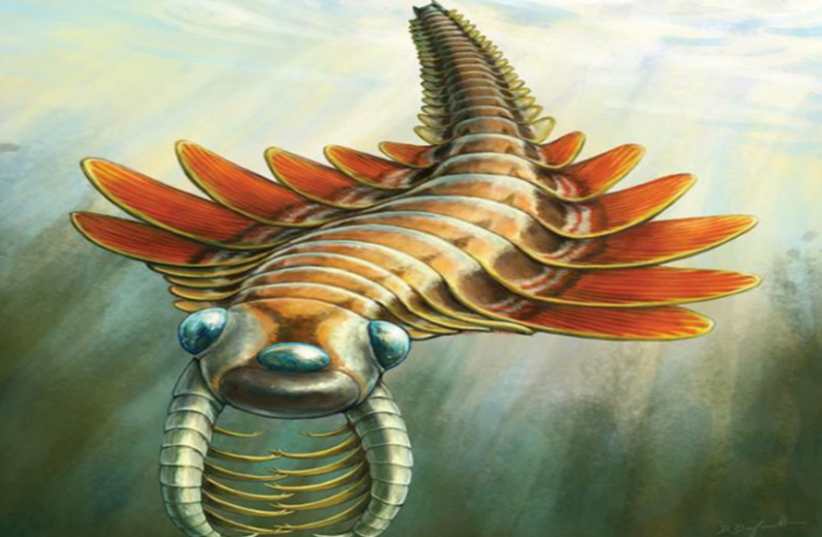 |
| New three-eyed Cambrian predator Mosura fentoni discovered. (photo credit: Danielle Dufault, © ROM) |
Scientists unveiled a 506-million-year-old predator, Mosura fentoni, an anthropod possessing three eyes, discovered in the Canadian Burgess Shale site. The anatomy of Mosura fentoni was described in the journal Royal Society Open Science.
Measuring 6.3 cm long, Mosura fentoni's body was divided into as many as 26 segments, defying the trend of early arthropods with relatively simple body plans. It had 16 segments covered with gills at the posterior end of its body. According to the researchers, this region resembles the abdomen-like structures that horseshoe crabs, woodlice, and some insects use to breathe.
Atop Mosura fentoni's head were three eyes that, although not especially sharp, fulfilled their function much better than those of the prey it stalked. Below the eyes, two serrated spirals extended with which Mosura fentoni trapped its prey. Once it caught its quarry, a pair of spine-covered grasping claws, which were serrated spirals trapping prey against its small, circular mouth, would finish the job.
The new species demonstrates features that place it within the extinct order of radiodonts (Radiodonta). The team drew inspiration from a Japanese pop culture reference, naming it Mosura fentoni after Mothra, Godzilla's winged nemesis. Over recent decades, paleontologists at the Royal Ontario Museum uncovered dozens of additional Mosura fentoni fossils.
Mosura fentoni possessed a characteristic not seen in any other radiodont: a body region resembling an abdomen formed by multiple segments at its posterior end, leading researchers to place it within its own group. "It's something that we've never seen in this group before, not just in terms of the large number of segments, but also in terms of how they're differentiated from other parts of the body," explained Joseph Moysiuk from the Manitoba Museum.
"Radiodonts were the first group of arthropods to branch off in the evolutionary tree, so they provide a key insight into the ancestral traits of the whole group," said Jean-Bernard Caron from the Royal Ontario Museum. "The new species highlights that these early arthropods were already surprisingly diverse and adapting comparably to their distant modern relatives."
The fossils of Mosura fentoni show details of internal anatomy, including elements of the nervous, circulatory, and digestive systems, and were extracted from the Burgess Shale between 1975 and 2022. Some specimens even possessed traces of nerve bundles in each of the creature's three eyes.
The team observed other features in Mosura fentoni, including dark, reflective patches within the creature's body and swim flaps. The researchers posit that these patches represent lacunae: internal cavities that held the animal's blood after it was pumped out of its tubelike heart. However, not all researchers are convinced that these marks represent fossilized blood pouches. Joanna Wolfe, a paleontologist at Harvard University who was not involved in the new paper, suggested they could represent other features, like gut glands.
The adaptation of Mosura fentoni's gilled segments may be related to a particular habitat preference or behavioral characteristics that required more efficient breathing.
Mosura fentoni most likely had to dart away from larger contemporaries like the 60 cm long Anomalocaris or the spaceship-shaped Titanokorys. The radiodont group also included Anomalocaris canadensis, a predator one meter long that shared the waters with Mosura fentoni.
"Having this collection of both old and new specimens kicked us into gear to finally figure this animal out," said Moysiuk.
The discovery of Mosura fentoni underscores the rich diversity preserved in the Burgess Shale, a substantial fossil deposit in the Canadian Rockies, designated a UNESCO World Heritage Site in 1980. "The Burgess Shale has been astonishing us for decades, and it is a geological formation from which we have unearthed true monsters from a remote past," according to La Razón.
While some of Mosura fentoni's features may be up for scientific debate, Caron believes the body segments of the ancient sea creature make clear its connection with living arthropods. "It's a very strange animal indeed, but maybe not necessarily as strange as it initially looks," he remarked.


No comments:
Post a Comment