Monday, September 29, 2025

Space News: QROCODILE bites into the mystery of dark matter

QROCODILE bites into the mystery of dark matter
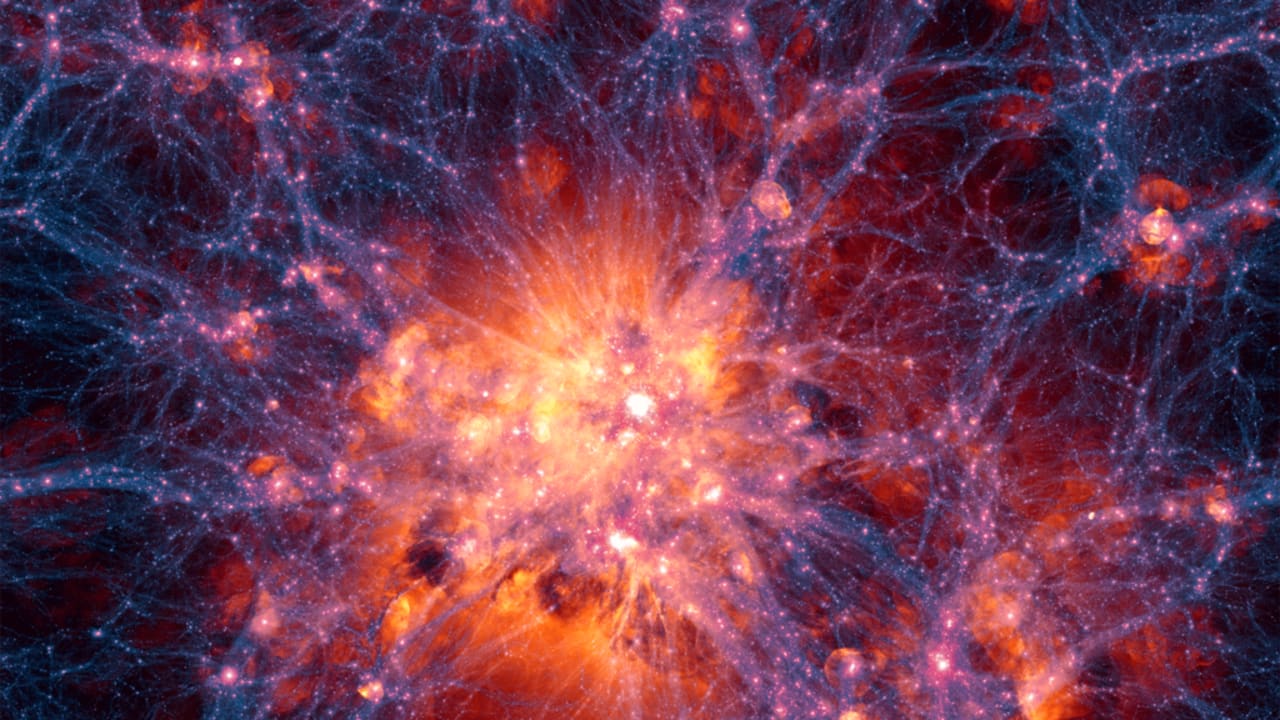

The researchers recorded a small number of unexplained signals suspected to be lightweight dark matter.

By Esther Davis, Jerusalem Post, September 29, 2025


Dark matter and gas (Illustrative). (photo credit: Wikimedia Commons)

A cutting-edge experiment led by the University of Zurich and the Hebrew University has made a breakthrough in the search for and understanding of dark matter, the university announced earlier this month. 

Forging world-leading limits on how dark matter interacts with ordinary matter, the team utilized a new experimental technique called QROCODILE (Quantum Resolution-Optimized Cryogenic Observatory for Dark matter Incident at Low Energy) to observe particles at nearly absolute zero for an unprecedented 400 hours.

Dark matter

Dark matter is thought to make up approximately 85% of the universe’s mass. It is completely invisible and undetectable by any ordinary method. It doesn’t interact with light or any other EM-radiation

So why would we think it exists? Its existence is implied by gravitational effects on things we can observe that don’t make sense without something so heavy but invisible being present. Dark matter is effectively the universe’s gravitational scaffolding, creating the forces that give the universe its structure.

Astrophysicists believe that dark matter is concentrated in a halo shape around a galaxy. Its local density within the solar system is thought to be much less than 85% of that in the overall universe.

An artist’s impression shows the Milky Way galaxy. The blue halo of material surrounding the galaxy indicates the expected distribution of the mysterious dark matter. (credit: Wikimedia Commons)

The Experiment

The researchers used QROCODILE - superconducting detectors cooled to near absolute zero (0K) for over 400 hours. At absolute zero, subatomic particles cease to vibrate entirely and are completely at rest. This gave the researchers record-breaking sensitivity to detect any effects dark matter was having.

The superconducting detector is capable of measuring ridiculously faint energy deposits of 0.11 eV, approximately 0.00000000000000000002 Joules. This is millions of times smaller than the energy normally detected in particle physics experiments.

By measuring such tiny amounts of energy, they could test super-light dark matter, matter thousands of times less massive than any previous experiments had.

What did they find?

The researchers recorded a small number of unexplained signals. Although these signals could be from cosmic rays or background radiation such as radon gas, food, and rocks, they nonetheless give us an exciting, new, world-leading limit on how light dark matter interacts with electrons and atomic nuclei.

Dark matter particles detected on Earth are thought to pass through us, traveling through the halo of dark matter surrounding the Milky Way, meaning they are detected as vectors - with both direction and magnitude. 

Due to its thin-layer geometry and capability to detect single photons, the QROCODILE sensor is sensitive to the direction of incoming dark matter, provided enough signal events are detected. This crucially helps reject background noise and allows researchers to determine the origin of a signal, including the direction of Earth’s motion through the galactic halo.

The discovery by Hebrew University and the University of Zurich has the potential to help us detect the directionality of this dark matter.

It is hoped that this will also help future research distinguish true dark matter signals from random interference and noise.

The next news bite

The next stage of the experiment will be known as NILE QROCODILE - Next Incremental Low-threshold Exposure. In NILE QROCODILE, they will enhance the sensitivity of the detectors to pick up even smaller amounts of energy than the QROCODILE experiment could.

The NILE QROCODILE stage will be conducted underground, aiming to minimize the risk of detecting cosmic rays rather than dark matter.

NILE QROCODILE will have improved shielding, larger detector arrays, and lower energy thresholds. This means it will pick up even smaller interactions between dark matter and atoms and should solidify whether it truly is light dark matter that the researchers detected.

Prof. Yonit Hochberg of Hebrew University said, “For the first time, we’ve placed new constraints on the existence of especially light dark matter.”

 This study marks an important step toward understanding the complex hypothetical matter thought to comprise a significant portion of our universe and brings astrophysicists closer to proving that it indeed exists.


THIS PAGE WAS POSTED BY SPUTNIK ONE OF THE SPUTNIKS ORBIT BLOG
https://disqus.com/HOME/FORUM/THESPUTNIKSORBIT-BLOGSPOT-COM

Saturday, September 27, 2025

Health and Wellness News: Study: Petting your cat sends an oxytocin wave through both of you


Study: Petting your cat sends an oxytocin wave through both of you


A cat's low-frequency purr can lower human heart rate and blood pressure, studies find.

By Jerusalem Post Staff, September 24, 2025


Study: Petting your cat sends an oxytocin wave through both of you.
(photo credit: Hananeko_Studio. Via Shutterstock)

A February 2025 study found that owners who spent 15 relaxed minutes petting, hugging, or quietly holding their cats experienced higher oxytocin levels, and the animals showed a parallel rise as long as they were free to walk away, Science Alert reported. Saliva samples collected before and after each home session confirmed that the longer a cat voluntarily stayed near its person, the larger the hormone spike for both partners. Forced hugs or attempts to corner an evasive cat produced no surge and sometimes a drop in oxytocin. “The hormone flows when the cat feels safe and comfortable,” the authors wrote, according to Science Alert.

Low-frequency purring also mattered. Earlier research cited by the same outlet showed that the rumble helped cats heal while lowering human heart rates, blood pressure, and cortisol—a physiological shift linked to activation of the parasympathetic nervous system.

Cats evolved from solitary hunters, so their displays of trust tend to be subtle and must be earned over time. A 2021 Japanese study demonstrated that two or three minutes of gentle stroking or even a calm bedtime-story voice raised oxytocin in owners, suggesting that the words mattered less than the soothing tone.

The hormone’s influence extended beyond pets. A 2005 experiment with human volunteers indicated that oxytocin made people more willing to trust strangers in financial games, and a 2002 trial showed that gentle cat contact reduced cortisol, lowered blood pressure, and eased pain.

Comparative work highlighted species differences. A 2016 experiment recorded a 57 percent oxytocin increase in dogs after ten minutes of play with a human but only a 12 percent rise in cats. Researchers linked the gap to evolutionary history: pack-oriented dogs were bred for constant eye contact, while cats reserve the hormone surge for moments when they feel entirely secure.

Attachment style mattered as well. Cats that chose to climb into a lap or initiate head rubs showed the strongest oxytocin spikes. Anxious animals began with high baseline levels that sometimes fell if interactions became too intense, and aloof cats showed little change. Respecting an animal’s boundaries proved essential.

Oxytocin, long called the biological glue of parent-child bonding, also appeared during everyday exchanges with felines. Touching a familiar cat elevated the hormone more than contact with an unfamiliar animal, and companion cats offered a buffer against anxiety and depression similar to human social support.

Cats rarely rely on prolonged eye contact; instead they signal comfort with a slow blink. Returning that blink signaled safety and could trigger an oxytocin release in both species. Each blink, rumble, or nudge acted as a chemical handshake.

Purring remained central: the low vibration correlated with higher oxytocin in humans and lower cortisol. Even brief daily gestures—an aisle-side greeting, a quiet stroke along the back—kept the hormone circulating. “Science may never explain why cats choose to show affection in riddles, but the hormones don’t lie,” said one researcher, according to Vice News.

The preparation of this article relied on a news-analysis system.


THIS PAGE WAS POSTED BY SPUTNIK ONE OF THE SPUTNIKS ORBIT BLOG

https://disqus.com/HOME/FORUM/THESPUTNIKSORBIT-BLOGSPOT-COM

Thursday, September 25, 2025

Archaeology News: Gold hoard unearthed in Galilee offers glimpse of Byzantine politics, wealth


Gold hoard unearthed in Galilee offers glimpse of Byzantine politics, wealth


Archaeologists found 97 gold coins and Jewlery in Susita, revealing life during the Sassanid invasions.

By Pessach Benson / TPS, September 25, 2025


The obverse of a gold coin showing the portrait of Emperor Heraclius (610–613 CE).
(photo credit: Dr. Michael Eisenberg, University of Haifa)

Archaeologists uncovered a rare Byzantine-era gold hoard in Susita National Park in Israel’s Galilee region, shedding new light on the region’s history during the tumultuous Sassanid-Persian invasions, Israel’s Nature and Parks Authority announced on Thursday.

The discovery, made at the end of July 2025, includes 97 gold coins and dozens of intricately crafted gold earrings adorned with pearls, semi-precious stones, and glass. Among the coins is a particularly rare termisis, minted in Cyprus around 610 AD during a revolt against Emperor Phocas.

“This is one of the major Byzantine-era hoards discovered on land in Israel, and its uniqueness lies in the combination of jewelry and gold coins from the periods of various emperors,” said Dr. Michael Eisenberg, co-director of the excavation expedition and a researcher at Haifa University’s Zinman Institute of Archaeology.

He noted that some of the coins still contained fragments of the cloth bag in which they had been buried, offering a remarkable glimpse into the practices of the period.

Dr. Danny Shion, the expedition’s numismatist, explained the significance of the termisis coin. “This is a rare find that adds an important layer to the understanding of the political and economic history of the period,” he said. Only the second coin of its kind has ever been found in Israel.

The complete hoard of gold and jewelry. (credit: Dr. Michael Eisenberg, University of Haifa)
The discovery was made by chance when Eddie Lipsman, a metal detector operator assisting the team, detected metal near a large stone.

“The device went crazy, I couldn’t believe it – gold coins began to be revealed one after another,” Lipsman recalled. The team carefully excavated the area and, after ensuring no further items were present, began cataloging and studying the hoard.

The coins span from the reign of Emperor Justin I (518–527 AD) to the early years of Emperor Heraclius (610–613 AD), including full *solidi* as well as halves (*semisis*) and thirds (*termisis*).

“Gold is a noble metal, and when you find coins and jewelry that are about 1,400 years old that look like new, it’s a rare experience,” Eisenberg said.

Dr. Arleta Koblewska, co-director of the excavation, expressed particular admiration for the jewelry. “The earrings are the big surprise for me. Delicate goldsmithing combining semi-precious stones and pearls – I hope that contemporary goldsmiths will recreate this beauty,” she said.

The discovery is more than just a treasure find. “This extraordinary hoard offers a rare window into the politics, wealth, and daily life of Byzantine Galilee, illuminating a period of upheaval and cultural richness that has long been shrouded in history,” Eisenberg added.

Prominent seat of early Christianity

Susita, overlooking the Sea of Galilee from the east, was a prominent Christian center in the Byzantine period, serving as a bishop’s seat with at least seven active churches.

The Haifa University team has been excavating the site for 26 years, uncovering evidence of the Sassanid conquest, including the burning of the Church of the Martyr Theodoros. These findings support the theory that the region’s Jewish communities may have participated in uprisings alongside the Sassanid army against Byzantine rule. Dr. Dror Ben-Yosef, heritage supervisor for the Northern District of the Israel Nature and Parks Authority, explained the location’s broader significance.


“The story of Susita teaches about the cultural and religious currents and subcurrents that were present in the country at the same time and the diversity of its inhabitants,” Ben-Yosef said.

“To understand the complexity of the area some 1,400 years ago, it is enough to climb Mount Susita and look west towards Tiberias – the Jewish city. While a rich Christian community developed in Susita around seven churches, the residents of Tiberias maintained a Jewish lifestyle centered on synagogues.”


THIS PAGE WAS POSTED BY SPUTNIK ONE OF THE SPUTNIKS ORBIT BLOG  https://disqus.com/HOME/FORUM/THESPUTNIKSORBIT-BLOGSPOT-COM

Wednesday, September 24, 2025

Health and Wellness News: The nutritional combination that makes the apple an especially powerful tool for the body


The nutritional combination that makes the apple an especially powerful tool for the body


It fell on Newton, poisoned Snow White, and became the icon of Apple. But beyond the stories, the apple is one of the healthiest, most available, and most versatile fruits there is.

By Dikla David, Dietician, September 21, 2025

                                         Washed fruit (photo credit: SHUTTERSTOCK)

The apple comes in a variety of colors and flavors – green, red, yellow, or mixed, sweet or sour – so everyone can find the version that suits them. It easily fits into a school bag or work bag without getting squashed, is loved even by children who “refuse fruit,” and above all, it is tasty, crunchy, and easy to snack on.

Behind the simplicity of the apple hides an impressive health world:

Antioxidants – polyphenols, flavonols, and anthocyanins that help fight oxidative damage, reduce the risk of heart disease, cancer, and inflammation.

Dietary fibers (pectin) – balance sugar and cholesterol, contribute to satiety, to the health of the digestive system, and to reducing the risk of cancer. A clinical study published in the American Journal of Clinical Nutrition showed that daily consumption of three Gala apples for six weeks reduced blood inflammation markers in overweight and obese people. The researchers explain that the unique combination of fibers (pectin) and polyphenols in apples may contribute to balancing sugar levels and improving cardiovascular health. This finding strengthens the advantages of the apple and the recommendation to include apples as part of the daily diet.

Vitamins and minerals – mainly vitamin C (in a moderate amount), B vitamins, and magnesium.

Oral health – a juicy bite of an apple helps clean the mouth and protect against bacteria.

                                                Apples (credit: SHUTTERSTOCK)

Which color is best?

Red or green? Sweet or sour? Nutritionally, there is no big difference; the sour taste comes from acids that blur the feeling of sweetness, and the colors come from different phytochemicals.

The apple fits almost everything: Fresh, baked, fried, juiced, made into vinegar or cider, in jams, puree, and sauces. And in baking, it is the star of cakes, pies, and classic desserts.

It is recommended to eat apples with the peel, preferably between meals, and they can be combined with almonds and nuts to slow down sugar absorption.

Dikla David is a clinical dietitian at Maccabi Healthcare Services.

                             Stuffed Baked Apples with a crumbled biscuit base
THIS PAGE WAS POSTED BY SPUTNIK ONE OF THE SPUTNIKS ORBIT BLOG

https://disqus.com/HOME/FORUM/THESPUTNIKSORBIT-BLOGSPOT-COM

Tuesday, September 23, 2025

Science News: Israeli breakthrough in diamond tech open doors to faster, reliable quantum devices

Israeli breakthrough in diamond tech open doors to faster, reliable quantum devices


Israeli and German scientists announced the development of a method to capture nearly all the light emitted by microscopic defects in diamonds - an advance that could make quantum devices faster.

By Pessach Benson / TPS, September 20, 2025

                                      Diamond (illustrative) (photo credit: INGIMAGE)

A breakthrough in diamond technology could bring quantum communication and ultra-sensitive sensors out of the lab and into real-world use.

Israeli and German scientists announced the development of a method to capture nearly all the light emitted by microscopic defects in diamonds - an advance that could make quantum devices faster, more reliable, and easier to integrate into existing systems.

Researchers at the Hebrew University of Jerusalem, in collaboration with Humboldt University in Berlin, focused on nitrogen-vacancy (NV) centers, tiny imperfections in diamond crystals that emit single particles of light, or photons, carrying quantum information. These photons are essential for developing next-generation quantum computers, secure communications, and precision sensors. Until now, most of this light scattered in all directions, making it difficult to harness for practical applications.

By embedding nanodiamonds containing NV centers into specially designed hybrid nanoantennas, the researchers managed to guide the light in a precise direction instead of letting it dissipate. The antennas, constructed from layers of metal and dielectric materials in a bullseye pattern, work best when the nanodiamonds are positioned exactly at their centers - down to a few billionths of a meter.

The result is a dramatic improvement: up to 80 percent of photons are captured at room temperature, a major leap over previous methods.

An aerial view of Hebrew University of Jerusalem's Mount Scopus campus. (credit: MARC ISRAEL SELLEM)

The findings were published in APL Quantum, a peer-reviewed journal.

Findings 'bring us much closer to practical quantum devices'

“This brings us much closer to practical quantum devices,” said Prof. Ronen Rapaport of the Hebrew University. “By making photon collection more efficient, we’re opening the door to technologies such as secure quantum communication and ultra-sensitive sensors

Dr. Boaz Lubotzky added, “What excites us is that this works in a simple, chip-based design and at room temperature. That means it can be integrated into real-world systems much more easily than before.”

The advance demonstrates that diamonds, long prized for their sparkle, may also be essential tools in cutting-edge technology. By allowing scientists to control and collect single photons with unprecedented efficiency, this work could accelerate the deployment of quantum networks, enhance the performance of quantum computers, and enable sensors capable of detecting the smallest environmental changes.

Efficient photon collection is critical for quantum-secured communications, which could make data transfers virtually unhackable. Because quantum sensors can detect magnetic fields, temperature changes, or other phenomena with unprecedented precision, the study could lead to ultra-sensitive devices for medicine, navigation, and materials science. 

Moreover, the chip-based design means this technology could be mass-produced and integrated into existing electronics.


THIS PAGE WAS POSTED BY SPUTNIK ONE OF THE SPUTNIKS ORBIT BLOG
https://disqus.com/HOME/FORUM/THESPUTNIKSORBIT-BLOGSPOT-COM

Saturday, September 20, 2025

Archaeology News: Galilee cave yields 4th-century coin hoard tied to Jewish resistance under Rome

Galilee cave yields 4th-century coin hoard tied to Jewish resistance under Rome


The coins were unearthed in Hukok, an ancient Jewish settlement near the Sea of Galilee associated with Jewish resistance under Roman rule.

By PESACH BENSON, Jerusalem Post, September 18, 2025

https://www.jpost.com/archaeology/article-867877

Copper coins dating back more than 1,600, discovered in northern Israel.
(photo credit: EMIL ELJEM/ISRAEL ANTIQUITIES AUTHORITY)

A rare hoard of 22 copper coins dating back more than 1,600 years has been uncovered in a hidden underground complex in the Lower Galilee, offering a tangible link to the region’s Jewish history under Roman rule, the Israel Antiquities Authority announced on Thursday.

The coins were unearthed in Hukok, an ancient Jewish settlement near the Sea of Galilee associated with Jewish resistance under Roman rule.

“The discovery of the rare hoard of coins in the Hukok hiding complex is a living testimony to the determination of the Jews of the Galilee and their ongoing struggle to maintain their identity and traditional Jewish lifestyle even in difficult times under Roman rule,” said Israeli Heritage Minister Rabbi Amichai Eliyahu. “Finds of this type connect us directly to the lives of our ancestors and remind us of the depth of our historical roots here.”

The coins were found in a pit at the end of a narrow winding tunnel within the Hukok hiding complex, one of the largest and most intricate underground networks in the Galilee. Originally carved during the Great Revolt of 66–70 CE and expanded for the Bar-Kochba Revolt of 132–136 CE, the tunnels were expected to yield artifacts from those periods. Instead, the coins bore the images of Emperors Constantius II and Constans I, dating them to the 4th century CE, during the lesser-known Gallus Revolt of 351–352 CE—the last Jewish rebellion under Roman rule.

The coins' owners intended to return to collect them

“It seems that the people stashing this hoard carefully planned its hiding place, hoping to return to it when the threatening troubles were over,” said researchers Uri Berger of the Israel Antiquities Authority and Prof. Yinon Shivtiel of Zefat Academic College, which is jointly excavating the site with the Antiquities Authority. “The hoard provides, in all probability, unique evidence that this hiding complex was used in another crisis, hundreds of years after it was originally built—a rebellion for which we have only scant historical records.”

Copper coins dating back more than 1,600, discovered in northern Israel. (credit: EMIL ELJEM/ISRAEL ANTIQUITIES AUTHORITY)

The Hukok complex, excavated between 2019 and 2023, connects a series of underground spaces through narrow passages and winding tunnels. The dig involved students from Zefat Academic College, volunteers from the Israel Cave Explorer Club, soldiers, and local residents.

“Fortunately, it was the many volunteers excavating the hiding complex who actually uncovered this important treasure, and they enjoyed the great joy and excitement of discovery. The excavation became not only a scientific event but also a significant communal educational experience,” said Dr. Einat Ambar-Armon, director of the Israel Antiquities Authority Community Archaeological Educational Center in the Northern Region.

The Keren Kayemet LeYisrael–Jewish National Fund is developing the site for archaeological tourism.

The coin hoard will be presented for the first time this week at a conference hosted by Kinneret Academic College. A study of the findings is due to be published in the Israel Numismatic Research Journal.

Thursday, September 18, 2025

Health and Wellness News: Once and for all: Dr. Maya Rosman reveals how many eggs are allowed per day


Once and for all: Dr. Maya Rosman reveals how many eggs are allowed per day


In the past, eggs were considered a food that raises cholesterol levels, but now it is revealed that the truth lies somewhere in between.

By Dr. Maya Rosman, Jerusalem Post, September 11, 2025


                                                      Eggs - good or bad? (photo credit: SHUTTERSTOCK)

For many years we were warned: “Don’t eat too many eggs – it will raise your cholesterol,” but in scientific studies – the picture in recent years has changed, and significantly. So how many eggs are really allowed to be eaten? The answer: It is much less clear-cut than it seems.

In many recent studies, including large meta-analyses published in the American Journal of Clinical Nutrition and BMJ Nutrition, Prevention & Health, it has been found that egg consumption – even 1-2 per day – does not increase the risk of cardiovascular disease in the general population.

In fact, some studies have even found a positive link between eating eggs and an improved blood lipid profile.A study including over 200,000 participants from 50 countries found no link between egg consumption and mortality or heart disease, even among those who ate more than 7 eggs per week. The researchers noted that the findings were consistent – with no increase in cholesterol levels or cardiovascular risk.

The conclusion? It’s not the quantity that’s the problem, but the overall quality of the diet and lifestyle.

                                                                            Eggs (credit: SHUTTERSTOCK)

Why eat eggs?

Eggs have nutritional advantages that are hard to beat: They contain the highest quality protein of all food protein sources. The biological value of egg protein is 100 – the highest, even more than meat, fish, or dairy products. The protein in eggs supports muscle building, strengthening the immune system, preventing hair loss, and more.

The yolk (yellow part) contains most of the vitamins, minerals, fat, and even more protein than the white. The white mainly contains water, with some protein and calories. Therefore, most people are recommended to eat one egg per day, and vegetarians can even include 2-3 eggs per day as part of a balanced diet.

What about cholesterol?

In the past, it was believed that cholesterol from food necessarily raises blood cholesterol. Today it is clear that this is not always true, not in every case, or for every person: Cholesterol levels in the body are mainly influenced by internal production by the liver, not just diet.

Often, cholesterol increase is due to excess weight, diabetes, or genetic background – not necessarily from one egg per day.

Even those with high cholesterol can consume one egg per day or intermittently – according to personal dietary guidelines.

Which egg is the healthiest?

The colour of  the yolk – whether yellow or orange – mainly comes from what the hen eats. Some feed mixtures contain colouring (natural or not) that turn the yolk deep orange. But the yolk colour has no effect on the nutritional value or quality of the egg.

Even between a brown egg and a white egg – there is no nutritional difference. The shell color depends only on the breed of the hen – and does not affect the egg’s contents, taste, or quality.

Organic eggs come from hens that receive organic, non-sprayed feed and do not receive routine medications.

Free-range eggs come from hens kept in more spacious cages and sometimes allowed to roam outside. Nutritionally, there is no significant difference between regular eggs, free-range eggs, or organic eggs. The difference is mainly ethical – related to the treatment of animals.

                                             Pancakes (credit: Katrin Primak, SHUTTERSTOCK)

The way the egg is prepared

Hard-boiled, omelette, pancake – or even a brown egg – their nutritional value is almost identical.

Cooking time does not harm important nutrients, and in some cases even improves their availability. Here’s a brief explanation:

Protein – not destroyed by cooking. Heat only changes its structure (a process called denaturation), but in the body, it is broken down into amino acids in the same way. Even with long cooking – the nutritional result is almost identical.

B vitamins – like B2 (riboflavin), B5 (pantothenic acid), and B12 – are heat-resistant and only break down at very high temperatures. Omelets or pancakes do not harm them.

Iron – found in the yolk, very heat-stable. Not destroyed by cooking, even prolonged.

Zinc – also a mineral not sensitive to heat, well absorbed even after high-heat cooking.

Vitamin D – relatively stable, mainly in the yolk. Preserved even with gentle cooking like omelets or baking.


 THIS PAGE WAS POSTED BY SPUTNIK ONE OF THE SPUTNIKS ORBIT BLOGhttps://disqus.com/HOME/FORUM/THESPUTNIKSORBIT-BLOGSPOT-COM