
QROCODILE bites into the mystery of dark matter
A cutting-edge experiment led by the University of Zurich and the Hebrew University has made a breakthrough in the search for and understanding of dark matter, the university announced earlier this month.
Forging world-leading limits on how dark matter interacts with ordinary matter, the team utilized a new experimental technique called QROCODILE (Quantum Resolution-Optimized Cryogenic Observatory for Dark matter Incident at Low Energy) to observe particles at nearly absolute zero for an unprecedented 400 hours.
Dark matter
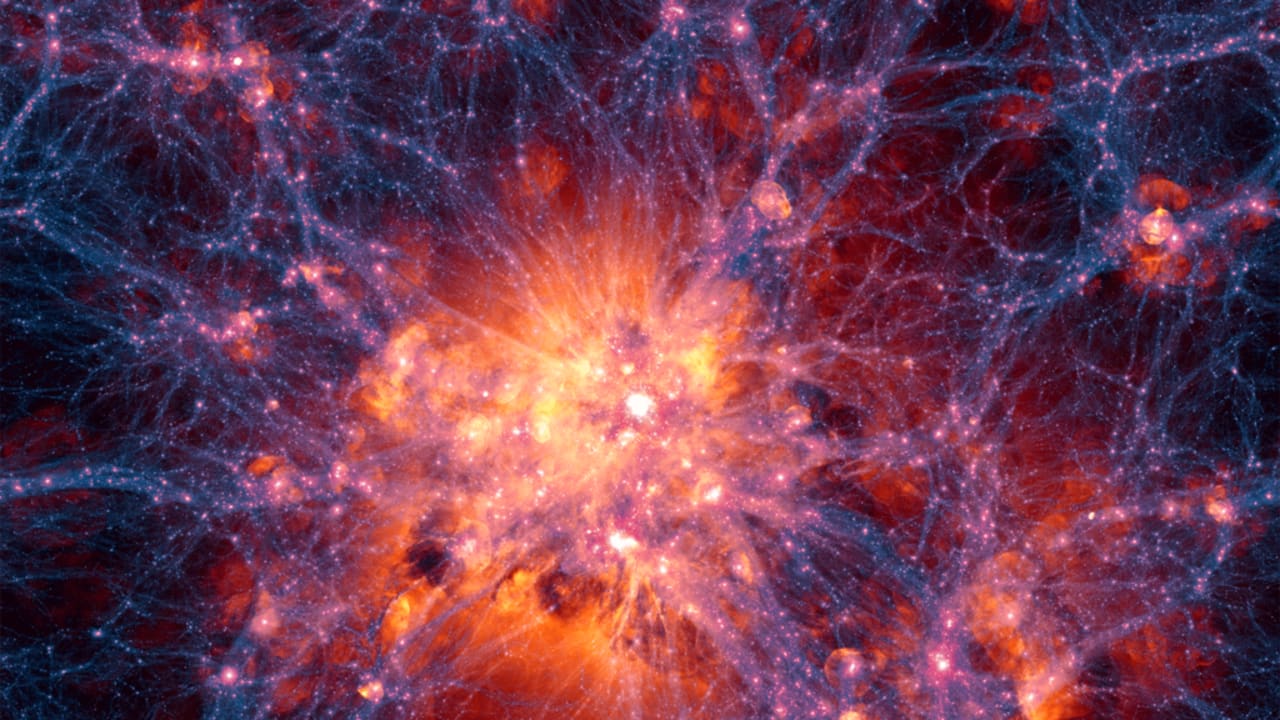
Dark matter is thought to make up approximately 85% of the universe’s mass. It is completely invisible and undetectable by any ordinary method. It doesn’t interact with light or any other EM-radiationSo why would we think it exists? Its existence is implied by gravitational effects on things we can observe that don’t make sense without something so heavy but invisible being present. Dark matter is effectively the universe’s gravitational scaffolding, creating the forces that give the universe its structure.
Astrophysicists believe that dark matter is concentrated in a halo shape around a galaxy. Its local density within the solar system is thought to be much less than 85% of that in the overall universe.

The Experiment
The researchers used QROCODILE - superconducting detectors cooled to near absolute zero (0K) for over 400 hours. At absolute zero, subatomic particles cease to vibrate entirely and are completely at rest. This gave the researchers record-breaking sensitivity to detect any effects dark matter was having.The superconducting detector is capable of measuring ridiculously faint energy deposits of 0.11 eV, approximately 0.00000000000000000002 Joules. This is millions of times smaller than the energy normally detected in particle physics experiments.
By measuring such tiny amounts of energy, they could test super-light dark matter, matter thousands of times less massive than any previous experiments had.
What did they find?
The researchers recorded a small number of unexplained signals. Although these signals could be from cosmic rays or background radiation such as radon gas, food, and rocks, they nonetheless give us an exciting, new, world-leading limit on how light dark matter interacts with electrons and atomic nuclei.Dark matter particles detected on Earth are thought to pass through us, traveling through the halo of dark matter surrounding the Milky Way, meaning they are detected as vectors - with both direction and magnitude.
Due to its thin-layer geometry and capability to detect single photons, the QROCODILE sensor is sensitive to the direction of incoming dark matter, provided enough signal events are detected. This crucially helps reject background noise and allows researchers to determine the origin of a signal, including the direction of Earth’s motion through the galactic halo.
The discovery by Hebrew University and the University of Zurich has the potential to help us detect the directionality of this dark matter.
It is hoped that this will also help future research distinguish true dark matter signals from random interference and noise.
The next news bite
The next stage of the experiment will be known as NILE QROCODILE - Next Incremental Low-threshold Exposure. In NILE QROCODILE, they will enhance the sensitivity of the detectors to pick up even smaller amounts of energy than the QROCODILE experiment could.The NILE QROCODILE stage will be conducted underground, aiming to minimize the risk of detecting cosmic rays rather than dark matter.
NILE QROCODILE will have improved shielding, larger detector arrays, and lower energy thresholds. This means it will pick up even smaller interactions between dark matter and atoms and should solidify whether it truly is light dark matter that the researchers detected.
Prof. Yonit Hochberg of Hebrew University said, “For the first time, we’ve placed new constraints on the existence of especially light dark matter.”
This study marks an important step toward understanding the complex hypothetical matter thought to comprise a significant portion of our universe and brings astrophysicists closer to proving that it indeed exists.


No comments:
Post a Comment