Sunday, April 26, 2026

Defense News: IDF uses Ro'em self-propelled howitzer artillery for first time in southern Lebanon

 IDF uses Ro'em self-propelled howitzer artillery for first time in southern Lebanon


The firing was declared an operational success and even served as a basis for developing new artillery fire responses while fighting, the military wrote in a press release.

By Jerusalem Post Staff, April 17, 2026

https://www.jpost.com/defense-and-tech/article-893333

IDF operates its domestically produced Ro'em self-propelled howitzer for the first time in southern Lebanon in April 2026.(photo credit: IDF SPOKESPERSON'S UNIT)

The IDF has operated its domestically produced Ro'em self-propelled howitzer for the first time, using it in an operation in southern Lebanon, the military announced on Thursday. 

The Ro'em was used to fire at several Hezbollah anti-tank targets, which posed a threat to IDF forces. The firing was declared an operational success and even served as a basis for developing new artillery fire responses while fighting, the military wrote in a press release.

"This is a historic event," Lt. Col. B., head of the Ro'em branch in the IDF, said. "This translates to one thing: more firepower in less time, exposure, and risk to forces on the ground."

The Ro'em can be fired at a much higher rate than existing systems, at longer ranges, and even along multiple trajectories so that different shells hit the target simultaneously.

"It offers mobility, full automation, and the ability to operate as part of a maneuver deep into enemy territory. It shoots farther and more accurately, making it a true breakthrough," B said. 


Greater rate of fire with fewer crew

The system features a fully automated turret, capable of handling ammunition selection, loading, gun laying, and firing without manual intervention. This automation reduces the crew to just three soldiers, a dramatic improvement over the seven-person crew required for the M109.

Its reduced crew size helps address IDF concerns, including manpower challenges such as injuries, and its high degree of automation allows for more flexible staffing. 

The Ro’em is designed to operate as part of a fully networked battlefield, receiving fire missions directly from command-and-control systems and coordinating with sensors, drones, and other artillery units.

This connectivity shortens the sensor-to-shooter cycle and allows the IDF to deliver precise, timely fire support with minimal delay. The system’s automation also enables extremely fast shoot-and-scoot tactics, reducing exposure to enemy counter-battery fire.


THIS PAGE WAS POSTED BY SPUTNIK ONE OF THE SPUTNIKS ORBIT BLOGhttps://disqus.com/HOME/FORUM/THESPUTNIKSORBIT-BLOGSPOT-COM

Thursday, April 16, 2026

Space News: Water on Mars? Scientists discover 'bathtub ring' which may reveal contours of ancient ocean

Water on Mars? Scientists discover 'bathtub ring' which may reveal contours of ancient ocean


Like Earth and the solar system's other planets, Mars formed roughly 4.5 billion years ago. Early in its history, Mars was warmer and wetter than the cold and arid place it is today.

By Reuters, April 16, 2026


A "selfie" taken by NASA's Perseverance Mars rover, made up of 62 individual images, on July 23, in this image released on September 10, 2025.  (photo credit: NASA/JPL-CALTECH/MSSS/HANDOUT VIA REUTERS)
There is a lot of evidence from orbiting satellites and surface rovers indicating that liquid water was present long ago on the surface of Mars in the form of ponds, lakes, and rivers. But the idea that Mars once had a huge and long-lived ocean on its northern plains has remained a matter of debate.

Scientists have now detected what might be the contours of this putative ocean on Earth's planetary neighbor, using data collected by a NASA probe that orbited Mars for a decade. Their research indicates the presence of the Martian equivalent of the continental shelf that defines the boundaries of Earth's oceans.

They compared it to a huge "bathtub ring" showing where water may have once met land on Mars. Because Mars does not possess continents and lacks the geological process called plate tectonics that led to the formation of Earth's continents, the researchers are calling the Martian landforms a coastal shelf.

Like Earth and the solar system's other planets, Mars formed roughly 4.5 billion years ago. Early in its history, Mars was warmer and wetter than the cold and arid place it is today.

"The Martian ocean could have existed when the planet had an active hydrological cycle, with flowing rivers and lakes, nearly 3.7 billion years ago, and it likely disappeared as the planet became dry. Exactly where the water went remains highly debated," said University of Texas planetary scientist Abdallah Zaki, lead author of the research published on Wednesday in the journal Nature.


Mars landscape. (credit: NASA)

A coastal shelf could have formed on Mars over millions of years due to rivers dumping sand and mud into an ocean, waves spreading those sediments around, and the sea level rising and falling over time. Looking from above, the sedimentary rock making up this shelf might superficially resemble the ring that remains after a bathtub has been drained.

What is a 'bathtub ring?'

"A 'bathtub ring' on Mars means that if an ocean filled the northern lowlands, it may have left behind a shoreline, or shelf-like boundary, marking the water level," Zaki said.

"If we sent a rover, we would expect to see sedimentary rocks and structures similar to those found on Earth's continental shelves, including layering, sloping surfaces called clinoforms, and textures produced by waves and currents," Zaki said.

The researchers examined topographical data for Mars that was obtained by NASA's Mars Global Surveyor and identified a band suggestive of oceanic contours. Previous research has indicated that this hypothesized ocean in the Martian northern hemisphere covered approximately a third of the planet's surface, equivalent to about 13% of the total area of Earth's oceans.

The study builds on earlier evidence of a bygone Martian ocean, including studies identifying features resembling an ancient shoreline. Ground-penetrating radar data obtained by China's Zhurong rover, described in a study published last year, detected evidence suggesting sandy beaches from a Martian shoreline now buried underground.

Scientists have also identified multiple landforms that appear to be remnants of ancient river deltas, where rivers may have flowed into a larger body of water.

"The northern ocean on Mars, if it existed, dried up a long time ago, and there have been billions of years of volcanic activity and wind abrasion on Mars, so interpreting ancient landforms is not straightforward," Caltech planetary scientist and study senior author Michael Lamb said.

"Nonetheless, our study shows some telltale signs of a coastal shelf. And the shelf occurs in the same zone as the deformed shorelines and where scientists have previously mapped river deltas and other landforms and deposits characteristic of a land-ocean transition," Lamb said.

Taken together, Lamb said, the evidence points toward a long-lived ancient ocean.

"This means that Mars once looked much more like the Earth than it does today," Lamb said.

The existence of an ocean would be an important factor in understanding whether Mars was ever able to give rise to life.

"If Mars once had an ocean covering roughly one third of the planet over geologic timescales, that would suggest that a large part of its surface had sustained water, which is a key ingredient for habitability," Zaki said.

"That does not mean Mars was inhabited, but it does suggest that potentially habitable environments may have been more widespread and longer-lived than if water had only existed briefly or locally," Zaki said.


THIS PAGE WAS POSTED BY SPUTNIK ONE OF THE SPUTNIKS ORBIT BLOGhttps://disqus.com/HOME/FORUM/THESPUTNIKSORBIT-BLOGSPOT-COM

Sunday, April 12, 2026

Archaeology News: Native American use of dice, probability predates known Old World dice by millenia - study

 Native American use of dice, probability predates known Old World dice by millenia - study

In total, archaeologist Robert Madden observed 659 sets of Native American dice from 57 archaeological sites across 12 different states.

By Miriam Sela-Etam, Jerusalem Post, April 10, 2026

https://www.jpost.com/archaeology/article-892527


A series of Native American dice discovered at archaeological sites in the western US, April 9, 2026.
(photo credit: Robert J Madden, 2026/Published by Cambridge University Press)

Native Americans were making dice and using probabilty theory at least 12,000 years ago, making them the world's oldest evidence of gambling, according to a new study published in American Antiquity.

In total, archaeologist Robert Madden observed 659 sets of Native American dice from 57 archaeological sites across 12 different states. 

Out of those, he found 565 “diagnostic” examples of Native American dice and 94 “probable” examples of dice, all from the “precontact periods (Late Pleistocene / Early Holocene, Middle Holocene, and Late Holocene), spanning roughly 13,000 years of North American prehistory.”

His analysis is based on the markers presented in Stewart Culin's 1907 Games of the North American Indians, a catalogue of nearly 300 sets of dice used by Indigenous peoples across the continent.

The three oldest sets of dice found, dating to nearly 12,900 years ago, were from Folsom culture sites in Wyoming, Colorado and New Mexico, the study explained, noting that they also predate the “earliest currently known dice in the Old World by millennia.”


A series of Native American dice discovered at archaeological sites in the western US, April 9, 2026. (credit: Robert J Madden, 2026/Published by Cambridge University Press)

In addition, the findings indicate that Native American groups were some of the first to use probability theory, which was later formally developed by European mathematicians in the 1600s, most likely based on dice games.

“This is the first evidence we have of structured human engagement with the concepts of chance and randomness,” Madden said to Live Science. "We're seeing really complex practices and an intellectual accomplishment here.”

“The dice tend to show up in liminal spaces where you have a lot of high mobility. It might have something to do with how separated these people are and the need to relate to people you don't see very often.”

Purpose of dice games

Further, the study presented several suggestions for the purpose of these games within Indigenous communities.

While there is not much physical evidence, the study noted that there are numerous cultural accounts of Native American traditions portraying dice games as a sacred activity, played during both ceremonial and secular events.

Additionally, the study argued that dice and gambling may have been created as an icebreaker to play with strangers who would have otherwise had no framework for interaction.

While trade usually depended on an existing relationship, dice games created a temporary, rule-governed space for the exchange goods, information or creating connection.

THIS PAGE WAS POSTED BY SPUTNIK ONE OF THE SPUTNIKS ORBIT BLOGhttps://disqus.com/HOME/FORUM/THESPUTNIKSORBIT-BLOGSPOT-COM

Wednesday, April 8, 2026

Science News: Researchers find traces of caffeine, cocaine in sharks in The Bahamas

Researchers find traces of caffeine, cocaine in sharks in The Bahamas


The researchers said this is the first report of caffeine and acetaminophen in any shark species worldwide, and the first report of diclofenac and cocaine in sharks from The Bahamas


By Jerusalem Post Staff, April 8, 2026


(One more cup of coffee? photo credit: SHUTTERSTOCK)


Sharks in The Bahamas tested positive for multiple contaminants linked to human activity, according to NBC News. The study, published in the journal Environmental Pollution, documented cocaine, caffeine, and painkillers acetaminophen, and diclofenac in tissue samples from 85 sharks. 

According to the study, the proliferation of vacation homes and rental properties has “significantly increased the volume and chemical complexity of local wastewater.”

The research, titled “Drugs in Paradise: Caffeine and Cocaine Detected in Bahamas Sharks,” analyzed five different types of sharks. Most samples came from waters near tourist areas, including sites near Eleuthera.

The researchers said this is the first report of caffeine and acetaminophen in any shark species worldwide, and the first report of diclofenac and cocaine in sharks from The Bahamas. They described the region as “an environment commonly described as pristine.”

Brazilian sharks

Investigators reported altered triglyceride, urea, and lactate levels in sharks with detected contaminants compared to those without. The repeated identification of caffeine as the most prevalent detection suggests that widely consumed compounds can become persistent markers of human influence in the ocean.

The findings align with broader evidence that wastewater tied to urban development, tourism, and vacation homes is entering coastal waters. In 2024, more than 10 sharks in waters off Brazil tested positive for cocaine. Researchers noted that contamination patterns vary by location but are consistent with coastal areas receiving inputs associated with human presence and infrastructure.


 THIS PAGE WAS POSTED BY SPUTNIK ONE OF THE SPUTNIKS ORBIT BLOGhttps://disqus.com/HOME/FORUM/THESPUTNIKSORBIT-BLOGSPOT-COM

Sunday, April 5, 2026

Archaeology News: Stone stele depicting Roman emperor, Egyptian gods found near Karnak temple site in Luxor

 Stone stele depicting Roman emperor, Egyptian gods found near Karnak temple site in Luxor

The stele was discovered during the three-year-long restoration efforts of a gateway from the time of Ramesses III in Karnak.

By Miriam Sela-Eitam, Jerusalem Post, March 30, 2026

https://www.jpost.com/archaeology/article-891653


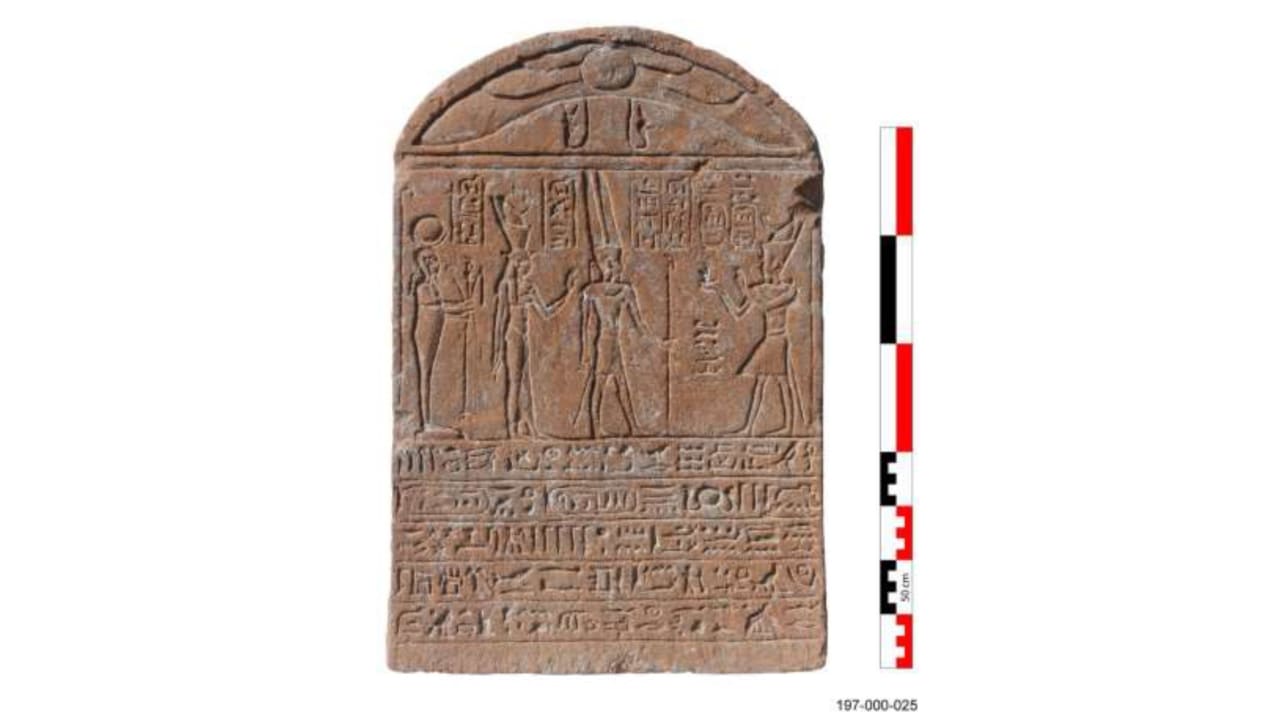
Stele depicting Roman Emperor Tiberius standing before the Theban triad of the ancient Egyptian gods found near the Karnak Temple Complex, March 30, 2026. (photo credit: EGYPTIAN TOURISM AND ANTIQUITIES MINISTRY)

A sandstone stele dating to the reign of Roman Emperor Tiberius (14 to 37 CE) was discovered near Luxor, Egypt, by a team of Egyptian and French archaeologists, Egypt’s Tourism and Antiquities Ministry announced is a statement last week. 

The stele depicts Tiberius standing before the Theban triad of the ancient Egyptian gods: Amun (or Amun-Ra), Mut, and Khonsu.

Below the scene are five lines of hieroglyphic text documenting the restoration of the retaining wall of Amun’s Temple within the Karnak Temple Complex.

Dr. Abdel Ghaffar Wagdy, director-general of Luxor Museum and leader of the Egyptian side of the archaeological mission, noted that the stele underwent meticulous restoration and is set to be displayed at a museum in the future.

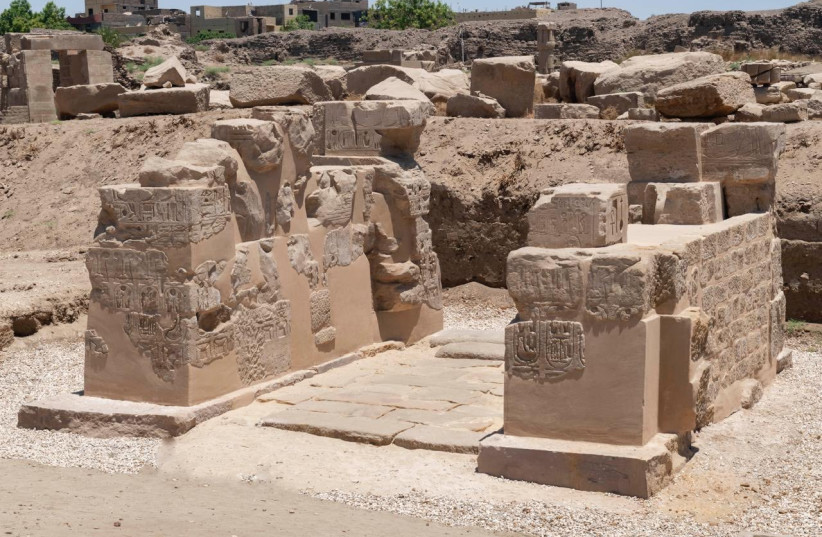
The stele was discovered during the three-year-long restoration efforts of a gateway from the time of Ramesses III, the second pharoah of the 20th Dynasty (1189 to 1077 BCE), in Karnak, after the lower part of the wall had been found heavily deteriorated and covered in vegetation.

Restored Ramesses III gate near the north end of the Karnak Temple Complex near Luxor, Egypt, March 30, 2026. (credit: EGYPTIAN TOURISM AND ANTIQUITIES MINISTRY)

Evidence of earlier construction, restoration found

In order to restore the gate, archaeologists needed to dismantle it, restore each stone block, and document them all before reassembling the gateway fully. They found that several of the decorated stone blocks actually dated to the earlier reign of Amenhotep III of the 18th Dynasty (1550 BCE to 1295 BCE), possibly reused from an older gate set along the same wall.

Sections of the northern wall of Amun’s Karnak temple were discovered on either side of the gate, themselves belonging to the New Kingdom (16th-11th century BCE), as well as evidence of additional construction from the 18th Dynasty and reign of Ramesses III.

Further evidence suggests Greek and Roman era restoration efforts of the wall and gate.

Additionally, during excavations at the site during the summer of 2025, archaeologists succeeded in uncovering a paved road linking the gate to the Courtyard of the Third Pylon within Karnak’s complex.

Egyptian Tourism and Antiquities Minister Sherif Fathy praised the joint French-Egyptian efforts, noting that the restoration and discovery are a part of a larger framework to develop Karnak into an open-air museum. 

He added that “the restoration work and archaeological discoveries achieved in recent years represent an important scientific addition that contributes to providing a clearer vision of the development of the Karnak temples throughout the ages, especially during the first millennium BCE.”


 THIS PAGE WAS POSTED BY SPUTNIK ONE OF THE SPUTNIKS ORBIT BLOGhttps://disqus.com/HOME/FORUM/THESPUTNIKSORBIT-BLOGSPOT-COM