Top Aces has completed the initial test flight of its F-16 Advanced Aggressor Fighter (F-16 AAF) equipped with its proprietary Advanced Aggressor Mission System (AAMS). This sophisticated technology enables Top Aces' aircraft to replicate the most advanced capabilities of contemporary air-to-air combat opponents. With the completion of the first test flight, the F-16 AAF will now execute a series of robust operational test activities in preparation for its entry into service with the United States Air Force.
Powered by an open system architecture, AAMS permits the rapid integration of sensors and functions that a customer wishes to use to improve their air combat readiness. For example, today the system is fielded with:
• Active Electronically Scanned Array (AESA) air-to-air radar;
• Helmet-Mounted Cueing System (HMCS);
• Tactical datalink communications between aircraft and other entities;
• Infrared Search and Track (IRST) systems;
• High Fidelity Weapon Simulation allowing accurate replication of adversary tactics;
• Advanced Electronic Attack pod employment and passive RF detection capabilities; and
• An array of tactical functions coordinating the above systems to provide a spectrum of realistic adversary effects.
The AAMS represents four years of research and development work by Top Aces engineers and technology partner Coherent Technical Services, Inc. (CTSi) of Lexington Park, MD. Last year, the AAMS was certified for use on Top Aces' fleet of A-4N Skyhawks and is currently in service with the German Armed Forces and other European customers for advanced airborne training. Now this same federated mission system has been installed on Top Aces' F-16A aircraft by M7 Aerospace of San Antonio, TX, an Elbit Systems of America company experienced in aircraft Maintenance, Repair and Overhaul (MRO).
Top Aces plans to upgrade the majority of its F-16 fleet with the ground-breaking AAMS technology within the next year.
"When you combine the power and avionics of the F-16 with the AAMS, it provides the most realistic and cost-effective training solution available to pilots flying fifth-generation fighters, such as the F-22 or F-35", says Russ Quinn, President, Top Aces Corp., a 26-year USAF veteran and former Aggressor pilot with more than 3,300 F-16 flight hours.
"Due to the plug-and-play nature of our AAMS, it also allows for the addition of new and emerging sensors well into the future, which provides the flexibility to upgrade our F-16s and meet the needs of the Air Force for years to come," adds Mr. Quinn.
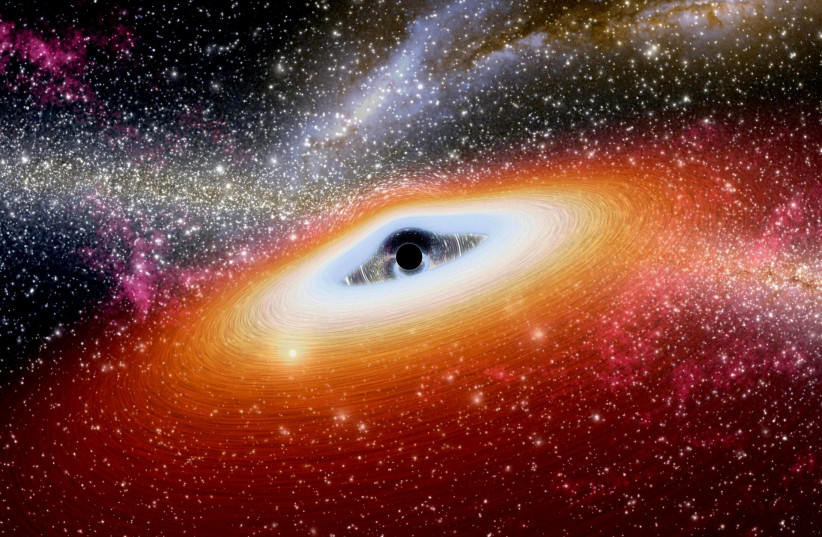
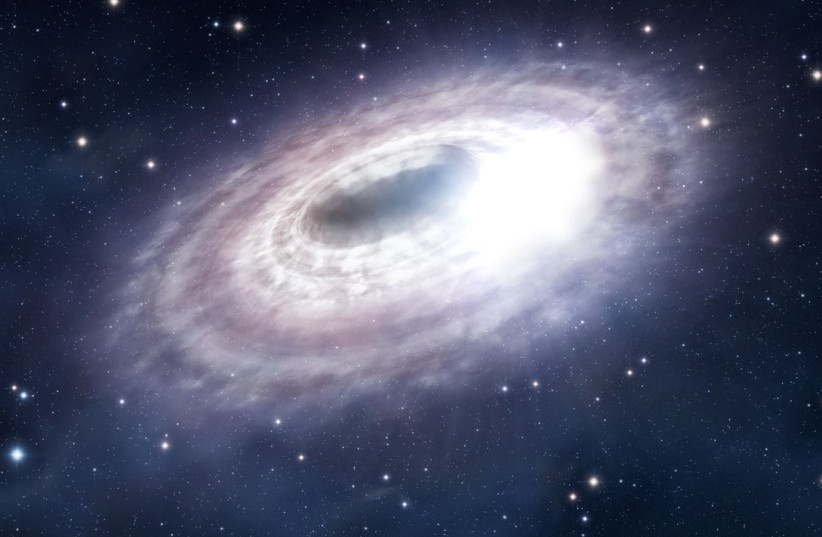
A supermassive black hole is seen in the center of a galaxy (illustrative). (photo credit: PIXABAY)
Black holes
are one of the most mysterious and terrifying phenomena to populate the
universe, and according to a new study, there may be far more of them
than we realize: A total of 40 quadrillion (40,000,000,000,000,000).
The findings come in the first study of a series published in the peer-reviewed academic periodical The Astrophysical Journal,
which focuses on modeling the mass function of black holes of various
sizes, ranging from stellar all the way to supermassive.
How many black holes are there in the universe?
That's a difficult question and likely cannot be answered any time
soon. But that is not the case with the observable universe, a vast
expanse of space that has a diameter of approximately 90 billion
light-years that represents the furthest extent of what in the universe
that can be seen by us on Earth with all the telescopes, space probes
and other methods of observation currently at our disposal.
So how many black holes are there in the observable universe?
According to the calculations of this study, that's 40 quadrillion, also known in scientific notation as 40 x 10^18.
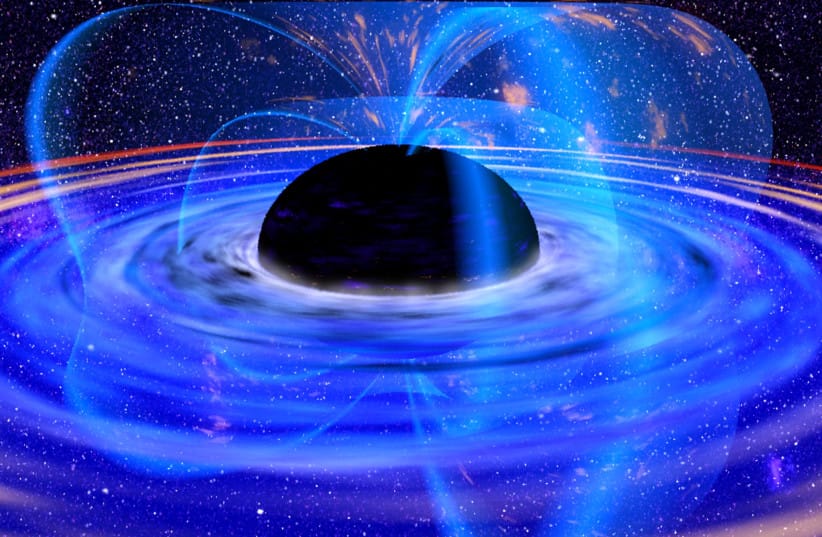
Artistic impression of a material disc with illuminated gas around
Sagittarius A*, the supermassive black hole in the center of the Milky
Way. (credit: Wikimedia Commons )
But that's not all.
All these black holes gather a lot of matter into them through accretion. But just how much matter is that?
According
to the study, black holes have taken up around 1% of all ordinary
matter. This specifically refers to baryonic matter, which would
describe most things encountered in everyday life. Non-baryonic matter
refers to things like free electrons, neutrinos and, most notably, black
holes.
How do we know how many black holes exist?
In short, scientists did the math.
In
order to determine the number of black holes in the observable universe
and how much matter they have taken in, the researchers developed a new
method of calculation. This was done by evaluating a number of factors
like rate of star formation, the amount of stellar mass and metallicity -
the abundance of metals, which, in astronomy, refers to any element
heavier than hydrogen and helium.
Artist impression of a supermassive black hole at the center of a galaxy. (credit: Wikimedia Commons)
It further relied on the use of a stellar and binary evolution code
to further calculate the evolution of stars. This evolution code is
combined with data and information about star formation and the
enrichment and distribution of metals in individual galaxies.
Then, it was all put into a model alongside the use of necessary equations.
It's
complicated, to say the least. But it is also innovative; a robust and
revolutionary "computation of the stellar black hole mass function
across cosmic history," lead author PhD student Alex Sicilia at the
International School for Advanced Studies (SISSA) in Italy noted in a statement.
And
its complexity is only further heightened by how multidisciplinary it
is. As noted by Sicilia's supervisor Prof. Andrea Lapi, it required
expertise in galaxy formation and evolution, gravitational waves,
stellar astrophysics and more.
What are black holes?
Black
holes are, to put it simply, massive concentrations of gravity that are
so strong, nothing, not even light, can escape them. As such, it can be
very hard to spot them. In fact, scientists weren't even sure they
existed 20-30 years ago. The only way we know black holes exist is
because they have an enormous gravitational pull that influences
surrounding matter. In other words, it can be hard to see a black hole,
but we can see it affecting everything around it.
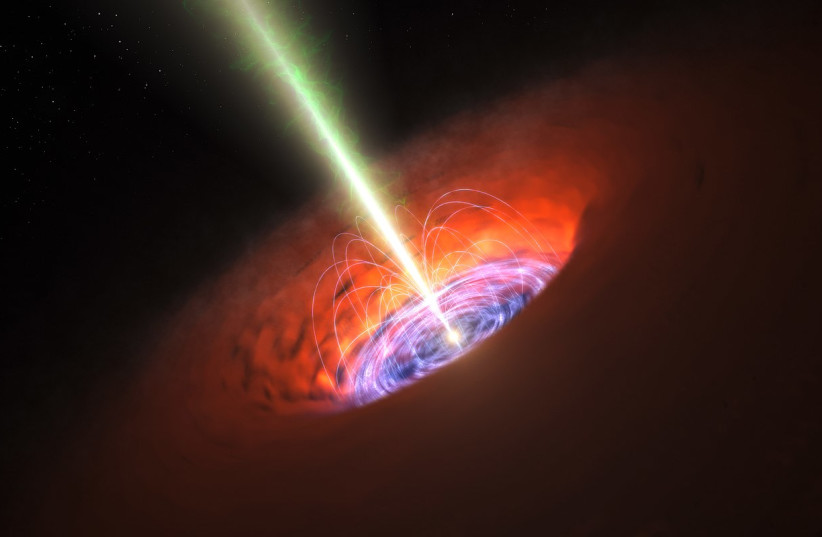
An artist's impression of a black hole accretion disk. (credit: Wikimedia Commons)
Most
black holes are formed when a star dies, its core collapsing in on
itself to form one massive concentration of gravity. They continue to
accrete matter over time and, while light and matter can't escape,
radiation and radio waves do get emitted.
Today,
our scientific understanding of black holes as grown considerably, and
we now know a lot more about them. For example, supermassive black holes
– which, as their name implies, are absolutely enormous – can be
located at the centers of most major spiral galaxies. Our own Milky Way
galaxy is no exception, with the supermassive black hole Sagittarius A* being located in the galactic center.
The recent study may have also shed light on another intergalactic mystery: The origin of supermassive black holes.
How are supermassive black holes created?
While the origins of most black holes are known, how supermassive black holes are created is a lot more unclear.
It
is thought that black holes gather material rapidly from the
surrounding environment and are surrounded by what is known as an
"accretion disk." These disks consist of fast-rotating high-temperature
gases that give off light - though the black holes themselves do not.
However, it is unclear if this is true, and our understanding of this process may be very much incomplete.
This
is something many scientists, including an international research team
led by the University of Haifa utilizing NASA's Hubble Space Telescope,
are trying to answer.
But this study presents a theory.
To
put it simply, supermassive black holes are thought to form with a
seed, which has been hypothesized to be formed when galaxies that birth
stars and experience supernovae see gases migrate inward to the galactic
center which will, eventually, fully condense and merge until a
supermassive black hole seed is formed. It is then that the black hole
grows bigger through accretion.
That
much was already known, but what the researchers figured out was about
seed distribution. Light seeds are distributed throughout the universe,
but how do they become heavier? That seems to be through the mergers of
star clusters and collapses, which would form heavier seeds. These
heavier seeds in turn are what are used to grow these supermassive black
holes.
Right now,
this is very much theoretical, but it is something the team is keen to
focus on next in an upcoming study. But it brings us another step closer
to understanding the mysteries of black holes and how they influence
and impact the universe around them.
Please recommend this page & follow the Sputniks Orbit
White steam billows from the Cattenom nuclear power plant in Cattenom, eastern France.
Hours before the window for lodging objections closes, EU environment and energy ministers meeting in France Friday differed sharply on a European Commission provision that would classify nuclear and natural gas energy as "sustainable".
The controversy pits countries led by France—where nuclear generates a world-leading 70 percent of electricity—against Germany, Austria and others in the 27-nation bloc.
Debate over the Commission's so-called "taxonomy" is not on the agenda of the informal, three-day talks in Amiens, but flared nonetheless.
In late December the European Commission unveiled a classification labelling investment in nuclear gas-based energy as sustainable, in order to favour sectors that reduce the greenhouse gas emissions driving global warming.
Nuclear power is carbon-free, and gas is significantly less polluting than coal.
Countries in the European Union had until midnight Friday to suggest modifications.
After that, the Commission—taking these suggestions into account—must "rapidly" publish a final text that will be definitely adopted four months later.
Passage in its current form seems more than likely: it would take a majority of deputies in the EU parliament or 20 of the 27 members states to derail it, and critical mass is lacking in both cases.
A letter to the executive European Commission from some European Parliament deputies protesting that the period for suggesting changes was too short has fallen on deaf ears.
And among EU member states, a dozen have backed France's position and the Commission's proposed taxonomy.
Many are central European nations looking to switch from carbon-intensive coal-fired power to natural gas.
"Nuclear is a decarbonised energy," French environment minister Barbara Pompili told journalists in Amiens.
"We cannot deprive ourselves of it at the same time that we need to very rapidly reduce our carbon emissions."
'A very bad signal'
Despite the strong headwinds, anti-nuclear resistance has not subsided.
"It is neither sustainable nor economic", countered Germany environment minister Stefan Tidow. "It is not a green energy."
Luxembourg and Austria have gone even further, threatening to take the case to court if nuclear is certified as sustainable, citing the risk of accidents and the as-yet unresolved problem of nuclear waste.
"It would be greenwashing," Luxembourg's environment minister, Carole Dieschbourg, told AFP.
"And it would send a very bad signal: it is not a transition energy, it takes too long," she added, alluding to the lag time for building nuclear reactors.
Her Austrian counterpart, Leonore Gewessler, said labelling nuclear power as sustainable will "undermine the credibility of the taxonomy" because it does not fulfil the legal criterion of "not causing damage to the environment".
The EU Commission has proposed a measure requiring financial products to specify what percentage of the activities financed involve nuclear energy, a transparency measure that would allow investors to steer clear if they wanted to.
Berlin has expressed reservations about joining Vienna and Luxembourg in a legal challenge.
"For now, we're working on our response, and when the Commission presents a new text we'll analyse it from a legal standpoint," said Germany state secretary for economic affairs and climate action Sven Giegold.
Austria has also objected to tagging gas as sustainable, with The Netherlands—which backs the label for nuclear energy—arguing "there is no scientific reason to include" gas.
Polish undersecretary of state for the environment Adam Guibourge-Czetwertynski disagreed.
"Gas replacing coal because there's nothing better in the short term, that makes sense," he said.
January 20 solar flare is seen on the right. (NASA/SDO)
After a series of eruptions on the Sun, Earth may be in for auroras over the next few days.
A sunspot called AR2929 has emitted two solar flares, accompanied by coronal mass ejections. Although neither was directed at Earth, the ejections that are currently blasting through space may deliver glancing blows to our planet's atmosphere that could cause minor geomagnetic storms.
The first flare took place on January 18 at 5:44 pm UT, and was categorized as an M1.5 class-flare. The second erupted on January 20 at 6:01 am UT. It was more powerful, clocking in at M5.5. Both are considered mid-level flares – not the most powerful activity of which our Sun is capable, but plenty strong enough for its effects to be felt here on Earth.
For both flares, a burst of X-rays ionized the top of Earth's atmosphere, causing brief, minor short-wave radio blackouts; the first above South America and the second over the Indian Ocean.
Coronal mass ejections (CMEs), which are caused by magnetic field lines snapping and reconnecting, are massive ejections of up to billions of tons of plasma from the solar corona, carrying an embedded magnetic field. These often occur in concert with solar flares, and travel outwards from the Sun, taking several days to arrive at Earth if they're heading in our direction.
The CME associated with the January 20 flare. (NOAA)
If they're not, they can still deliver a glancing blow. That's what we might see with the two CMEs from AR2929. The resulting geomagnetic storms will be minor: perhaps a few power grid fluctuations, minor degradation of radio communications, and minor interruptions to space operations.
We might also see auroras, when charged particles from the CME collide and interact with Earth's atmosphere and magnetic field to produce gorgeous light shows at high latitudes.
Such flares are becoming more common as the Sun ramps up to solar maximum, the peak of solar activity that occurs over an 11-year cycle.
This cycle is based on the Sun's magnetic field, which flips every 11 years, with the north and south magnetic poles switching places. It's not known what drives these cycles (recent research suggests it has to do with an 11.07-year planetary alignment), but the poles switch when the magnetic field is at its weakest, also known as the solar minimum.
The January 20 flare in 131 Angstrom wavelengths. (NASA/SDO)
The Sun's magnetic field controls its activity, including sunspots (temporary regions of strong magnetic fields), solar flares, and coronal mass ejections, so the solar minimum manifests as a period of minimal activity. After the poles have switched, solar activity gradually ramps up to maximum, when the Sun is at its rowdiest.
The most recent solar minimum took place in December 2019. We're currently in the ramping up stage, heading for a solar maximum in around July 2025. Last year saw some truly epic flares, which could mean we're in for even more spectacular fireworks this year.
No two solar cycles are the same, so it's difficult to predict exactly how active the Sun will get. Probes and observatories such as the Parker Solar Probe and the Solar Dynamics Observatory are helping scientists try to better understand our Sun's behavior in order to better predict solar storms.
The possibly incoming CMEs are due to reach Earth's orbital distance sometime over the next few days, with a good chance of auroras on the weekend. You can keep an eye on the aurora forecast here or here.
Hunga Tonga-Hunga Ha‘apai eruption. (NASA et `al.)
The ongoing volcanic eruption in Tonga began in December 2021, but it wasn't until 5:15 pm local time on January 15, 2022, that the powerful explosion occurred.
It generated an enormous cloud of ash, earthquakes, and tsunamis that reached as far as the distant coastlines of Peru on the other side of the Pacific.
Now scientists are even looking for the effects of the eruption in space.
The eruption column reached the Earth's stratosphere, the second layer of the atmosphere up from the ground. The sound of the explosion was heard thousands of kilometers away in Yukon Territory, Canada. And although below the threshold for human hearing, the pressure (sound) waves were even detected by barometers in the UK.
It seems that the eruption also appears to have generated a series of so-called "atmospheric gravity waves", which were detected by a NASA satellite, radiating outwards from the volcano in concentric circles.
Scientists, including me, are now looking to see what impact these waves may be having in space.
The purpose of our research is to better understand the top levels of the atmosphere, well above where the International Space Station (ISS) orbits, and in particular to what extent changes in it are driven by events on Earth (as opposed to the space environment).
It could also help us better understand how technology such as GPS is affected by volcanic eruptions.
Because the atmosphere is mostly transparent to human eyes, we rarely think of it as a complex and dynamic structure with many distinct layers. The upper tendrils of our atmosphere extend well above the Karman line, the point 100 km (62 miles) above sea level where space officially starts.
https://youtu.be/6SqMCIKV364
These atmospheric layers are full of waves traveling in all directions, not unlike waves on the surface of the sea. Such atmospheric gravity waves can be generated by any number of phenomena, including geomagnetic storms caused by outbursts on the Sun, earthquakes, volcanoes, thunderstorms, and even sunrise.
You have probably seen some of the effects of these yourself, as these same waves can create undulating clouds.
The ionosphere
Such waves do not just travel horizontally, they also propagate upwards to some of the very highest parts of our planet's atmosphere – the ionosphere.
This is a region of the Earth's atmosphere that extends from about 65 km to over 1,000 km up (the ISS orbits at about 400 km). At these altitudes, atmospheric gases are partially "ionized", forming a so-called plasma, meaning its molecules are split into charged particles – positive atoms called ions and negative electrons.
Ionization in the atmosphere occurs due to exposure of ultraviolet radiation from the Sun, high-energy particles from space, and even meteors burning up.
But given that oppositely charged particles exert an attractive force on each other, like a magnet sticking to a fridge door, ions and electrons also tend to recombine, once again producing neutral molecules.
So there is a complex and continuous fluctuation in the ionosphere between plasma production and loss of plasma due to recombination.
While these processes are mostly undetectable in visible light, they can affect longer wavelength radio light. The plasma in the ionosphere can reflect radio waves at certain frequencies, scatter them at others, or even block them entirely.
These properties make the ionosphere useful for several modern technologies including high frequency radio communications, and over-the-horizon radar.
But just like at ground level, the ionosphere is subject to weather. This is caused by either the space environment (space weather) or by events on Earth.
Space disturbances
When atmospheric gravity waves generated by a volcanic eruption (or any source) reach the ionosphere they can trigger what are called "traveling ionospheric disturbances".
These are compression waves that can enhance the fluctuations in plasma density substantially in a short space of time and can travel for thousands of miles around the globe. These effects can disrupt modern technology, such as by interfering with the accuracy of satellite global positioning systems (GPS).
Volcanic eruptions in the past have been associated with measurable changes in the ionosphere as detected by GPS receivers on the ground, for example in 2015 and 2013.
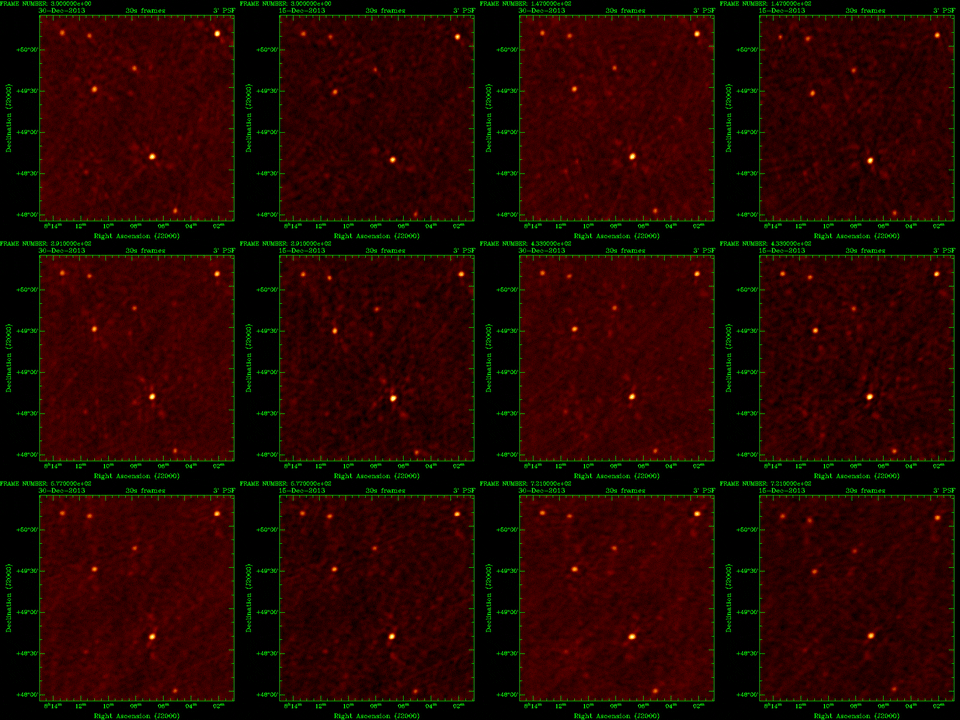
To study these disturbances in more detail than their effects on GPS, I use data from a facility called the Low Frequency Array (Lofar). One of the world's largest radio telescopes, Lofar consists of dozens of radio antennas spread across Europe, designed to observe distant natural radio sources in the early Universe, such as radio galaxies.
The appearance of radio sources in space, when viewed through the ionosphere, is similar to how the view of objects through a glass of water can become distorted when we stir (or shake) it up.
With careful analysis, one can use these distortions to understand what is happening in the ionosphere itself. Traveling ionospheric disturbances can enhance these distortions, particularly at the radio wavelengths we use with Lofar.
screen shot only CC
The video above (and seen here), created by Richard Fallows, shows some Lofar data from December 2013. The bright points of light are natural radio sources such as distant galaxies. The sequence in the left panel is from a quiet night, and in the right panel the ionosphere is disturbed. The sources can be seen to rapidly change position and fade in and out.
Over the coming weeks, we will be looking quite carefully at our Lofar data to investigate whether there are distinct patterns visible that could be attributed to the Tongan eruption.
Ultimately, the research could help us better understand how volcanoes on Earth influence space and technology.
As the ionosphere is the atmospheric interface between Earth and space, it may even shed light on the precise degree to which disturbances are driven by terrestrial versus space weather events.
According to a tweet from an Indian source (@ Kunal_Biswas707) The Indian Army has started equipping regular infantry units with a Negev machine gun NG7 GPMG made by the Israeli company IWI.
IWI's Negev NG7 machine gun in 7.62 x 51 mm NATO Calibre ( heavy extending stock with cheek rest )
It will be recalled that in March 2020 it was reported on IsraelDefense website that India had signed an agreement with IWI to supply 16,479 Negev machine guns from its production in the amount of $118 million and that about a year ago it was reported that in early 2021 the Indian Army received first shipment of 6,000 machine guns to Northern Command units on borders with China and Pakistan.
IWI Negev LMG 7.62x51
The project to supply the machine guns to the Indian army is in progress, with the commitment to supply all the "Negev" machine guns within two years. IsraelDefense has learned that the Indian military is interested in large follow-up deals and to purchase additional large quantities of these machine guns in the future.
Please recommend this page & follow the Sputniks Orbit
Israel successfully completes flight test of Arrow 3 Weapon System
"Test conducted together with US Missile Defense Agency (MDA) and led by Israel Aerospace Industries. MoD Ganz: "Our systems provide Israel with the freedom to maneuver strategically
AWS operational radars array detected the target and transferred data to the battle management control (BMC), which analyzed the data and established a defense plan. After the defense plan was established, two Arrow-3 interceptors were launched toward the target and successfully completed the mission.
Defense Minister Benny Gantz: “I commend the successful outcome of the recent flight test – Israel’s defense establishment and industries continue to develop some of the world’s most advanced systems. With every step forward, with every development, we equip the State of Israel with the capabilities to defend itself against developing threats.”
Along with the IMDO, representatives of the MDA, Israeli Air Force and industries involved in AWS development, participated in the test.
IAI is the primary contractor for the development of the Arrow Weapon System and Arrow interceptors. MLM designs, develops and produces the Arrow interceptors, and Elta, a subsidiary of IAI, develops the radar detection array. Elisra, a subsidiary of Elbit Systems, develops the BMC. BOEING Company, TOMER and RAFAEL are the main subcontractors for the development and production of the Arrow 3 interceptor. RAFAEL designs and develops the target.
Arrow 3. Photo courtesy Israel Ministry of Defense
“This test was designed to challenge every element of the Arrow Weapon System, and it performed beautifully. Data collected from this test guide future development of the AWS,” said MDA Director Vice Adm. Jon Hill. “MDA remains committed to assisting the Government of Israel in upgrading its missile defense capability against current and emerging threats.”
Chief of the IDF General Staff, Lt. Gen. Aviv Kohavi: “The IDF and Israel’s defense establishment see great importance in constantly upgrading and improving our air defense capabilities. The test conducted this morning is another element in our ability to respond to developing threats in the region, and is a part of the implementation of the IDF's multi-year plan.”
Head of the Directorate for Defense Research and Development (DDR&D) in the Israel Ministry of Defense, Brig. Gen. (Res.) Dr. Dani Gold: “This groundbreaking test reflects a significant leap forward in the capabilities of the defense establishment to develop in the face of emerging regional threats and to adapt for the future battlefield. The DDR&D and partnering industries will continue spearheading Israel’s technological advance to maintain our national security.”
Why Israel’s Arrow 3 Anti-Ballistic Missile System Test Is A Big Boost Amid Threat From Iran
IMDO Director, Moshe Patel: “Today we successfully completed a complicated flight test of the Arrow Weapon System and the Arrow 3 interceptor. The Israel Ministry of Defense continues its efforts to enhance and to upgrade Israel’s multi-tier missile defense capabilities against emerging threats in the region. Since the successful series of tests in Alaska in 2019, we have significantly expanded the Arrow Weapon System’s capabilities. I would like to express our appreciation to the MDA and the US Government for the enduring cooperation over a period of 30 years, to build and strengthen Israel’s Missile Defense.”
Boaz Levy, IAI: "The Arrow System, developed as a result of the close cooperation between Israel Aerospace Industries (IAI), the Israel Ministry of Defense (MoD), the United States Missile Defense Association (MDA), and the Israeli Air Force, proved once again that Israel holds one of the world's most advanced defense systems against ballistic missiles.
"Throughout the flight test, the system was tested against ‘future threats’, in a challenging scenario, while gathering essential information that will be used by the defense establishment and the company's engineers for the development of future technologies.
"The Arrow System is one of IAI's advanced developments, including cutting-edge technologies with the capability of identifying and intercepting surrounding threats. On behalf of IAI Management and the Chairman of the IAI Board of Directors Mr. Amir Peretz, I would like to thank the Israel Ministry of Defense, Israeli Air Force, other defense partners, and IAI's employees for their professionalism and courage, which have led to a successful trial."
The AWS is a central part of Israel’s multi-layered defense array that also includes the Iron Dome Defense System and David’s Sling Weapon System. This test is part of the IDF’s multi-year development program. The success of this test is an important milestone for Israel’s operational capability to defend itself against existing and evolving threats in the region.
Please recommend this page & follow the Sputniks Orbit
An employee of Sotheby's Dubai presents a 555.55 Carat Black Diamond "The Enigma" to be auctioned at Sotheby's Dubai gallery, in Dubai, United Arab Emirates, Monday, Jan. 17, 2022.
Credit: AP Photo/Kamran Jebreili
Auction house Sotheby's Dubai has unveiled a diamond that's literally from out of this world.
Sotheby's calls the 555.55-carat black diamond—believed to have come from outer space—"The Enigma." The rare gem was shown off on Monday to journalists as part of a tour in Dubai and Los Angeles before it is due to be auctioned off in February in London.
Sotheby's expects the diamond to be sold for at least 5 million British pounds ($6.8 million). The auction house plans to accept cryptocurrency as a possible payment as well.
Sophie Stevens, a jewelry specialist at Sotheby's Dubai, told The Associated Press that the number five bears an importance significance to the diamond, which has 55 facets as well.
"The shape of the diamond is based on the Middle-Eastern palm symbol of the Khamsa, which stands for strength and it stands for protection," she said. Khamsa in Arabic means five.
"So there's a nice theme of the number five running throughout the diamond," she added.
Stevens also said the black diamond is likely from outer space.
"With the carbonado diamonds, we believe that they were formed through extraterrestrial origins, with meteorites colliding with the Earth and either forming chemical vapor disposition or indeed coming from the meteorites themselves," she said.
Black diamonds, also known as carbonado, are extremely rare, and are found naturally only in Brazil and Central Africa. The cosmic origin theory is based on their carbon isotopes and high hydrogen content.
An employee of Sotheby's Dubai presents a 555.55 Carat Black Diamond "The Enigma" to be auctioned at Sotheby's Dubai gallery, in Dubai, United Arab Emirates, Monday, Jan. 17, 2022.
(L-R) Mr George-Cristian Potrivitu, Co-founder and Chief Technology Officer of Aliena, who is also an NTU PhD candidate,
and Dr Mark Lim Jian Wei, Co-founder and CEO of Aliena, who is also Adjunct Principal Investigator at the Energy Research Institute @ NTU (ERI@N).
Credit: Aliena
Aliena, a tech spin-off from Nanyang Technological University, Singapore (NTU Singapore), has today deployed into space a nanosatellite fitted with a fuel-efficient engine it has developed. The nanosatellite was sent from the SpaceX Falcon 9's Transporter-3 mission which launched from Cape Canaveral Space Force Station, Florida, US.
The satellite's engine, a Hall effect thruster, a type of ion thruster in which ions from the propellant are accelerated by an electric field, was invented and developed by Aliena. Compared to current satellite engines of its type, the new engine consumes just a fraction of power for its operation.
Thrusters are crucial to satellites, as they need them to make occasional thrust firings to keep them in orbit, otherwise they will re-enter Earth's atmosphere, putting an end to their mission. This is due to the resistive force or drag from the thin atmosphere which they encounter.
Historically, most satellites weighed a few thousand kilograms and were huge, measuring as tall as several storeys. Over the last two decades however, miniaturized satellites have been gaining popularity, which led to the development of smaller, lighter, and more fuel-efficient engines that keep satellites functional while in space.
Compared to current Hall thrusters that require around a thousand watts to keep larger satellites in orbit and are unsuitable for smaller spacecrafts, Aliena's engine can keep a nanosatellite operational with less than 10 watts of power. The entire propulsion system fits into a 10 cm by 10 cm by 10 cm cube and weighs less than two cartons of milk, significantly less than conventional counterparts.
Often referred to as the fourth state of matter, plasma and its physical properties play a key role in Aliena's engine. The NTU startup taps on plasma propulsion to allow small satellites to move in space with force from as little as a few micro-Newtons, which is comparable to the amount of force an ant uses to take a few steps forward.
Dr. Mark Lim Jian Wei, Co-founder and CEO of Aliena, who is also Adjunct Principal Investigator at the Energy Research Institute @ NTU (ERI@N), says that "as the space industry continues to grow exponentially and rapidly, Aliena aims to address a growing demand for in-space mobility through our plasma engines. Once a nascent market, we have seen a sudden surge in the number of space-tech companies being incorporated to capitalize on the cost effectiveness of small satellites and accessibility to space to deploy their own constellations that will impact terrestrial and extra-terrestrial businesses."
Mr George-Cristian Potrivitu, Co-founder and Chief Technology Officer of Aliena, who is also an NTU Ph.D. candidate, says that "Aliena is focused on developing cutting edge satellite propulsion systems based on plasma, and this mission definitely marks a very important milestone for the private space ecosystem in Singapore, which is rapidly emerging from its nascent phase.
With the launch, we will prove that our system functions well in space on a satellite, which is important as we continue to expand our customer base. We want to enable their emerging operations and to help catalyze new business opportunities in space through the provision of unprecedented mobility to small spacecraft, allowing them to execute the most challenging of missions."
Empowering satellites for the next frontier of space exploration
The Aliena thruster also features other technical innovations that help increase its durability and allows for the instant ignition of the system without the need for external heating for warm-up.
Aliena's engine is an electric plasma propulsion system that is more fuel efficient as compared to non-electric systems and requires smaller and lighter batteries and fewer solar panels as compared to existing thrusters on the market.
A 3D image rendering of a satellite, powered by Aliena's engine, in Earth's orbit.
Credit: Aliena
As a result of the fuel efficiency, satellites equipped with an Aliena engine would carry less fuel for missions, giving the satellites more flexibility in executing operations in space.
Providing satellites the ability to adjust their movement to the smallest degree is crucial for purposes such as constellation formation, when satellites require to group together to work as a system. It is also handy for in-orbit maintenance and servicing, as well as other complex operations in space, such as in the 2013 movie Gravity, where actress Sandra Bullock's character had to use a cold-gas thruster to propel herself to service the Hubble Space Telescope.
Dr. Lim added that "we hope the successful launch of the nanosatellite powered by our new engine will pave the way for emerging small satellite operations to be carried out with reduced power consumption, which also improves the usage of a satellite's capacity."
Following this mission, Aliena plans to deploy microsatellite-class engines (MUSIC) on a larger satellite platform in 2023 that will be launched onboard Orbital Astronautic's ORB-12 Strider mission.
Aliena has since secured separate orders from an undisclosed customer and has received interest from other enterprises for the use of its engines in their satellites.
Mr David Toh, CEO of NTUitive, says that "Aliena has achieved a very significant milestone in their product development, and we are pleased as an organization to have supported the company in all its endeavors to be a successful startup. Aliena is a great example of how university research can be translated and brought to the market rapidly through our funds and support programs, where we help accelerate the commercialisation process through support in areas such as Intellectual Property and office space, as well as to groom entrepreneurs and pair them up with technology most suited for their businesses."
Aliena was founded in 2018, after founders Dr. Lim and Mr Potrivitu met while working on their Ph.D.s at the Space Propulsion Centre in NTU. The company received a grant by NTU's innovation and enterprise company NTUitive in 2019, and the technology was test-bedded in the NTU Satellite Research Centre (SaRC).
Aliena first demonstrated the principles behind the engine's modes of operation at SaRC. The team was provided access to SaRC's facilities for the assembly of its prototype, and it was also where the engine first demonstrated a successful test launch, a milestone that the Aliena team said helped pave the way for Aliena to close its first oversubscribed funding round.
Spinning-off from NTU, Aliena was also supported by NTUitive through their flagship Strategic Research Innovation Fund (SRIF) that provided capital for the initial research and development required to advance the engine from its prototype.
NTU's first foray into space began more than 20 years ago. The first project was a communication payload codenamed Merlion launched in 1999, while the main satellite body was developed by the University of Surrey.
NTU has since built and sent nine satellites into Earth's orbit. The X-SAT, NTU's microsatellite built in collaboration with Defence Science Organisation, is Singapore's first locally built satellite which was launched into space in 2011.