

Defense tech firm Rafael reveals first-ever hypersonic interceptor
Sky Sonic system, under development for three years, to be shown off at Paris Air Show, after Iran claimed earlier this month it built a hypersonic missile
Israel’s Rafael defense contractor unveiled Wednesday that it has been developing a first-of-its-kind anti-hypersonic missile defense system.
According to the company, the Sky Sonic interceptor missile, which has been in development for around three years, will be shown for the first time at the upcoming Paris Air Show next week.
The announcement comes after Iran earlier this month claimed it had developed a new hypersonic missile. Rafael officials said the company had only recently been given approval by the Defense Ministry to reveal the system.
Rafael said the Sky Sonic missile “represents a major technological leap in hypersonic missile defense.”
“Designed with exceptional maneuverability and high-speed capabilities, it effectively neutralizes hypersonic missiles [which travel at speeds of over five times the speed of sound] with unmatched precision and stealth,” it said.
The company could not provide a timeline as to when the missile will be ready to use but said it would be conducting first test flights in the near future.

Speaking to reporters, former minister Yuval Steinitz, chairman of Rafael, said the company had identified the potential hypersonic missile threat a number of years ago and began a research and development venture.
“We are following the developments and emerging threats in the current security context and are developing the most advanced defense systems,” he said.
Steinitz noted that the company’s David Sling medium-range air defense system — already in use by the Israeli military — can technically deal with hypersonic missiles, but said the new system is designed specifically to counter that threat.
“Project Sky Sonic is an innovative, unique development of its kind for the hypersonic weapon threat,” he said.
Hypersonic weapons, which fly at speeds in excess of Mach 5, or five times the speed of sound, could pose serious challenges to missile defense systems because of their speed and maneuverability. Iran described its new missile, the Fattah, as being able to reach Mach 15.
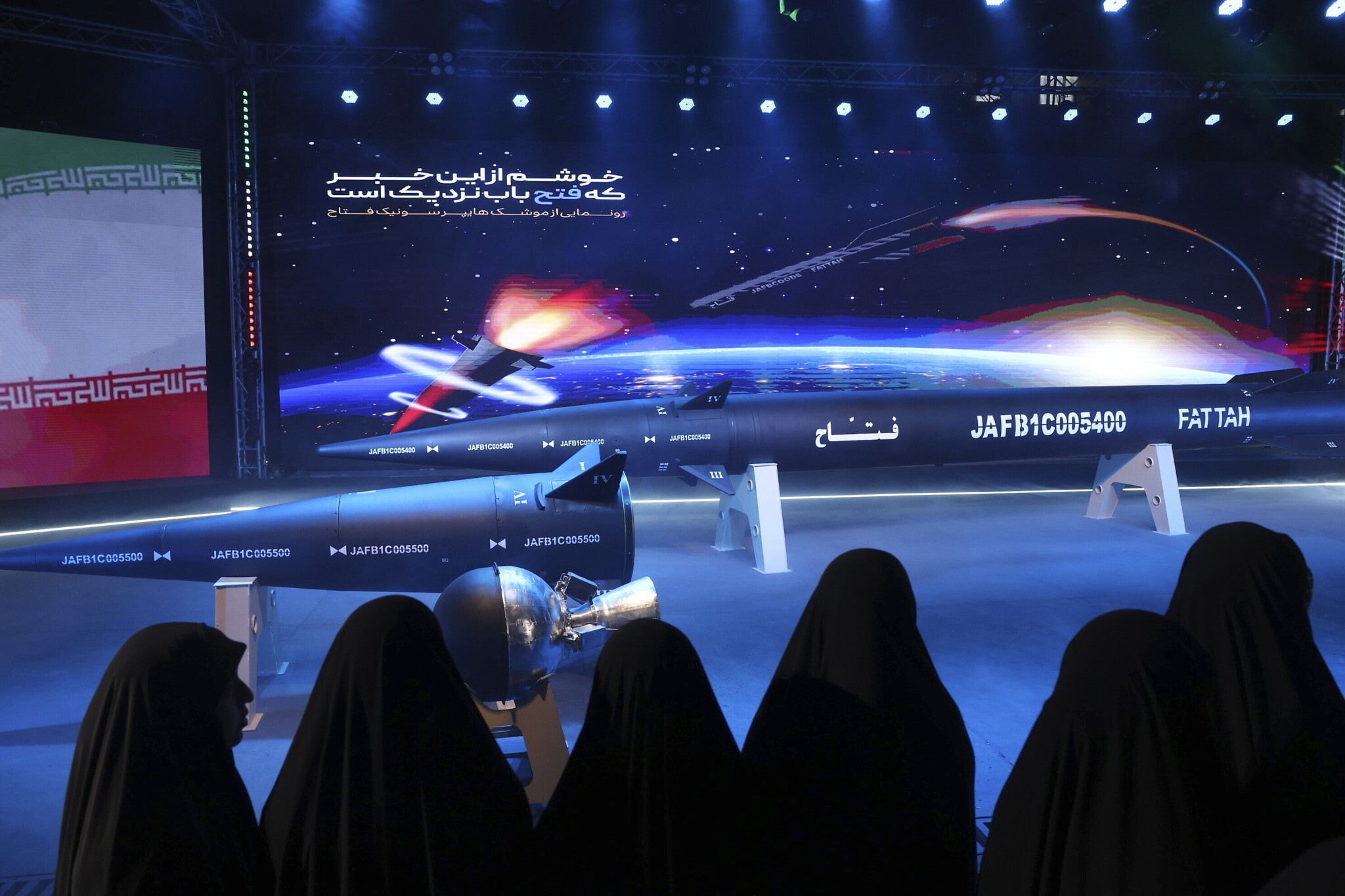
Most air defense systems operate up to an altitude of 20 kilometers, while anti-ballistic systems intercept targets outside of Earth’s atmosphere, generally above 70 kilometers.
The Sky Sonic system aims to intercept hypersonic threats within the 20-70 kilometer altitude range, where the incoming missile would likely maneuver to avoid being knocked down by traditional air defenses.
Rafael officials said the United States has shown interest in Sky Sonic.
China is believed to be pursuing hypersonic weapons, as is the US. Russia claims to already be fielding the weapons and has said it used them on the battlefield in Ukraine. However, speed and maneuverability aren’t a guarantee the missile will successfully strike a target. Ukraine’s air force in May said it shot down a Russian hypersonic Kinzhal missile with a Patriot battery.
Rafael is considered one of Israel’s premier military contractors, helping develop some of the country’s leading weapons systems, including the short-range Iron Dome air defense system and the precision-guided Spike missile.
It is also currently developing a high-powered laser interception system, dubbed Iron Beam, which has been hailed as a potential “game-changer” in the battle against projectile attacks.
----------------------------------------------------------------------------------------
From I24:
Hypersonic missiles encompass a new threat, and is the latest weapon in the evolution of arms designed to beat interception systems like Israel's Iron Dome
Rafael Advanced Defense Systems, a leading Israeli defense technology company, on Wednesday announced the development of an advanced missile interceptor dubbed “Sky Sonic,” described as a groundbreaking defensive response to the growing threat of hypersonic missiles.
The revolutionary system will be officially unveiled for the first time next week at the Paris Air Show, one of the world’s largest aerospace exhibitions.
Rafael’s “Sky Sonic” interceptor represents a major technological leap in hypersonic missile defense. It is designed with exceptional maneuverability and high-speed capabilities, allowing it to effectively neutralize hypersonic missiles – which travel at ten times the speed of sound – with unmatched precision and stealth.
Over the past years, the threat posed by hypersonic missiles has escalated, necessitating proactive measures to safeguard national security. Rafael is at the forefront of developing an effective solution to counter hypersonic threats, already known for its pioneering contributions in the field of defense systems such as the renowned "Iron Dome," "David's Sling," and the cutting-edge "Iron Beam" laser-based system.
"Rafael has identified a marked increase and arousing interest in the international arena with proven operational capabilities and a geopolitical reality that has created many opportunities,” Rafael’s chairman Dr. Yuval Steinitz said at a press briefing.
“We are following the developments and emerging threats in the current security context and are developing the most advanced defense systems. Project ‘Sky Sonic’ is an innovative, unique development of its kind for the hypersonic weapon threat.”
Hypersonic missiles are the latest weapon in the evolution of arms, designed to beat interception systems like the Iron Dome. They encompass a new family of threats – including hypersonic atmospheric cruise missiles, gliders, and cruisers that travel at incredible speeds while maintaining exceptional accuracy and maneuverability. Unlike ballistic missiles, hypersonic missiles have the ability to change their course mid-flight.
Consequently, a successful defense against hypersonic threats requires a multifaceted approach that involves not only countering their speed but also effectively tracking, detecting, and intercepting their unpredictable flight paths.
Last week, Iran unveiled their new “Fattah” advanced hypersonic missile which can reportedly reach a range of up to 870 miles and is able to evade "all enemy air defense systems."
It was the first time Tehran had presented a hypersonic missile capable of reaching a speed five times greater than the speed of sound. The missile would also be able to perform erratic maneuvers inside and outside the Earth's atmosphere to thwart any type of air defense.
"We are coming to the air show with Rafael's vast and impressive portfolio that includes systems that are at the forefront of technology. We at Rafael believe that even the seemingly impossible can be done. We have proven this in the past and will continue to prove it in the future,” said Maj. Gen. Yoav Har Even, CEO of Rafael.
“The orders for these systems are breaking records, and for the first time, we stand on a backlog of orders of over [$11 billion]... Rafael continues to be a significant pillar in the security of the State of Israel."
Developing a comprehensive defensive response to hypersonic threats presents numerous complex challenges, including detection and tracking difficulties that necessitate a synchronized sensor system capable of accurately identifying and locating the threat throughout its trajectory. Furthermore, accurate trajectory prediction demands an interceptor that can swiftly reach the target, minimizing uncertainty associated with the target's location. Lastly, the interceptor must exhibit exceptional maneuverability and operate on a non-ballistic trajectory to effectively pursue and neutralize the hypersonic threat.
"We continue to look ahead and develop the next generations of systems to defend against the threats of tomorrow,” said Brig. Gen. Pini Yungman, vice president and head of the air defense division at Rafael.
The Paris Air Show will provide a platform for Rafael to showcase its wide range of advanced systems and capabilities. Following a four-year hiatus due to the Covid pandemic, the show will feature for the first time unique Rafael solutions and systems. Visitors to the company’s pavilion will have the opportunity to experience firsthand the "Iron Dome" system, the "David's Sling" system, the "Iron Beam" laser air defense system, as well as advanced features of the "SPIKE" missiles integrated with combat helicopters, supplementary systems for aerial platforms, and much more.
----------------------------------------------------------------------------------------------
From JPost:
Rafael Advanced Defense Systems on Wednesday announced that it is midstream in working on developing a system to shoot down hypersonic missiles, dubbing its new project the “Sky Sonic” system.
Chairman Yuval Steinitz said that the current era has more of a focus on the threat posed by hypersonic missiles.
Steinitz said that while many define any missile which can fly at a speed beyond Mach 10 as “hypersonic,” the new threat that such missiles present is their ability to maneuver and alter their trajectory.
Many countries have expressed concern that no existing air defense, including Israel’s multi-tier defenses, could contend with such a threat.
Russia, China, and Iran have all made various claims about possessing or working on developing such advanced missiles.
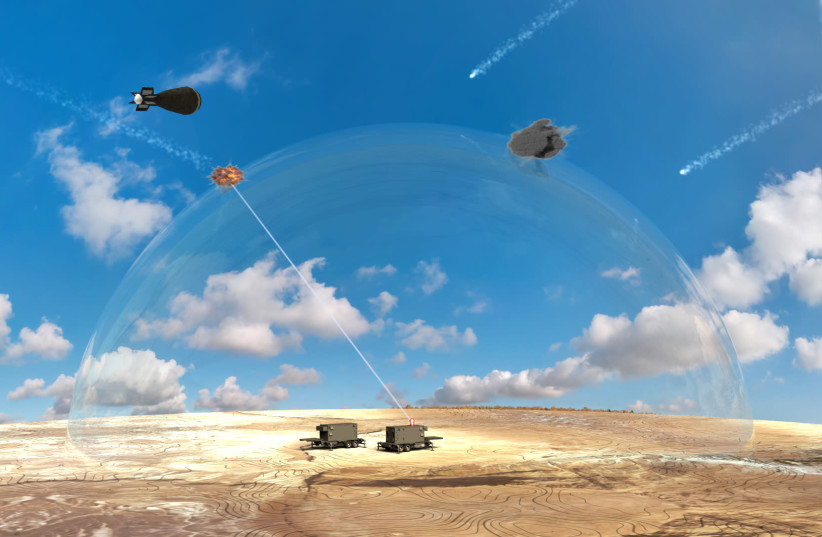
 Artistic depiction of how innovative laser defense system would function on the battle field (credit: Courtesy)
He said that the Sky Sonic defense missile system is “versatile and can hit all hypersonic missiles, flying high or low, maneuvering more or less.”
Further, the Rafael chairman said the new defense system “is already in development for a solution. If someone thought we are going downward in defense, we are deep into this.”
Next, Rafael CEO Yoav Har Even added, “We decided three years ago before the public started talking about it…we identified this as the next thing which must have a solution.”
Har Even said Rafael initiated its project for the simple reason that it fulfills the company’s two key missions: developing solutions helpful to Israel’s defense and which are at the forefront of technological development.
Steinitz said that Rafael was revealing its work on the project leading into next week’s Paris Air Show, which shows off state-of-the-art defense sector systems, and following a process to convince the Defense Ministry to approve the announcement.
Hypersonic missiles pose a unique threat
Rafael explained that the anticipated threat of hypersonic missiles would involve such threats dropping from the top of their trajectory in multiple hops, versus going high up into the atmosphere in a relatively straight line and coming back down in a similar straight line.
Such hypersonic missiles might only drop below the 20-kilometer height where existing air defense systems can hit them, at almost the last second before hitting a target.
This could defeat the mission of existing air defenses which are designed to hit missile threats during their arch trajectory going upward before they start to go downward.
Some hypersonic missiles might also be fired in more of a “line drive” fashion, closer to being fired straight across from the launch site, with much less of an arch.
These hypersonic missiles may fly above the key 20-kilometer height for existing systems to hit them during almost the entire trajectory even though they fly in more of a line-drive fashion, and with a smaller arch.
Steinitz noted that Rafael had hit a new high of NIS 40 billion in sales over the last year, a huge spike following the Russian invasion of Ukraine.
He said that Europe watched the war and realized that most of the attacks at a certain point were carried out by firing missiles, including Moscow’s claim that it was firing hypersonic missiles.
This meant new opportunities for Rafael in sales to European countries.
Rafael also discussed progress regarding its Iron Beam laser anti-missile system and its existing Iron Dome and David’s Sling anti-missile systems, noting that there would be many common features between the new Sky Sonic system and David’s Sling.
At the same time, Rafael emphasized that it is building Sky Sonic in a manner that should make it adaptable to a number of situations and scenarios.
______________________________________________________
From BreakingDefense (Seth Frantzman):
JERUSALEM — In response to what it describes as the “geopolitical reality” of hypersonic weapons, Rafael Advanced Defense Systems today announced that it is developing a new interceptor missile called Sky Sonic geared specifically at the hypersonic threat.
In a statement, the company described the missile as a “groundbreaking defensive response to the growing threat of hypersonic missiles.” The firm plans to show the weapon design off at next week’s Paris Air Show, aiming squarely at the European market.
The missile is currently being developed and has not undergone live testing yet. The multi-stage interceptor, developed for several years in secret, uses a Hit-to-Kill system that Rafael has used in other interceptors, per a company briefing held today. It is a distinct system, but in line with Rafael’s other air defense systems and missile interceptor it is designed with an open architecture to allow maximal flexibility, according to the company. Rafael has presented the project to the US and, the company said, feedback from USA has been positive.
The timing of the unveiling is notable. Just a week ago, Iran announced that it has developed a hypersonic missile called Fattah, that is a two-stage missile which exits the atmosphere and separates from a re-entry vehicle that then maneuvers toward a target. While there is some skepticism about whether Iran has that capability, it’s yet another sign of how hypersonic threats have proliferated over the last few years: Russia has used air-launched hypersonic Kinzhal missiles in Ukraine, while both China and North Korea claim to have developed hypersonic missiles.
“Rafael has identified a marked increase and arousing interest in the international arena with proven operational capabilities and a geopolitical reality that has created many opportunities. We are following the developments and emerging threats in the current security context and are developing the most advanced defense systems,” said Dr. Yuval Steinitz, Chairman of Rafael. “Project Sky Sonic is an innovative, unique development of its kind for the hypersonic weapon threat,” he said.
A “successful defense against hypersonic threats requires a multifaceted approach that involves not only countering their speed but also effectively tracking, detecting, and intercepting their unpredictable flight paths,” Rafael’s statement said.
Rafael officials described the hypersonic threat in a presentation and also showed a video of the Sky Sonic. Rafael officials stressed that “hypersonic” threats describe missiles that are not merely travelling fast (ballistic missiles travel past Mach 5) but also involve missiles that glide or maneuver. This means they bring together the threat of speed and also the kind of difficulties involved in intercepting low-flying cruise missiles that may maneuver to fly up valleys or change direction.
“Developing a comprehensive defensive response to hypersonic threats presents numerous complex challenges, including detection and tracking difficulties that necessitate a synchronized sensor system capable of accurately identifying and locating the threat throughout its trajectory,” the company said in a statement.
An interceptor launched against a hypersonic threat needs to be able to fly “swiftly” toward the target and also “the interceptor must exhibit exceptional maneuverability and operate on a non-ballistic trajectory to effectively pursue and neutralize the hypersonic threat.” The company did not give a range for the interceptor.
Company executives reiterated that they have developed a new technology with this missile, although they could not elaborate on specific aspects of that technology. Nor would the company give a range for the interceptor.
However, the company is clearly keeping both the local threat and potential exports in mind. Israel recently announced historically high defense exports of $12.5 billion. Rafael is one of Israel’s three largest defense companies and the traditional research and development center within Israel’s defense sector.
Rafael is showcasing its other systems, such as Iron Dome and David’s sling at the Paris Air Show. It will also be discussing Iron Beam, the laser air defense system that is being coupled with Iron Dome. This system is supposed to be operation in the near-term. The company says the “system delivers unparalleled accuracy in intercepting rockets, mortar projectiles, missiles, unmanned aerial vehicles (UAVs), and UAV swarms from several kilometers to a few hundred meters away. As an integral part of the comprehensive Iron Dome air defense system, the Iron Beam significantly enhances its defensive capabilities.”
---------------------------------------------------------
From A7:
RAFAEL Advanced Defense Systems Ltd., a leading defense technology company, announced today that it has developed an advanced interceptor, named "Sky Sonic," as a groundbreaking defensive response to the growing threat of hypersonic missiles. This revolutionary system will be officially unveiled for the first time at the Paris Air Show, one of the world's largest aerospace exhibitions, opening next week.
The Sky Sonic interceptor represents a major technological leap in hypersonic missile defense. Designed with exceptional maneuverability and high-speed capabilities, it effectively neutralizes hypersonic missiles, which travel at ten times the speed of sound, with unmatched precision and stealth. RAFAEL's booth at the Paris Air Show will showcase the interceptor, highlighting the company's commitment to pushing the boundaries of air defense technology.
Over the past years, the threat posed by hypersonic missiles has escalated, necessitating proactive measures to safeguard national security. RAFAEL, known for its pioneering contributions in the field of defense systems such as the renowned "Iron Dome," "David's Sling," and the cutting-edge "Iron Beam" laser-based system, is proud to be at the forefront of developing an effective solution to counter hypersonic threats.
Dr. Yuval Steinitz, Chairman of RAFAEL "RAFAEL has identified a marked increase and arousing interest in the international arena with proven operational capabilities and a geopolitical reality that has created many opportunities. We are following the developments and emerging threats in the current security context and are developing the most advanced defense systems. Project Sky Sonic is an innovative, unique development of its kind for the hypersonic weapon threat.
Major General Yoav Har Even, CEO of Rafael "We are coming to the air show with RAFAEL's vast and impressive portfolio that includes systems that are at the forefront of technology. We at RAFAEL believe that even the seemingly impossible can be done. We have proven this in the past and will continue to prove it in the future. The orders for these systems are breaking records and for the first time we stand on a backlog of orders of over 40 billion NIS and alongside the activity as a successful global business company, RAFAEL continues to be a significant pillar in the security of the State of Israel."
Brigadier General Pini Yungman, Executive Vice President and Head of the Air Defense Division at Rafael: "RAFAEL has achieved a reputation as a leading global manufacturer of air defense systems. From groundbreaking and operationally proven systems like the Iron Dome in its various configurations to the David's Sling and the SPYDER, we continue to look ahead and develop the next generations of systems to defend against the threats of tomorrow."
Hypersonic missiles encompass a new family of threats, including hypersonic atmospheric cruise missiles, gliders, and cruisers that travel at incredible speeds while maintaining exceptional accuracy and maneuverability. Unlike ballistic missiles, hypersonic missiles have the ability to change their course mid-flight. Consequently, a successful defense against hypersonic threats requires a multifaceted approach that involves not only countering their speed but also effectively tracking, detecting, and intercepting their unpredictable flight paths.
Developing a comprehensive defensive response to hypersonic threats presents numerous complex challenges, including detection and tracking difficulties that necessitate a synchronized sensor system capable of accurately identifying and locating the threat throughout its trajectory. Furthermore, accurate trajectory prediction demands an interceptor that can swiftly reach the target, minimizing uncertainty associated with the target location. Lastly, the interceptor must exhibit exceptional maneuverability and operate on a non-ballistic trajectory to effectively pursue and neutralize the hypersonic threat.
The Paris Air Show, the world's largest aerospace exhibition, will provide an excellent platform for RAFAEL to showcase its wide range of advanced systems and capabilities. Following a four-year hiatus due to the global pandemic, the show will feature for the first time unique RAFAEL solutions and systems. Visitors to the RAFAEL pavilion will have the opportunity to experience firsthand the "Iron Dome" system, the "David's Sling" system, the "Iron Beam" laser air defense system, as well as advanced features of the "SPIKE" missiles integrated with combat helicopters, supplementary systems for aerial platforms, and much more.
The "David's Sling" system, developed jointly by RAFAEL and the American company Raytheon, is a highly advanced solution for intercepting medium to long-range rockets, missiles, and cruise missiles. It utilizes a Hit-to-Kill mechanism, making it the world's leading interceptor. Equipped with a multi-stage interceptor that boasts rapid maneuverability, the system incorporates two targeting and guidance systems—a radar and an electro-optical sensor—at its nose tip. These cutting-edge technologies establish "David's Sling" as a global breakthrough in missile defense.
RAFAEL's "Iron Beam" system is set to be the world's first operational High Energy Laser Weapon System (HELWS). It has successfully intercepted a wide range of aerial threats and is nearing its deployment phase. The "Iron Beam" system delivers unparalleled accuracy in intercepting rockets, mortar projectiles, missiles, unmanned aerial vehicles (UAVs), and UAV swarms from several kilometers to a few hundred meters away. As an integral part of the comprehensive "Iron Dome" air defense system, the "Iron Beam" significantly enhances its defensive capabilities.
The SPIKE missile family, renowned for its electro-optical capabilities, demonstrates remarkable effectiveness in various environments, including sea, air, and land. With a range of up to 32 km in-ground launch and 50 km in air launch, the advanced SPIKE missiles offer unparalleled speed, accuracy, and the ability to neutralize multiple targets simultaneously. These state-of-the-art missiles empower combat helicopters with extended range and mission capabilities, revolutionizing their operational effectiveness.
Additionally, RAFAEL will present a range of cutting-edge systems designed for aerial platforms, incorporating the latest technological advancements to counter emerging threats effectively. The "Litening" and "RecceLite" systems, equipped with advanced intelligence gathering capabilities, along with the "SPICE" family and "Ice Breaker" long-range precision-guided missile system, the "Sky Shield" electronic warfare system, and advanced air-to-air missiles will all be featured at the RAFAEL booth. These systems, already operational in numerous armed forces worldwide, offer upgrade possibilities for existing platforms, granting them capabilities equivalent to next-generation air platforms and systems.


