Saturday, April 5, 2025

Science News: Megalodon shark may have reached 80 feet, new study finds


Megalodon shark may have reached 80 feet, new study finds


Megalodon sharks roamed the seas between 20 million and 3.6 million years ago.

By Jerusalem Post Staff, March 16th, 2025


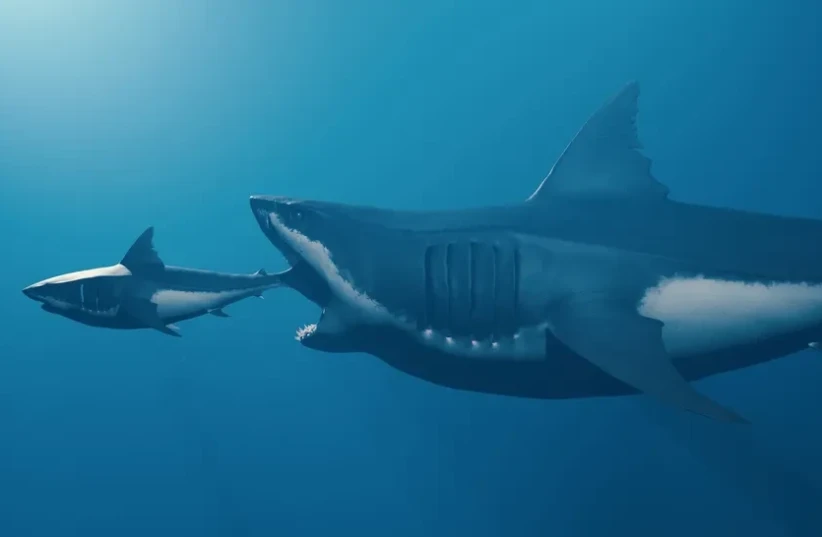
an illustration of a shark being eaten by an even larger shark Scientists have long assumed megalodons looked like big great white sharks, but new research suggests this is not the case (photo credit: Baris-Ozer via Getty Images)


The now-extinct megalodon shark may have been larger than first believed, reaching lengths of 80 feet (24.3 meters), according to a new study published in Palaeontologia Electronica last week. 

This is about the length of an eight-story building, meaning that megalodon sharks were about 4.5 meters longer than existing predictions. 

Megalodon sharks roamed the seas between 20 million and 3.6 million years ago. Despite this, no whole megalodon (Otodus megalodon) skeleton has ever been discovered, so most of the scientific research about them comes from fossils of their vertebrae scales and teeth.


"Previous estimates using teeth to predict its size had the shark reaching about 18-20 meters total length (59-65 feet)," co-author Phillip Sternes told Live Science

In the new study, however, researchers examined megalodon fossils and compared them to over 150 living and extinct shark species to try to build an image of the size of the giant shark. 


The researchers have developed a revised tentative body outline of a 80 foot megalodon (credit: DePaul University/Kenshu Shimada)


Part of the research involved comparing sections of the megalodon's trunk with the trunks of 145 modern and 20 extinct shark species. The largest megalodon fossil ever found is a 36-foot-long (11 m) section of its spine.

The researches based the estimations on the assumption that the megalodon was roughly proportional to other shark species, and then extrapolated from the 36 feet (11 meter) trunk section, to estimate that it may have had a 6 feet (1.8 meter) long head and 3.6 meter long tail, making it a total of 54 feet (16.4 meters)

Assuming that the megalodon was roughly proportional to the majority of other shark species, and extrapolating from the 36-foot (11 m) trunk section, the researchers estimated that this individual shark may have had a 6-foot-long (1.8 m) head and 12-foot-long (3.6 meter) tail, giving it a total length of 54 feet (16.4 meters).


Megalodon shark jaws and teeth at the American Museum of Natural History in New York. (credit: Wikimedia Commons)


However, one discovered megalodon vertebra measured much longer - at 9 inches (23 centimeters) in diameter — 3 inches (7.6 cm) bigger than the largest vertebra from the 54-foot shark.

Using this figure, this vertebra most likely belonged to a megalodon that measured in at 80 feet long.


Appearance of the megalodon

The study also found that the live offspring of the megalodon may have been 12 to 13 feet (3.6 to 3.9 m) long.

The teeth of megalodon sharks are similar to that of modern-day great white sharks, as both are similarly serrated. This led scientists to believe that the megalodon resembled a great white.

"Previous studies simply assumed that megalodon must have looked like a gigantic version of the modern great white shark without any evidence," study lead author Kenshu Shimada, a paleobiology professor at DePaul University in Chicago, told Live Science.

However, new research found that the megalodon was more likely slender and streamlined.


Based on the revised maximum body size, as well as hydrodynamic models of how creatures like whale sharks (Rhincodon typus), basking sharks (Cetorhinus Maximus), and whales move through the water, the researchers decided that the megalodon was more similar in build to a lemon shark (Negaprion brevirostris).


THIS PAGE WAS POSTED BY SPUTNIK ONE OF THE SPUTNIKS ORBIT BLOG

https://disqus.com/HOME/FORUM/THESPUTNIKSORBIT-BLOGSPOT-COM

How a new wave of fighter jets could transform aerial combat

APRIL 1, 2025, by D. Bacci, The Conversation

Unpiloted aircraft could act as "wingmen" to support piloted sixth generation jets. 
Credit: US Air Force

The most advanced fighter jets in the world are known as "fifth generation." They contain technologies developed in the first part of the 21st century. Examples of fifth generation fighter jets include America's F-35 Lightning II and F-22 Raptor, China's Chengdu J-20 and Russia's Sukhoi SU-57.

Now, however, nations are moving ahead with the sixth generation of combat jets. In the past few months, China has flown its J36 and J50 prototype jets. Meanwhile, the US has selected Boeing to build a new fighter aircraft called the F-47.

As with previous generations, the sixth will incorporate major advances in aircraft design, onboard electronics (avionics) and weapon systems.

But how will the new generation of jets stand out from the previous one? Future combat jets will not see dramatic increases in maximum speed, nor in flight performance. Instead, the true innovations will be in how these systems operate and achieve dominance in aerial combat.

Like the fifth generation, the sixth will be dominated by stealth technology. This helps fighters jets to reduce their chances of being detected by infrared and radar sensors, to the point that when their signatures are eventually picked up, the opponent has no time to act.

Stealth is achieved through particular shapes of airframe (such as diamond shapes) and coatings on the aircraft—called radar absorbing materials. The airframe is the fundamental structural framework of an aircraft, encompassing the fuselage, wings, tail assembly and landing gear.

The diamond-like shapes that already characterize fifth generation jets are likely to remain in the upcoming generation of fighter, but they will evolve.

A common feature we're likely to see is the reduction or complete removal of vertical tails at the back of the aircraft and their control surfaces. In current aircraft, these tails provide directional stability and control in flight, allowing the aircraft to maintain its course and maneuver.

However, sixth generation jets could achieve this control with the help of thrust vectoring—the ability to manipulate the direction of engines and therefore the direction of thrust (the force that moves the jet through the air).

The role of vertical tails could also be partially replaced by devices called fluidic actuators. These apply forces to the wing by blowing high speed and high pressure air on different parts of it.

The removal of the vertical tails would contribute to the fighter's stealth. The new generation of fighters is also likely to see the use of novel radar absorbing materials with advanced capabilities.

We'll see the introduction of what are known as adaptive cycle engines on sixth generation fighters. These engines will feature what's known as a three stream design, which refers to the airstreams blowing through the engine. Current jets have two airstreams: one that passes through the core of the engine, and another that bypasses the core.

The development of a third stream provides an extra source of air flow to increase the engine's fuel efficiency and performance. This will allow both the capability to cruise efficiently at supersonic speed and deliver a high thrust during combat.

It is likely that China and the US will build two separate fighters with different airframes. One will have a bigger airframe, designed for use in an area like the Pacific Ocean region. Here, the ability to fly further and carry a heavier payload will be key, because of the distances involved. Airframes designed for this region will therefore be larger.

Another fighter jet carrying a smaller airframe will be designed for use in areas such as Europe where agility and maneuverability will be more important.

The next wave of jets will have a system in the cockpit that gathers lots of information from other aircraft, ground surveillance stations and satellites. It would then integrate this data to give an enhanced situational awareness to the pilot. This system would also able to actively jam enemy sensors.

Another key feature will be the deployment of unmanned combat aerial vehicles (Ucavs), a form of drone aircraft. The piloted fighter jet would be able to control a variety of Ucavs, ranging from loyal wingmen to cheaper, unpiloted fighter jets that will assist the mission, including protecting the piloted fighter.

This will all be the responsibility of something called the advanced digital cockpit, a software-driven system that will use virtual reality and allow the pilot to effectively become a battle manager. Artificial intelligence (AI) will be a key feature of the support systems for the drones. This will allow them to be controlled with complete autonomy. The pilot will assign the main task—such as, "attack that enemy jet in that sector"—and the system will carry out the mission without any further input.

Another advancement will be the weapon systems, with the adoption of missiles that not only will be capable of traveling at hypersonic speeds, but will also incorporate stealth features. This will further reduce the reaction times of enemy forces. Directed energy weapons systems, such as laser weapons, could potentially appear in later stages, as this technology is under study.

Under America's sixth generation fighter program, the US Navy is working on a separate jet called the F/A-XX, complementing the F-47.

The UK, Italy and Japan are also working on a jet project known as the global combat air program (GCAP). This will replace the Eurofighter Typhoon in service with the UK and Italy and the Mitsubishi F-2 in service with Japan.

Germany, Spain and France are working on a fighter program called the future combat air system (FCAS). This could supersede Germany and Spain's Typhoons and France's Rafale.

The path for sixth generation fighter jets seems to have already been traced, but uncertainties remain. The feasibility of some of the characteristics described and development times and costs are not yet well defined. This interval of time was more than ten years for fifth generation fighter jets—and the sixth is going to be far more complex in terms of requirements and capability.

A new generation of fighter jet is expected to remain on active duty for something like 30 years. But warfare across the world evolves rapidly. It is unclear whether the design requirements we are fixing today remain relevant over the coming years.


Recommend this post and follow
Sputnik's Orbit

Monday, March 31, 2025

Science News: Ancient ecosystem uncovered beneath Antarctic glacier collapse


Ancient ecosystem uncovered beneath Antarctic glacier collapse

Scientists uncover a thriving ecosystem beneath an Antarctic glacier, 

revealing corals, octopuses, and giant sea spiders untouched for centuries.


By Walla, March 30, 2025

An octopus rests on the seafloor at a depth of 1,150 meters in the Bellingshausen Sea off Antarctica, in an area where the edge of the shelf and the slope are carved by several underwater channels. (photo credit: Screenshot, ROV SuBastian / Schmidt Ocean Institute)


Scientists have recently uncovered a wondrous and vibrant underwater world, previously hidden beneath a massive glacier in Antarctica.

The glacier, covering an area of about 510 sq.km. — roughly three and a half times the size of Tel Aviv-Yafo —detached from the George VI Ice Shelf in January 2025, revealing a thriving seafloor never before seen by humans.

Among the fascinating creatures discovered were icefish, giant sea spiders, and octopuses — evidence of the astonishing biodiversity that endures even under the most extreme conditions.


The enormous glacier, now named A-84, broke away from the ice shelf in the Bellingshausen Sea—a marginal sea of the Southern Ocean along the western edge of the Antarctic Peninsula — while scientists were aboard the research vessel R/V Falkor, operated by the Schmidt Ocean Institute.


When the dramatic event occurred, the research team swiftly altered their plans to seize the rare opportunity to explore the newly exposed depths.


Patricia Esquete examines a suspected new species of isopod collected from the Bellingshausen Sea seafloor. It will take researchers years to classify all the new species discovered during this expedition. (credit: Screenshot, Alex Ingle / Schmidt Ocean Institute)


“We seized the moment and changed the expedition plan to explore what lies beneath,” said Dr. Patricia Esquete, a senior scientist with the research mission from the Centre for Environmental and Marine Studies at the University of Aveiro in Portugal.

Over the course of eight days, the team explored the seafloor at depths reaching 1,300m. using an advanced underwater robot named ROV SuBastian. They discovered large coral reefs and sponge fields teeming with marine life — a thriving ecosystem that had managed to flourish despite the extreme cold and darkness.

Antarctica’s floating ice shelves hang over the sea like massive platforms, making access to the seafloor beneath them a major challenge for scientists. Typically, deep-sea creatures depend on organic matter sinking from the sunlit upper layers of the ocean.


A beautiful and lively ecosystem

However, this ecosystem — sealed beneath 150m. of ice for hundreds of years — developed in a unique way. “We did not expect to find such a beautiful and lively ecosystem,” said Dr. Esquete. “Given the size of the animals, it appears these communities have existed here for decades, maybe even centuries.”

Researchers believe that ocean currents may bring nutrients beneath the ice shelf, allowing these creatures to survive.


The exact process remains unclear, but the team hopes further studies will provide answers. “We originally came to this area to study the interface between the ice and the sea,” explained Dr. Jyotika Virmani, executive director of the Schmidt Ocean Institute.

“Being there right as the glacier calved was a rare scientific opportunity that gave us a first glimpse into the untouched beauty of nature.”

This discovery highlights the hidden wonders of our world and reminds us how much there is still to learn about nature — even in the coldest and most remote corners of the Earth, like Antarctica.


THIS PAGE WAS POSTED BY SPUTNIK ONE OF THE SPUTNIKS ORBIT BLOG

https://disqus.com/HOME/FORUM/THESPUTNIKSORBIT-BLOGSPOT-COM

Saturday, March 29, 2025

Space News: James Webb telescope reveals oxygen in galaxy from 13.4 billion years ago


James Webb telescope reveals oxygen in galaxy from 13.4 billion years ago


Light from JADES-GS-z14-0 has taken 13.4 billion years to reach Earth, revealing a chemically mature galaxy when the universe was less than 300 million years old.


By Jerusalem Post Staff, March 28, 2025

James Webb telescope reveals oxygen in galaxy from 13.4 billion years ago.
(photo credit: NASA, ESA, CSA, STScI, Brant Robertson (UC Santa Cruz), Ben Johnson (CfA), Sandro Tacchella (Cambrid)

Recent studies have detected oxygen in the most distant galaxy ever recorded, JADES-GS-z14-0, challenging existing theories about early cosmic development. The findings were published by two teams separately: the first study, led by Italian researchers, appeared in Astronomy & Astrophysics, while the second, led by Dutch researchers, is online on the arXiv platform and pending publication in The Astrophysical Journal.

Astronomers using data from the Atacama Large Millimeter/submillimeter Array (ALMA) identified oxygen in JADES-GS-z14-0, a galaxy so distant that light from it has taken about 13.4 billion years to reach Earth. This means researchers observed the galaxy as it existed when the universe was less than 300 million years old, approximately 2% of its current age.

The detection of oxygen is causing the astronomical community to rethink how quickly galaxies formed in the early universe. "It's like finding a teenager where you would only expect to find babies," said Sander Schouws, a PhD student at Leiden Observatory and first author of one of the studies, referring to JADES-GS-z14-0's unexpected maturity.

Previously, scientists believed that the universe at that time was too young to form galaxies rich in heavy elements. However, JADES-GS-z14-0 was found to be chemically more mature than expected, indicating rapid chemical evolution. This suggests that stars in the early universe were born, died, and dispersed heavy elements into their surroundings much faster than previously thought.

"They opened a new view on the first phases of galaxy evolution," said Stefano Carniani from the Scuola Normale Superiore di Pisa, referring to the rapid maturation of JADES-GS-z14-0.

The presence of oxygen allows astronomers to measure the distance to the early galaxy more accurately, confirming its extreme distance with an uncertainty of just 0.005%, as reported by Digital Trends. "Thanks to ALMA, we obtained an extremely precise measurement with an uncertainty of just 0.005%, equivalent to 5 centimeters over a distance of 1 kilometer," said Eleonora Parlanti, a PhD student at the Scuola Normale Superiore in Pisa and author of one of the studies.


"I was really surprised by this clear detection of oxygen in JADES-GS-z14-0," said Gergö Popping, an astronomer at the European Southern Observatory, according to The Independent.

The findings suggest that galaxies formed much faster than expected in the early universe, raising new questions about the development of the early cosmos. "The evidence of a mature galaxy in the infant universe raises questions about when and how galaxies formed," said Carniani.

The James Webb Space Telescope (JWST) played a crucial role in this discovery, revealing that galaxies appeared earlier and were more luminous than anticipated. "While the galaxy was originally discovered with the James Webb Space Telescope, it took ALMA to confirm and precisely determine its enormous distance," said Rychard Bouwens of Leiden Observatory.

Astronomers are eager to understand how galaxies like JADES-GS-z14-0 could have matured so quickly. "It seems we are about to witness a paradigm shift in the models of the universe's evolution, and this is very exciting," said Andreu Font-Ribera from the Institute of High Energy Physics (IFAE) in Barcelona.

The unexpected discovery reveals the synergy between the JWST and ALMA in studying the formation and evolution of the first galaxies. "Together, we can study the formation and evolution of the first galaxies," said Bouwens.

The article was written with the assistance of a news analysis system.


THIS PAGE WAS POSTED BY SPUTNIK ONE OF THE SPUTNIKS ORBIT BLOG


Friday, March 28, 2025

Nanostructured copper alloy rivals superalloys in strength and stability

MARCH 27, 2025, by Lehigh U.


Colorized scanning transmission electron microscope (STEM) image showing a Cu3Li precipitate in the Cu-Ta-Li alloy. The orange-colored features are primarily Cu atoms in the alloy matrix, while the blue and yellow features correspond to the Cu3Li precipitate. The yellow represents Ta atoms in the atomic bilayer complexion, and the blue features represent Li atoms in the core of the Cu3Li precipitate.
 Credit: Lehigh University


Researchers from the U.S. Army Research Laboratory (ARL) and Lehigh University have developed a nanostructured copper alloy that could redefine high-temperature materials for aerospace, defense, and industrial applications.

Their findings, published in the journal Science, introduce a Cu-Ta-Li (copper-tantalum-lithium) alloy with exceptional thermal stability and mechanical strength, making it one of the most resilient copper-based materials ever created.

"This is cutting-edge science, developing a new material that uniquely combines copper's excellent conductivity with strength and durability on the scale of nickel-based superalloys," said Martin Harmer, the Alcoa Foundation Professor Emeritus of Materials Science and Engineering at Lehigh University and a co-author of the study. "It provides industry and the military with the foundation to create new materials for hypersonics and high-performance turbine engines."

The ARL and Lehigh researchers collaborated with scientists from Arizona State University and Louisiana State University to develop the alloy, which can withstand extreme heat without significant degradation.

Combining copper with a complexion-stabilized nanostructure

The breakthrough comes from the formation of Cu3Li precipitates, stabilized by a Ta-rich atomic bilayer complexion, a concept pioneered by the Lehigh researchers. Unlike typical grain boundaries that migrate over time at high temperatures, this complexion acts as a structural stabilizer, maintaining the nanocrystalline structure, preventing grain growth, and dramatically improving high-temperature performance.

The alloy holds its shape under extreme, long-term thermal exposure and mechanical stress, resisting deformation even near its melting point, noted Patrick Cantwell, a research scientist at Lehigh University and co-author of the study.

By merging the high-temperature resilience of nickel-based superalloys with copper—which is known for exceptional conductivity—the material paves the way for next-generation applications, including heat exchangers, advanced propulsion systems, and thermal management solutions for cutting-edge missile and hypersonic technologies.

A new class of high-performance materials

This new Cu-Ta-Li alloy offers a balance of properties not found in existing materials:Nickel-based superalloys (used in jet engines) are extremely strong but lack the high thermal conductivity of copper alloys.

Tungsten-based alloys are highly heat-resistant but dense and difficult to manufacture.

This Cu-Ta-Li alloy combines copper's exceptional heat and electrical conductivity while remaining strong and stable at extreme temperatures.

While not a direct replacement for traditional superalloys in ultra-high temperature applications, it has the potential to complement them in next-generation engineering solutions.

How the researchers made and tested it

The team synthesized the alloy using powder metallurgy and high-energy cryogenic milling, ensuring a fine-scale nanostructure. They then subjected it to:10,000 hours (over a year) of annealing at 800°C, testing its long-term stability.

Advanced microscopy techniques, revealing the Cu3Li precipitate structure.

Creep resistance experiments, confirming its durability under extreme conditions.

Computational modeling using density functional theory (DFT), which validated the stabilizing role of the Ta bilayer complexion.

The U.S. Army Research Laboratory was awarded a U.S. patent (US 11,975,385 B2) for the alloy, highlighting its strategic significance, particularly in defense applications like military heat exchangers, propulsion systems, and hypersonic vehicles.

The scientists say further research will include direct measurements of the alloy's thermal conductivity compared to nickel-based alternatives, work to ready it for potential applications, and the development of other high-temperature alloys following a similar design strategy.

"This project is a great example of how federal investment in fundamental science drives American leadership in materials technology," Harmer said. "Scientific discoveries such as this are key to strengthening national security and fueling industrial innovation."


Recommend this post and follow
Sputnik's Orbit

Saturday, March 22, 2025

Defense News: Boeing wins contract for NGAD fighter jet, dubbed F-47


Boeing wins contract for NGAD fighter jet, dubbed F-47


By Stephen Losey, Defense News.com, Mar.21/2025


The Air Force said Boeing's F-47 will fly by the end of President Trump's administration. Shown here is early Boeing concept art for its version of NGAD. (Boeing)

Editor’s note: This is a developing story.


The Pentagon has awarded the long-awaited contract for the Air Force’s Next Generation Air Dominance future fighter jet, known as NGAD, to Boeing, President Donald Trump announced Friday.


The sixth-generation fighter, which will replace the F-22 Raptor, will be designated the F-47, Trump said. It will have “state-of-the-art stealth technologies [making it] virtually unseeable,” and will fly alongside multiple autonomous drone wingmen known as collaborative combat aircraft.


“It’s something the likes of which nobody has ever seen before,” Trump said in an Oval Office announcement with Defense Secretary Pete Hegseth, Air Force Chief of Staff Gen. David Allvin and Lt. Gen. Dale White, the Air Force’s military deputy for acquisition, technology and logistics. “In terms of all the attributes of a fighter jet, there’s never been anything even close to it, from speed to maneuverability to what it can have [as] payload. And this has been in the works for a long period of time.”


“America’s enemies will never see it coming,” he continued.


              An updated illustration of the Boeing F-47 NGAD concept (Boeing)

The competition for NGAD was between Lockheed Martin and Boeing, after Northrop Grumman announced in 2023 that it would not compete for the program as a prime contractor.


A statement from Boeing was not immediately available.


Allvin said in a statement Friday that experimental versions of the NGAD have been flying for the last five years, “flying hundreds of hours, testing cutting-edge concepts and proving that we can push the envelope of technology with confidence.”


Allvin said the significant advance experimentation and work on the F-47 will allow the service to fly the jet by the end of Trump’s administration.


Air Force Chief of Staff Gen. David Allvin presents a display of the F-47, the Air Force's Next Generation Air Dominance fighter. (Screenshot via Defense Department)


“The F-47 has unprecedented maturity,” Allvin said. “While the F-22 is currently the finest air superiority fighter in the world, and its modernization will make it even better, the F-47 is a generational leap forward. The maturity of the aircraft at this phase in the program confirms its readiness to dominate the future fight.”


Allvin said the F-47 would cost less than the F-22 and “be more adaptable to future threats,” and that the Air Force will have more NGAD fighters in its fleet than Raptors. The Air Force now has about 180 F-22s which cost $143 million apiece.


Trump declined to reveal the price of NGAD, saying that would reveal some of the jet’s highly classified technology and size.


The price of NGAD has presented a major vulnerability to the program, one which placed it in jeopardy last year. Former Air Force Sec. Frank Kendall paused the program in July 2024 after cost estimates came in around triple that of the F-35, or as much as $300 million per tail.


Trump also left the door open to selling versions of NGAD to allies — though he said those might be “toned-down” versions.


“Because someday, maybe they’re not our allies, right?” Trump said.


THIS PAGE WAS POSTED BY SPUTNIK ONE OF THE SPUTNIKS ORBIT BLOG


Thursday, March 20, 2025

Defense News: RAFAEL and Elbit Secure Contract to Equip NATO Frigates with Advanced Naval Decoy Systems


RAFAEL and Elbit Secure Contract to Equip NATO Frigates with Advanced Naval Decoy Systems


The four-year contract will provide five vessels with the DESEAVER MK-4 system and RAFAEL's cutting-edge decoy countermeasures, enhancing maritime electronic warfare capabilities

By Israel Defense, 17/03/25

                           Decoy Launcher. Photo: Elbit Systems website

Rafael Advanced Defence Systems Ltd. and Elbit Systems Ltd. have been awarded a contract to supply a cutting-edge Naval Decoy Control & Launching System (DCLS) to protect the new Frigates of NATO European countries. The contract, set to be executed over a period of four years, includes the delivery of systems for 5 vessels. The agreement is part of a joint program between RAFAEL and Elbit, and will provide an integrated solution from both companies, featuring Elbit's state-of-the-art operational DESEAVER MK-4 Stabilized and Trainable DCLS, along with a range of RAFAEL's high-end decoy countermeasures. 

RAFAEL's passive and active decoy countermeasures were designed to effectively neutralize threats such as advanced Anti-Ship Missile (ASM) seekers. RAFAEL's family of passive RF and IR decoy countermeasures, such as BEAM TRAP, SMOKE TRAP and WIZARD has undergone a significant recent upgrade with the addition of the C-GEM active decoy, developed specifically to counter the most threatening adversary ASMs.

Elbit's DESEAVER MK-4 Countermeasure Dispensing System (CMDS) is an advanced maritime Electronic Warfare (EW) solution designed to effectively counter complex missile attack scenarios. The system is part of Elbit's advanced integrated EW suite, which enables high situational awareness in the maritime arena and the ability to counter various threats. The combination of the suite's ECM capabilities with the launcher's decoy system enhances the ship's defense capabilities against different threats.

The integrated system fires various types of decoy rounds from multiple launchers to counter simultaneous threats, positioning it as the fourth generation of naval EW dispensing systems that enhance soft-kill anti-missile defense capabilities. The system consists of trainable and stabilized launchers, capable of rapidly and accurately deploying decoys selected by anti-missile algorithms. It supports the launch of both passive and active decoys and is fully integrated with other ship combat systems. The solution enables the transition from legacy fixed Decoy Launching Systems to the DESEAVER MK-4 an operational trainable and stabilized DLS, combining both passive and active decoy countermeasures. This will significantly enhance the vessel's survivability in modern combat scenarios.

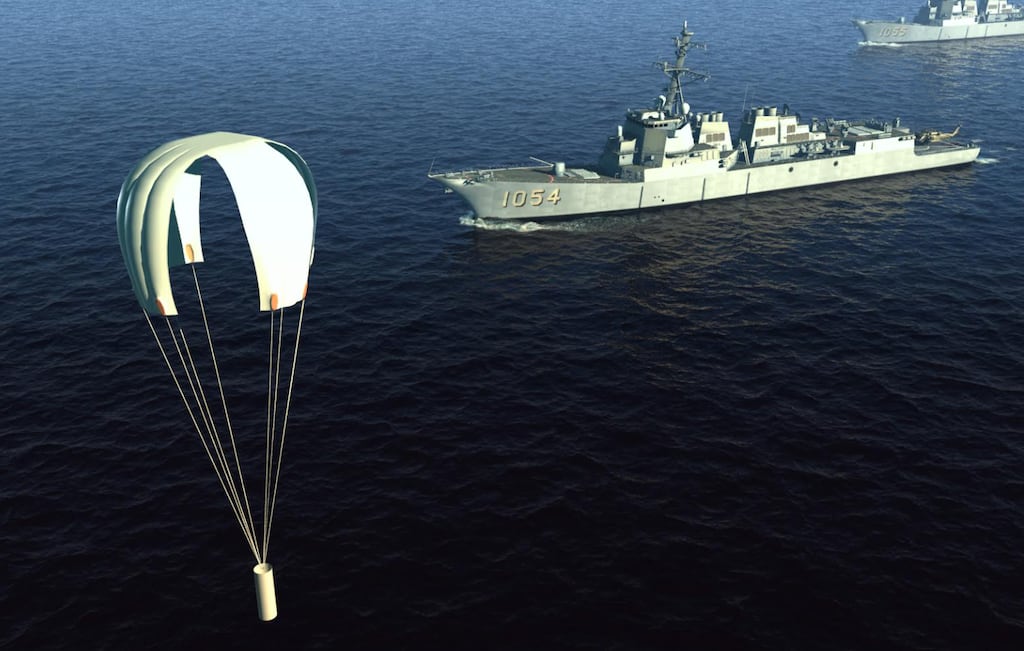
Israel's Rafael has developed C-GEM, a shipborne active off-board decoy for countering anti-ship missiles. (Rafael Advanced Defense Systems)

Tzvi Marmor, EVP and General Manager of RAFAEL's Land and Naval Systems Division: "We are proud to lead this partnership and are honored by the trust that has been placed in us by awarding us this significant contract. We are committed to delivering cutting-edge, combat-proven electronic warfare solutions that enhance naval operational capabilities. With decades of operational experience and a deep understanding of the evolving threats in the maritime domain, RAFAEL is dedicated to providing reliable and innovative EW systems that ensure mission success and safeguard our allies at sea."

Oren Sabag, General Manager of Elbit Systems ISTAR & EW: "This award adds to the many contracts we have secured in recent years for EW self-protection solutions across the naval and air domains, highlighting our advanced and proven technologies. The modern battlefield demands innovative and effective EW self-protection solutions, and we are proud to deliver these advanced systems that enhance the effectiveness and self-protection of forces."


THIS PAGE WAS POSTED BY SPUTNIK ONE OF THE SPUTNIKS ORBIT BLOG