
Analysis | A New Era at Sea: Autonomous Vessel Conducts First Combat Pilot Rescue
The rescue was carried out as part of an operation by Task Force 59, an innovative U.S. Navy unit established to integrate unmanned systems and artificial intelligence into maritime operational activities
By Yotam Gutman, Isrealdefense.co.il, 14/06/2026
https://www.israeldefense.co.il/en/node/69355
_0.jpg)
For decades, combat search and rescue missions were considered one of the most dangerous fields in the military domain. Rescue helicopters, commando forces, escort aircraft, and medical teams operated under fire to save pilots or soldiers who had fallen in enemy territory or crashed into the sea during routine or operational activity. But this week, a historic moment was recorded: for the first time in the world, an unmanned surface vessel (USV) carried out an actual extraction of military personnel under combat conditions.
The incident took place near the Strait of Hormuz, one of the most tense regions in the world from a security perspective. An American Apache helicopter crashed during operational activity, and two crew members remained in the water for about two hours. Instead of sending a manned vessel into the dangerous area, the U.S. Navy deployed the Corsair, an autonomous USV developed by Saronic Technologies.
The Corsair is a vessel approximately 7 meters long, capable of moving at high speed and operating over hundreds of nautical miles without a human crew on board. It is equipped with autonomous navigation systems, cameras, sensors, and artificial intelligence that enable it to operate even in complex maritime environments. During the mission, it reached the crash site, located the crew members, retrieved them from the water, and transported them to an extraction point where a rescue helicopter was waiting.
The crew members were lifted into the helicopter and flown from there to an undisclosed destination – either a U.S. Navy vessel or an American base in the region. It is possible that the use of a USV was intended to reduce the risk to additional aircraft or vessels during the rescue mission, and if so, it fulfilled its role precisely, demonstrating one of the most significant capabilities of remotely operated systems.
The rescue was carried out as part of the U.S. Navy’s Task Force 59, an innovative unit established to integrate unmanned systems and artificial intelligence into maritime operations. The force operates primarily in the Middle East and focuses on deploying fleets of autonomous vessels, drones, and sensors for surveillance, intelligence, and maritime defense. In recent years, Task Force 59 has become the Navy’s main operational laboratory for maritime autonomy.
But this rescue is only the beginning. In recent years, the U.S. Navy has invested billions of dollars in developing a new generation of USVs – some small and fast, others the size of actual warships. In May, Saronic Technologies unveiled the Marauder, a new medium-sized USV designed for long-range missions, convoy escort, electronic warfare, and even weapons deployment. At the same time, the Navy is exploring the operation of a hybrid fleet concept in which unmanned vessels operate alongside manned ships.
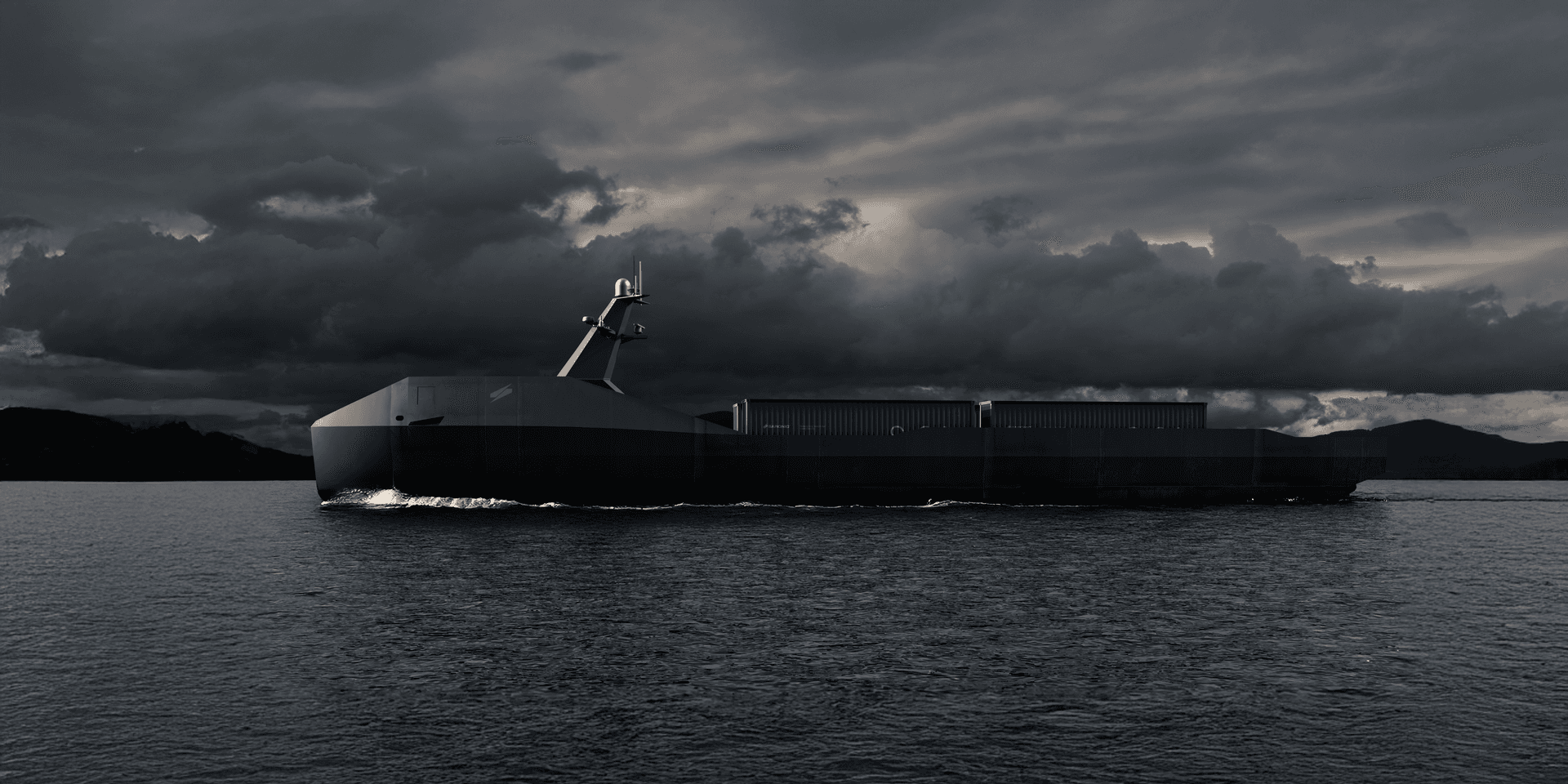 |
| The Marauder is a 180' Autonomous Surface Vessel (ASV) designed to host and deliver significant capabilities across complex maritime environments. Capable of carrying up to 150MT in four 40' ISO containers, eight 20' ISO containers, or other modular payload configurations, Marauder is Saronic's premier platform for logistics and at-sea payload deployment. |
According to U.S. Navy assessments, within a few years dozens or even hundreds of autonomous vessels will be deployed in regions such as the Persian Gulf, the South China Sea, and the Mediterranean. The key advantage is clear: a USV can be sent into a dangerous area without risking human life, while enabling continuous and more cost-efficient operations than manned vessels.
The incident in the Strait of Hormuz illustrates how warfare is undergoing a transformation. If in the past unmanned systems were mainly used for intelligence gathering or strikes, they are now beginning to take part in missions once considered entirely human, including rescue under fire.
The moment a robotic vessel rescued American pilots from the sea may be remembered as the point at which USVs ceased to be experimental technology, and became an integral part of the modern battlefield.


No comments:
Post a Comment