
www.techexplorist.com/astronomers-find-lightest-double-neutron-star-system-seen/105674/
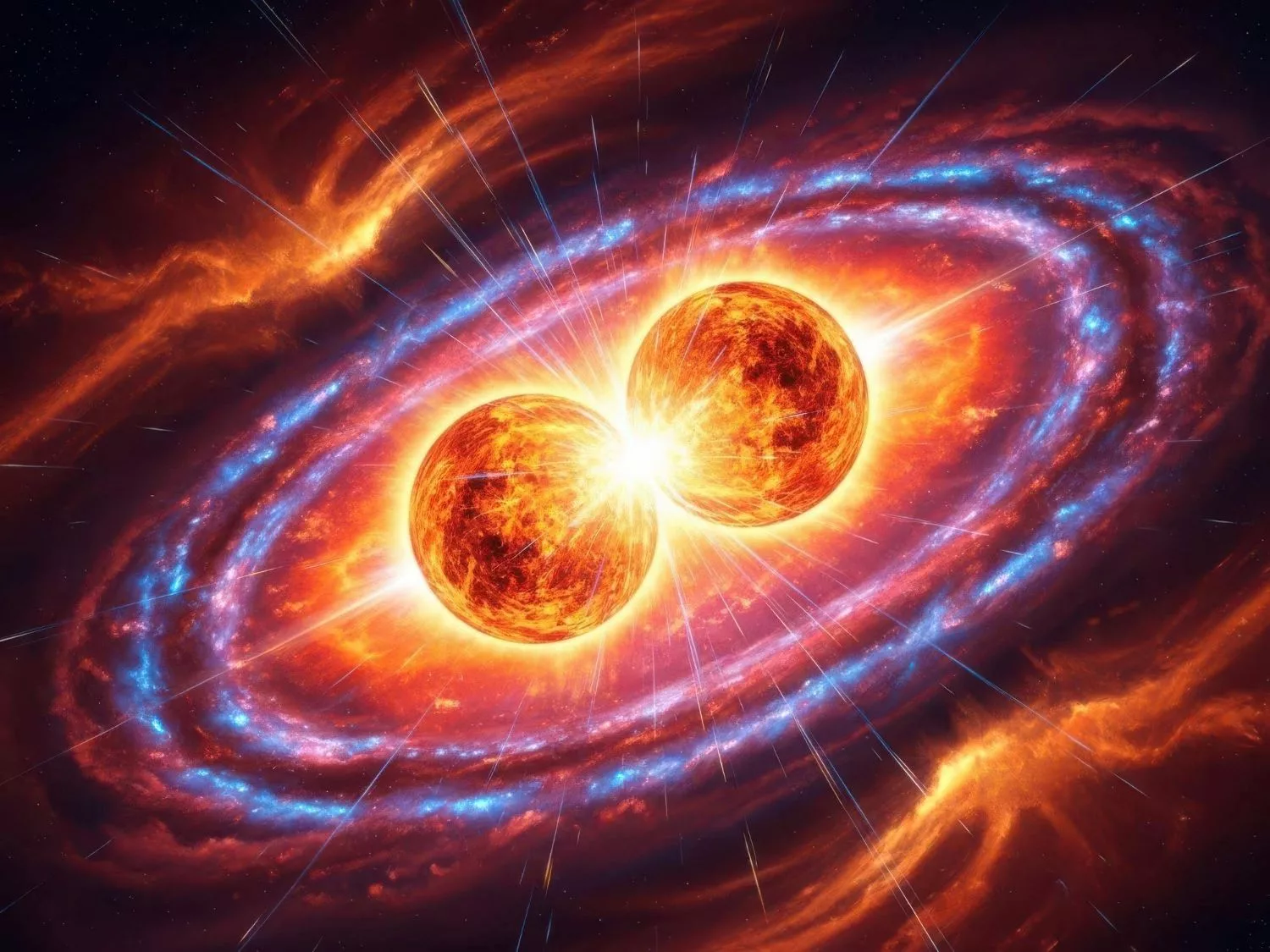
Astronomers have just unveiled a remarkable discovery: a compact double neutron star (DNS) system unlike any seen before. The pulsar PSR J1856–0039, detected with China’s Five-hundred-meter Aperture Spherical Radio Telescope (FAST), is rewriting what we know about the extremes of stellar physics and gravitational theory.
Neutron stars are the extremely compact remnants left behind after the explosive demise of very large (massive) stars as supernovae. As long as these neutron stars are in a binary system with each other, they provide scientists with a unique opportunity to test Albert Einstein’s Theory of General Relativity and observe the catastrophic collisions that result in the generation of gravitational waves.
PSR J1856-0039 represents a unique example of a double neutron star (DNS) system. The pulsar component of PSR J1856-0039 rotates once every 23.4 milliseconds, which places it in the category of “mildly recycled.” The pulsar component of PSR J1856-0039 rotates once every 23.4 milliseconds, which places it in the category of “mildly recycled.”
Remarkably, this is the least massive of all the DNS discovered to date, with a total mass of 2.49 solar masses. In addition, the companion neutron star has a mass of 1.185 solar masses and is among the least massive neutron stars ever detected.
Determining the birth population of double neutron stars
Using high-precision measurements of PSR J1856–0039’s pulse arrival times, researchers were able to measure many of the relativistic effects that exist in this system. For instance, the orbital decay of this system is occurring at a rate of approximately 1.28 x 10^-12 seconds/second, which is consistent with the predicted decay due to gravitational wave emission.
The periastron precession, which is the movement of the point on the orbit that comes closest to the center, is occurring at 17.6 degrees per year; this is a very typical effect seen in relativity. The Einstein delay, a slight delay in the pulsar signals, provides evidence of how space-time has been warped.
Additionally, it appears as though the measured rate of orbital decay agrees with the prediction made by general relativity with an error of less than one percent, providing some of the strongest support for Einstein’s theory.
This pair of neutron stars is expected to collide and combine within 82 million years. Depending on whether the system slows down rapidly enough during the collision process to remain stable as a single neutron star, or if the system collapses into a black hole, these collisions are the power sources for several of the most energetic events in the universe, such as short gamma-ray bursts, and the production of heavy elements such as gold and platinum.
Colliding neutron stars could shed light on universal mysteries
Discoveries such as PSR J1856-0039 offer a valuable opportunity to test relativity in a real-world setting, pushing the limits of our knowledge of gravity. Additionally, such discoveries help researchers refine their models of gravitational-wave signals, which are required for detectors such as LIGO and Virgo.
These systems offer insights into the formation and evolution of neutron stars. They also reveal why some are unusually light. They also reveal the ultimate fate of compact pairs, whether they survive as stable neutron stars or collapse into black holes.
Long-term observations of PSR J1856-0039 may also test the validity of Lense-Thirring Precession, a very subtle phenomenon in which the rotation of a body creates a “dragging” effect on its surrounding spacetime. Detection of such an effect would provide another great validation of Einstein’s Theory of Relativity.
Journal Reference:
- Z. L. Yang et al., Relativistic Effects of PSR J1856–0039 Double Neutron Star System in a 2.36-Hour Compact Orbit, Physical Review Letters (2026). DOI: 10.1103/hmjp-htd1

No comments:
Post a Comment