https://www.popularmechanics.com/science/a73939479/mars-aliens-nuclear-theory/

So why haven’t we seen evidence of it?
- John Brandenburg—a plasma physicist at an aerospace development company—argues that there was an alien civilization on Mars.
- He cites data from NASA’s Curiosity rover, claiming that xenon levels on the Red Planet indicate a nuclear disaster wiped the population out.
- Brandenburg’s theory poses striking questions in the broader search for extra terrestrial life; namely: How would we know if another civilization already came and went?
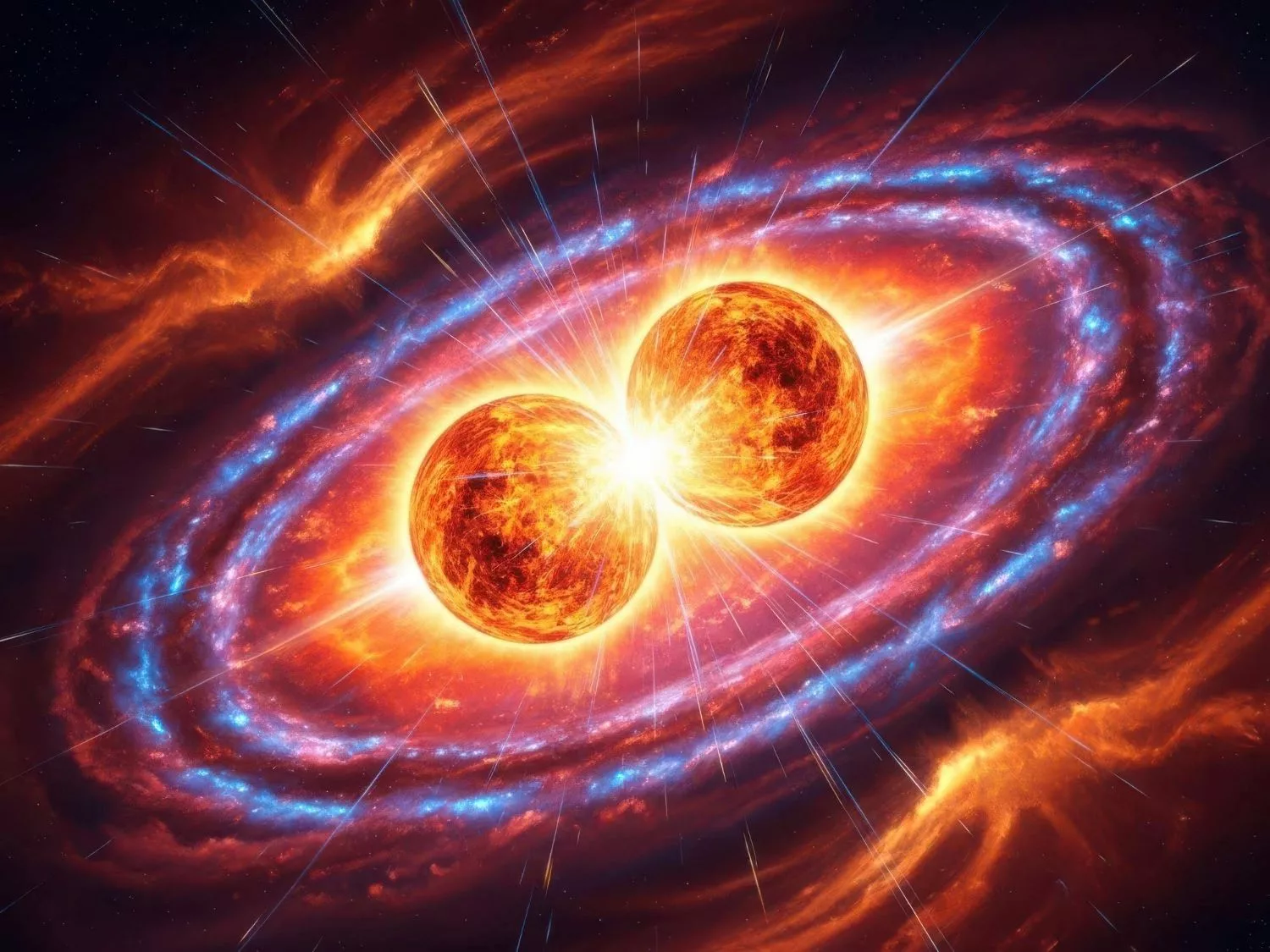
The aliens were next door, and somebody killed them. That’s the story plasma physicist John Brandenburg, PhD, tells about Mars. His theory suggests that a civilization built monuments on our neighboring planet before nuclear explosions wiped it out. He also argues that humanity must investigate—because we could face the same danger.
In his 2014 Journal of Cosmology paper, Brandenburg presents Martian chemistry and supposed ruins as evidence of a planetary massacre. Both the journal’s editorial standards and Brandenburg’s theory itself have drawn criticism from other scientists. But the decisive question is whether his proposed explanation fits the measurements he provides. Dismissing the alleged attack leaves another question worth asking. If a civilization had flourished somewhere in our solar system and disappeared billions of years before we started looking, what would remain? Could we send a rover across its former home without ever knowing what had been there?
Brandenburg—who did not respond to requests for an interview—argues that we’ve already found evidence of nuclear explosions in Mars’s atmosphere, focusing particularly on the Red Planet’s xenon measurements. Xenon comes in several forms, called isotopes, each with different numbers of neutrons in their atoms. Timothy Swindle, PhD—a professor emeritus and director emeritus at the University of Arizona’s Lunar and Planetary Laboratory—explains that radioactive decay and reactions caused by radiation can add to that mix. If an explosion produced the xenon on Mars, scientists would expect to find those isotopes in certain proportions.
Some of the evidence Brandenburg referenced comes from pieces of Mars that landed here on Earth. NASA’s Curiosity, a car-sized rover that landed on Mars in August 2012, gave scientists a way to check these meteorite findings against the atmosphere of our celestial neighbor itself.
“My battery is low and it’s getting dark.” In 2019, those final words shook the internet when NASA announced that Curiosity’s predecessor—Opportunity—shut down after more than a decade of exploring Mars. But was the rover’s last transmission as poetic as this heart-wrenching line seems to be? Sadly, no. The quote is taken out of context; in actuality, it’s a Tweet from a science journalist who was summarizing accounts of Opportunity’s last moments. What really occurred was a cocktail of unfortunate circumstances. Data from Opportunity told the team that it was low on battery, and a blinding sandstorm was incoming. Scientists instructed Opportunity to hunker down through the storm and conserve energy. After the weather cleared, they were unable to make contact with the rover again. But perhaps the internet’s favorite probe—the one that “lived” for years in isolation so that it could send information back to Earth—deserves the cinematic ending we imagine for it.
The “spacecraft measurements by Curiosity match those in one class of Martian meteorites quite closely,” Swindle says, apart from small differences in isotopes Brandenburg doesn’t discuss. Older rocks, on the other hand, tell a somewhat different story. Allan Hills 84001, a Martian meteorite found in Antarctica in 1984, contains a slightly different xenon mix, Swindle says, “suggesting that the atmosphere may have changed over billions of years.” And when asked if the xenon measurements support Brandenburg’s explosion claim, Swindle disagrees. “In a word, no,” he says.
Brandenburg focuses on the unusually high proportion of xenon-129 in Mars’s atmosphere. A nuclear explosion could produce it, but its presence alone hardly clinches the case. Swindle says the problem becomes clearer when you look at how Brandenburg tries to recreate the full Martian xenon pattern. In the 2014 paper, Brandenburg starts with the isotope mix found in Earth’s atmosphere, then calculates what would happen if xenon measured after nuclear tests were added to it. He adds just enough of the nuclear-test xenon to bring xenon-129 up to the level measured on Mars. That isotope is bound to match because Brandenburg used it to set the proportions.
Several other isotopes also appear to line up. But Swindle points out that fission, the splitting of atomic nuclei that causes a nuclear explosion, doesn’t produce four of them. Their agreement says only that Mars’s starting xenon looks similar to Earth’s, not that an explosion occurred. The meaningful test is whether the mixture also matches the other isotopes that fission does produce. It doesn’t. The fit gets progressively worse among the heavier isotopes. At xenon-136, Swindle says Brandenburg’s plotted mixture contains 50 percent more than the amount measured on Mars. “Normally, if you can’t match it to within a few percent, it’s not a good match at all,” he says.
Swindle also identifies an internal contradiction. Brandenburg invokes a shift toward lighter fission products to explain xenon-129. Swindle says that shift should produce progressively less xenon as you move from isotope 131 to 132, 134, and 136. But Brandenburg’s calculated mixture already predicts too much of those heavier isotopes compared to the amounts measured in Mars’s atmosphere, and the gap gets larger with each one. “The mismatch is in the opposite direction,” Swindle says.
There’s another possible source of xenon-129. Radioactive iodine-129 decays into it naturally, although that explanation brings its own timing problem. Half of the iodine-129 decays every 15 million years, so most of it would have disappeared early in Mars’s history. The difficult part, Swindle says, is coming up with a timeline in which Mars released so much decay-produced xenon-129 after the planet had already lost most of its atmosphere.
Here, it’s important to distinguish between Brandenburg’s 2014 and 2023 papers. In the more recent work, he uses different xenon comparisons. The paper was published by Scientific Research Publishing—an organization included on librarian Jeffrey Beall’s archived list of potentially predatory resources. Swindle’s criticism addresses the comparisons in the 2014 paper, not the newer analysis.
Brandenburg also sees another clue supporting his explosion theory in the ratio of argon-40 to argon-26 on Mars, which is higher than it is on Earth. He argues that Mars must have received an unusual dose of argon-40. However, Swindle says that considering the actual amounts of these isotopes paints a different picture. Per gram of planet, Mars’s atmosphere has only about 2 percent as much argon-36 as Earth’s, and it also has less argon-40. In other words, the ratio is high because Mars has so little argon-36, not because it has an unexplained surplus of argon-40. All things considered, Swindle would not say an ancient explosion was impossible. He calls the isotopic evidence “very, very weak.”
Outside scientists have other ideas about what may have happened to Mars’s xenon. In their 2024 Science Advances study, “Impact sculpting of the early martian atmosphere,” Oliver Shorttle and his colleagues used laser-driven shocks and computer models to study the effects of objects colliding with early Mars. They found that repeated collisions during the solar system’s first 200 to 300 million years of existence could’ve knocked xenon out of the planet’s atmosphere. The lighter xenon isotopes escaped more easily than the heavier ones, changing the balance of what remained. That could explain much of the pattern scientists measure today, although the study doesn’t explain the extra xenon-129 at the center of Brandenburg’s argument.
What we do know is that Mars once had rivers and lakes, and researchers have found ways to explain how they dried out—without nuclear devastation. Measurements from NASA’s MAVEN spacecraft show how solar wind and radiation stripped away atmospheric gas on Mars. Some of the water went into the rocks and may still be there, bound up in minerals in the planet’s red crust. This put the estimated amount of water at 30 to 99 percent of the planet’s original conditions, according to a 2021 study published in Science. Having water makes Mars a place worth searching for life, but it doesn’t tell us if anything lived there.
Any microbes living on Mars might’ve had somewhere to go as the surface dried out, perhaps underground, where conditions could have allowed them to survive. But Brandenburg is asking us to imagine inhabitants who built things, which is a much bigger leap. “We see zero evidence of ancient technological species in the Solar System,” says Jason Wright, PhD, a Pennsylvania State University astronomy and astrophysics professor and director of the school’s Extraterrestrial Intelligence Center.
Wright points to Gavin Schmidt and Adam Frank’s 2018 Silurian Hypothesis paper, which asks how an earlier industrial civilization might register in Earth’s geological record. (Though it doesn’t make an argument that one existed.) Wright says we might have only a few million years before the evidence becomes too hard to recognize as something a civilization left behind. The paper also considers chemical signatures that might outlast recognizable artifacts.
On Mars, Wright imagines a rover discovering an unmistakably technological device buried in sand. However, erosion complicates its survival. “Many artifacts that we, or our ancestors, considered to be durable may not persist for million-year timescales,” says Jacob Haqq-Misra, PhD, an astrobiologist and senior research investigator at Blue Marble Space, a nonprofit research institute based in Seattle.
Haqq-Misra suggests machine learning could help search high-resolution Martian imagery for anomalies. Recognition would require investigation with experts in natural planetary processes. “We should investigate all anomalies, but we should not assume all anomalies are evidence of aliens,” he says. A strange feature could eventually reveal an ordinary explanation or something scientifically new. The investigation has value even when the anomaly turns out to have a natural cause.
Brandenburg’s 2014 paper turns his alleged catastrophe into a warning about hostile civilizations. He proposes human exploration to help humanity avoid a similar fate. But Wright rejects the premise that cosmic silence necessarily requires an explanation: “The Fermi paradox isn’t really a problem that demands an answer.” Interstellar travel is difficult, and we have done limited searching.
Likewise, the Great Filter—a proposed obstacle to life’s advancement—need not exist. Wright cautions that nuclear war would not necessarily eliminate all human life, much less establish a universal fate. “We regularly project our own existential fears onto hypothetical aliens,” he says.
Haqq-Misra offers a possibility without a massacre: “Another civilization could have even visited the solar system long ago, with few if any traces left behind.” Civilizations might miss one another in space and time.
Understanding what alien traces could look like is worthwhile. However, before we treat Mars as a warning, the isotope mix predicted by Brandenburg’s proposed explosion needs to match what we actually found there. As is the case with all of our search for extraterrestrial life thus far, the question still remains: Are we—and have we always been—truly alone in the cosmos?