Tuesday, December 3, 2019

Defense - North Korea may deploy ‘super-large’ rocket launcher soon

North Korea may deploy ‘super-large’ rocket launcher soon


December 2, 2019

This Thursday, Oct. 31, 2019, photo provided by the North Korean government shows what it says is a test firing of a "super-large" rocket launcher by the Academy of Defense Science in North Korea. (Korean Central News Agency/Korea News Service via AP)


SEOUL, South Korea — North Korea said Friday the latest test-firing of its “super-large” multiple rocket launcher was a final review of the weapon’s combat application, a suggestion that the country is preparing to deploy the new weapons system soon.
South Korea’s military earlier said North Korea fired two projectiles, likely from the same “super-large” rocket launcher, on Thursday. It expressed “strong regret” over the launches and urged North Korea to stop escalating tensions.
On Friday, the North’s Korean Central News Agency confirmed the launches were made with the presence of leader Kim Jong Un and other top officials.
“The volley test-fire aimed to finally examine the combat application of the super-large multiple launch rocket system proved the military and technical superiority of the weapon system and its firm reliability,” KCNA said.
It said Kim expressed “great satisfaction” over the results of the test-firing.
Analyst Kim Dong-yub at Seoul’s Institute for Far Eastern Studies said North Korea appears to be entering the stage of mass-producing and deploying the rocket launcher. He wrote on Facebook that the weapons system may already have been deployed.
Thursday’s firing was the fourth test-launch of the rocket launcher since August.
Some experts say the flight distance and trajectory of projectiles fired from the launcher show they are virtually missiles or missile-classed weapons. The projectiles fired Thursday flew about 380 kilometers (235 miles) at a maximum altitude of 97 kilometers (60 miles), according to South Korea’s Joint Chiefs of Staff.
Japanese Prime Minister Shinzo Abe on Thursday called the projectiles ballistic missiles.
North Korea has fired other new weapons in recent months in what some experts say is an attempt to wrest concessions from the United States in stalled nuclear diplomacy while upgrading its military capabilities.
A U.S.-led diplomacy aimed at persuading North Korea to scrap its nuclear program in return for political and economic benefits remains largely stalemated since the February collapse of a summit between Kim and President Donald Trump in Vietnam.
Most of the North Korean weapons tested since the Vietnam summit were short-range. Attention is now on whether North Korea resumes nuclear and long-range missile tests if Trump fails to meet a year-end deadline set by Kim for Washington to offer new proposals to salvage the negotiations.
Trump considers North Korea’s self-imposed moratorium on nuclear and intercontinental ballistic missile tests a major foreign policy win.

Please recommend this page & follow the Sputniks Orbit 

Medical Science - Doctors pump new life into dead donor heart in US first

Doctors pump new life into dead donor heart in US first


By Hannah Sparks,  New York Post,  December 2,  2019

Duke Heart Center/Twitter

It’s alive!
Doctors at Duke University have managed to re-animate the heart of a deceased donor by using an artificial circulatory mechanism that continues pumping blood through the organ while it’s outside the body.
Once revived, the organ was immediately transplanted into a patient in need of a healthy heart, which was reportedly a success. Experts are calling this a major step toward reducing the current donor organ shortage.
To bring the heart back to life, physicians used a cutting-edge technique called warm perfusion that circulates blood, oxygen and electrolytes through the disembodied heart, prompting it to beat once again. The method was first used at the Royal Papworth Hospital in the UK in 2015.
An attending doctor filmed the remarkable (and graphic) process, and shared the footage on Twitter.
“1ST ADULT DCD HEART IN THE USA!!!! This is the donor pool actively expanding!,” wrote Jacob Niall Schroder, director of the heart transplantation program at Duke University Medical Center.
Heart tissue usually begins to deteriorate even before a patient has been declared dead due to low oxygen levels produced by the slowing heart. By the time death is proclaimed, the heart is already too damaged for reuse.
That’s why, before now, vital organs — meaning those necessary to life — such as the heart had to be taken from a donor who is still alive, but has been declared medically brain dead.
For the time between hosts, the heart is typically kept cold to prevent decay, and remains viable for no more than six hours before it must be placed in a new body.
It may be a first in the US, but Royal Papworth has performed heart transplants this way — what they call donation after cardiac death (DCD) — for 75 patients since their first trial four years ago, according to Schroder. In a tweet, he estimated that this new technique could broaden the donor pool by “as much as 30%.”
He told the Daily Mail, “This is the first time in the US, which is a huge deal because transplant need and volume is so high, but a few centers around the world, including Papworth, have pioneered this effort.”
Please recommend this page & follow the Sputniks Orbit 

Monday, December 2, 2019

Defense - No surprises as carrier enters 6th Fleet’s area of operations

No surprises as carrier enters 6th Fleet’s area of operations


By Navy Times Staff, December 1,  2019

An F/A-18F Super Hornet from the "Red Rippers" of Strike Fighter Squadron 11 takes off from the flight deck of the aircraft carrier Harry S. Truman on Sunday in the Atlantic Ocean. (Mass Communication Specialist 3rd Class Victoria Sutton/Navy)

In a surprise to no one, the Navy finally announced on Sunday that the aircraft carrier Harry S. Truman and its strike group entered the 6th Fleet’s area of operations.
“We are ready to continue our steadfast commitment to our allies and partners in U.S. 6th Fleet,” said strike group commander Rear Adm. Andrew J. Loiselle in a prepared statement released Sunday. “These vital sea lanes must remain open for global commerce and prosperity, and nothing in the world is able to foster regional security like a carrier strike group.”
After being sidelined for three months while work crews repaired power distribution panels damaged by intermittent electrical arcing, on Nov. 12 U.S. Fleet Forces Command declared Truman was fixed and ready to go to sea.
It departed Norfolk six days later to “reintegrate the carrier strike group” and prep the air wing, flattop and their crews for an operational deployment, the Navy said back then.
A week after exiting Norfolk, however, Truman conducted a replenishment-at-sea with the fleet fast combat support ship Supply and, as the days unfurled, it became clear that the carrier would keep heading east across the Atlantic Ocean until it reached the 6th Fleet’s area of operations.
The Harry S. Truman Carrier Strike Group includes Strike Fighter Squadron 11 “Red Rippers;” VFA-81 “Sunliners;” VFA-136 “Knighthawks;” VFA-211 “Fighting Checkmates;” Electronic Attack Squadron 137 “Rooks;” Carrier Airborne Early Warning Squadron 126 “Seahawks;” Helicopter Maritime Strike Squadron 72 “Proud Warriors;” Helicopter Sea Combat Squadron 11 “Dragon Slayers;” and a detachment from Fleet Logistics Support Squadron 40 “Rawhides.”
News that Truman has crossed the Atlantic dividing line into 6th Fleet’s AO might warm the hearts of family members of sailors assigned to sister Nimitz-class carrier Abraham Lincoln and the guided-missile cruiser Leyte Gulf, but the Pentagon hasn’t announced when or if they’ll be replaced by the eastbound carrier strike group.
Lincoln left Naval Station Norfolk April 1 for an around-the-world deployment that’s supposed to end in a homeport shift to Naval Air Station North Island near San Diego.
Within weeks of leaving, however, it was rushed to the Middle East amid heightened tensions with Iran’s regime and then had to delay its journey to California due to Truman’s electrical woes.
Please recommend this page & follow the Sputniks Orbit 

SPACE - S0 - 20191202 - Pole Tide Volcanoes, Earth and Cosmic Plasma

SPACE - S0 - 20191202 - Pole Tide Volcanoes, Earth and Cosmic Plasma

Good Morning, Observers!


A number of small and disorganized coronal holes are at center longitude right now, a bit of a collapse of the somewhat larger hole mentioned yesterday. Solar winds dropped steadily from yesterday to around 330 KPS, and the KP Index has stayed in the calm range. The lithosphere was a bit more active, however, with a Mag 6.0 along the Aleutian Island chain, about midway between Alaska and Russia.

Please Recommend this page and be sure to follow the Sputnik's Orbit 


AND WHILST YOU ARE HERE BE SURE TO FOLLOW AND RECOMMEND THE COCONUT WHISPERER https://disqus.com/home/forum/the-coconut-whisperer/

Animal Science - Study tries to understand why sharks return to the warm waters of Israel

Study tries to understand why sharks return to the warm waters of Israel 

Sharks gather at the shores of Israel, the researchers wish to know why.

By Omri Ron,  the Jerusalem Post , December 2, 2019
https://www.jpost.com/Israel-News/Study-tries-to-understand-why-sharks-return-to-the-warm-waters-of-Israel-609587

Dusky Shark swiming in the sea (photo credit: HAGAI NETIV/MORRIS KHAN STATION FOR SEA EXPLORATION IN HAIFA UNIVERSITY)

A team of researchers from the Morris Kahn Marine Research Station at Haifa University have returned to the shores of Hadera for the fifth year in a row, in what has become an annual shark-tracking exercise. 

Their research has already shown that the sharks return to their point of origin near the "Rabin Lights" power station on the shores of Hadera. "Our first tag was a dusky shark about 2.5 m. in length who we called 'Hamsa' [a symbol resembling an outstretched hand]. We called her Hamsa because this is the fifth season we are conducting this research as a part of long term research into Mediterranean sea predators, and sharks are a very important part of that system," said Dr. Aviad Sheinin, the head of apex predator research at the research station. 

"We can identify repetition in these sharks' behavior, as they return each year to the shores of Hadera. This year, we will focus on understanding that phenomenon using various technological means." 

The gathering of these sharks on the shores of Israel is a unique phenomenon not seen in other, similar places on the planet. Moreover, the researchers found that the first sharks to arrive at Hadera are dusky females, of which there is very little information on in the Mediterranean Sea region. 

The females are later joined by male sandbar sharks, which are an endangered species in the area. The returning females allow researchers to continue their studies on these predators, of which little is understood. 

"The number of sharks in the Mediterranean Sea is decreasing due to over-fishing of their food, or the fishing of the sharks themselves unintentionally," Dr. Sheinin concluded. "Part of the research is focused on trying to reduce their unintentional grouping, in a bid to help preserve them."

Please recommend this page & follow the Sputniks Orbit 

Agricultural Science - Cosmic Crisp apple

Cosmic Crisp apple: New variety 'keeps in the fridge for up to a year'

The new variety of the fruit took more than two decades to develop and allegedly lasts for up to a year in the fridge.


The Cosmic Crisp is a new variety of apple which is now on sale in the US. Pics: Cosmic Crisp

A new apple is being launched today - and it has nothing to do with mobile phones, computers or watches.
The Cosmic Crisp, now on sale in the US, is a new variety of the fruit which took more than two decades to develop and allegedly lasts for up to a year in the fridge.
The apple is called Cosmic Crisp because of the bright yellowish dots on its skin, which look like distant stars.
The apple is called Cosmic Crisp because of the bright yellowish dots on its skin, which look like distant stars
The launch of the apple cost $10.5m (£8.1m).
Farmers in the state of Washington - which produces two-thirds of the United States' apples - have the exclusive right to grow the variety for the next 10 years.
The trees take three years to produce a crop.
Aaron Clark of Yakima, whose family owns several orchards in central Washington and has planted 80 acres of the variety, said: "I've never seen an apple prettier in the orchard than these things are."
Toni Lynn Adams, spokeswoman for the Washington Apple Commission, which markets apples internationally, said: "A new apple brings excitement.
"A new variety can reinvigorate a market and industry."
The trees take three years to produce a crop
Work on developing the variety began in 1997.
Kate Evans, who co-led the apple's breeding programme at Washington State University, said: "It's ultra-crisp, very juicy and has a good balance of sweetness and tartness."
She said the fruit "maintains excellent eating quality in refrigerated storage - easily for 10 to 12 months".
"The goal, in my opinion, is to get more consumers eating apples," she said.
"Ultimately that is the goal of any plant breeder."

Please recommend this page & follow the Sputniks Orbit 

Sunday, December 1, 2019

Technology - Israeli start-up turns smartphone camera into a medical check-up

Israeli start-up turns smartphone camera into a medical check-up

When was the last time you had five or even 50 blood pressure tests every day? That’s where the future is heading.

By Eytan Halon, the Jerusalem Post,  November 2019

https://www.jpost.com/Israel-News/Israeli-start-up-turns-smartphone-camera-into-a-medical-check-up-609324


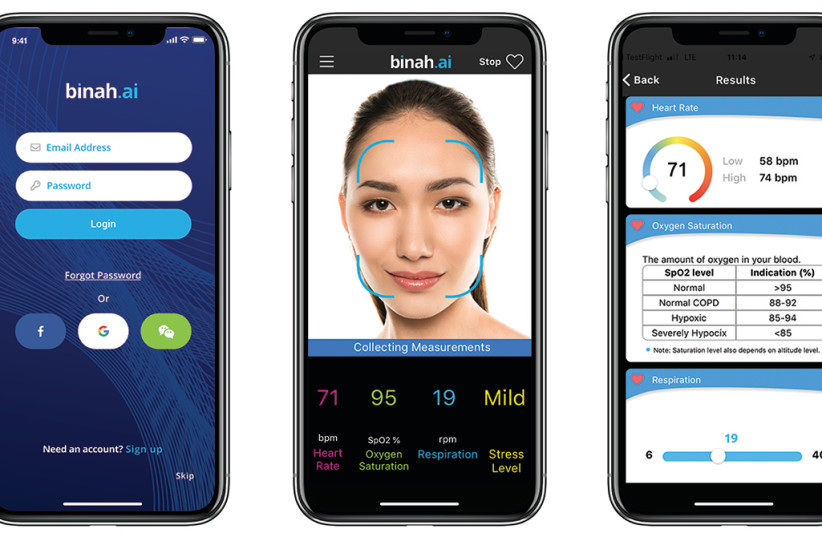
An illustration of Binah.ai's smartphone medical technology (photo credit: BINAH.AI)


Never beyond arm’s reach, the average person spends some three to four hours on their phone daily, checking their devices from just after waking up until just before going to bed. Now Tel Aviv start-up Binah.ai is using all those hours spent on WhatsApp and Facebook to simultaneously run essential medical tests – constantly monitoring the user’s vital signs – via their smartphone camera. 

Leveraging artificial intelligence, signal processing and machine vision capabilities, the company has developed technology to transform smart devices into a vital signs monitoring tool. Analyzing video of a person’s face captured by their smartphone camera, the company’s app monitors an individual’s heart rate within seven seconds, oxygen saturation within 10 seconds, respiration rate within 30 seconds, and heart rate variability within 45 seconds. 

Within 90 seconds, the app can also assess mental stress levels. Binah.ai is now finalizing its ability to monitor hemoglobin levels, and is hoping to soon unveil the capability to measure blood pressure and blood glucose levels. Leading the development of medical technology is co-founder and CEO David Maman, a passionate serial entrepreneur behind more than a dozen start-ups and who completed the sale of the first of four companies when he was just 19 years old. 

His latest company, Hexatier, was acquired by Huawei Technologies in 2016. “This technology can work anywhere because it doesn’t require any hardware. We can work on any smartphone or embedded device, such as a smart mirror,” Maman told The Jerusalem Post. “Every morning when you brush your teeth, we’ll be able to extract your vital signs.” Citing the lack of access to basic healthcare access for many rural communities worldwide, Maman emphasized that “you are able to extract vital signs from anywhere and anyone.

” Using the company’s technology, he said, “We are able to extend the reach of any type of medical service.” The decision to apply the company’s capabilities to the digital health sector followed a partnership between Binah.ai and Japanese automotive manufacturing giant Denso to monitoring the well-being of drivers, and subsequently the occupants of autonomous vehicles. 

“Because we’re analyzing video, the first important part is to extract the face of the person. We were lucky to start with the automotive industry because we needed to make sure that we can run our capabilities inside of a moving car – where people always wear sunglasses, hats or have beards,” said Maman. “We can even monitor a racing driver wearing a helmet by only analyzing the upper half of the cheeks. Once able to detect someone there, we can start tracking the individual.” 

The technology, Maman explained, relies on the simple and long-established optical technique of photoplethysmography, often used in pulse oximeters or “finger clips” to measure blood flow. Rather than shining a light beam into body tissue, the company’s technology analyzes the reflection of light that returns to the camera from the cheeks. 

While Binah.ai hopes to receive FDA clearance in the next few years to roll out its solution into hospitals, the company is currently securing partnerships in the insurance, telemedicine and automotive sectors. Maman also eyes additional use cases, including monitoring pilot health and for battlefield medicine use. Insurers benefit from the technology, he said, by gaining access to long-term evaluations of an applicant’s health, a digital underwriting process for life insurance and for fraud detection when evaluating claims. 

The company is currently working to launch its product with one of the largest insurance firms in Japan. For the growing field of telemedicine, providing remote healthcare for patients, the technology enables the evaluation of vital signs before a video consultation, during a video consultation and a follow-up period. “We have been through four different clinical trials, in India, Japan and Canada, to be able to determine what level of accuracy each and every feature provides. 

I am very happy to say that we support any skin color and support any age from four to 92 years old,” said Maman. “All the technology runs on edge [locally], so there are no privacy issues. We never see any of the inspected people, and never take or store images and videos.” 

The future is not on-demand, Maman says, but rather involves technologies running and monitoring continuously at the back-end. While currently selling its technology to business partners, the company plans to sell directly to consumers in the future. “When was the last time you had five or even 50 blood pressure tests every day? That’s where the future is heading,” said Maman. “It’s not about sending the information to someone, but to alert you when something is wrong. This is the future.”

Please recommend this page & follow the Sputniks Orbit 


Using fungi to search for medical drugs

Date:                      November 26, 2019
Source:                   Hubrecht Institute
Summary:             An enormous library of products derived from more than 10,000 fungi could help us find new drugs. Researchers have set up this library and screened it for biologically active compounds. The researchers identified various known compounds, among which the cholesterol lowering drug lovastatin.

Wild mushrooms (stock image). Credit: © Gerhard / Adobe Stock

An enormous library of products derived from more than ten thousand fungi could help us find new drugs. Researchers from the group of Jeroen den Hertog at the Hubrecht Institute, in collaboration with researchers from the Westerdijk Institute and Utrecht University, have set up this library and screened it for biologically active compounds. 
They tested the biological activity of these fungal products first using zebrafish embryos. The researchers chose to use zebrafish embryos, because it allows the analysis of effects on many cell types at the same time, in a working body, and because zebrafish are physiologically very similar to humans. 
They have already found various known compounds, among which the cholesterol lowering drug lovastatin. The library of fungal products offers ample opportunity to search for new drugs.

Fungal products

We constantly need new therapeutic compounds in the clinic for various reasons, including our increasing age, with corresponding illnesses, and resistance to existing drugs. Fungi are an excellent, but underexplored source of these kinds of compounds, such as lovastatin, a compound produced by the fungus Aspergillus terreus and that is used as a cholesterol lowering drug. 
Jelmer Hoeksma, one of the researchers at the Hubrecht Institute, explains: "Every year new compounds produced by fungi are identified, but so far we have only investigated a very small subset of all existing fungi. This suggests that many more biologically active compounds remain to be discovered."

Ten thousand fungi

The collaboration with the Westerdijk Fungal Biodiversity Institute, home to the largest collection of live fungi in the world, enabled the researchers to set up a large library of filtrates derived from more than ten thousand different fungi. 
A filtrate contains all the products that the fungus excretes. To search for therapeutic compounds, the researchers investigated the effects of this large library of fungal products first on zebrafish embryos. The zebrafish embryos enabled the researchers to study effects on the whole body during development. 
Zebrafish are vertebrates that are physiologically very similar to humans and are often used to test drugs for a variety of disorders. Within a few days these embryos develop most of their organs, making biological activity of the fungal compounds readily detectable. 
In addition, comparison to known drugs may result in identification of new drugs and also point towards the underlying mechanisms of action of these compounds.

Pigmentation

The researchers found 1526 filtrates that contain biologically active compounds with an effect on zebrafish embryos, from which they selected 150 filtrates for further analysis. From these, they isolated 34 known compounds, including the cholesterol lowering drug lovastatin, which was produced by the fungus Resinicium furfuraceum. Until now it was unknown that this fungus produces lovastatin. 
In addition, the researchers found filtrates that affect pigmentation in zebrafish embryos. Other studies have shown that factors involved in pigmentation can also play a crucial role in the development of skin cancer. The researchers are currently isolating the active compounds that cause pigmentation defects in zebrafish embryos from the filtrates.

Tip of the iceberg

This study underlines the large variety of biologically active compounds that are produced by fungi and the importance of further investigating these compounds in the search for new drugs. Hoeksma: "The large library of fungal filtrates that we have set up can also be tested in many other systems, such as models for antibiotic resistance in bacteria and tumor development, making this study only the tip of the iceberg."

Story Source: Materials provided by Hubrecht Institute. Note: Content may be edited for style and length.

Journal Reference:
Jelmer Hoeksma, Tim Misset, Christie Wever, Johan Kemmink, John Kruijtzer, Kees Versluis, Rob M. J. Liskamp, Geert Jan Boons, Albert J. R. Heck, Teun Boekhout, Jeroen den Hertog. A new perspective on fungal metabolites: identification of bioactive compounds from fungi using zebrafish embryogenesis as read-out. Scientific Reports, 2019; 9 (1) DOI: 10.1038/s41598-019-54127-9

Recommend this post and follow Sputniks Orbit

There’s Now an Operational Radio Telescope on the Far Side of the Moon

NOVEMBER 30, 2019 BY MATT WILLIAMS


The Chang’e-4 mission, the fourth installment in the Chinese Lunar Exploration Program, has made some significant achievements since it launched in December of 2018. In January of 2019, the mission lander and its Yutu 2 (Jade Rabbit 2) rover became the first robotic explorers to achieve a soft landing on the far side of the Moon. Around the same time, it became the first mission to grow plants on the Moon (with mixed results).

In the latest development, the Netherlands-China Low Frequency Explorer (NCLE) commenced operations after a year of orbiting the Moon. This instrument was mounted on the Queqiao communications satellite and consists of three 5-meter (16.4 ft) long monopole antennas that are sensitive to radio frequencies in the 80 kHz – 80 MHz range. With this instrument now active, Chang’e-4 has now entered into the next phase of its mission.

The radio observatory is the result of collaboration between the Netherlands Institute for Radio Astronomy (ASTRON) and the China National Space Agency (CNSA). ASTRON has a long history of conducting radio astronomy, which includes the operation of one of the largest radio telescopes in the world – the Westerbork Synthesis Radio Telescope (WSRT), which is also part of the European Very Long Baseline Interferometry Network (EVN).


This series of three photographs was taken during the unfolding of an antenna on the Queqiao satellite. Credit and ©: Marc Klein Wolt/Radboud University

The NCLE is the first observatory built by the Netherlands and China to conduct radio astronomy experiments while orbiting on the far side of the Moon. This location is considered ideal for such experiments since it is removed from any terrestrial radio interference. It is for this reason that Queqiao has had to act as a communications relay with the Chang’e-4 mission since radio signals cannot reach the far side of the Moon directly.

While the NCLE is capable of mounting multiple forms of scientific research, its main purpose is to conduct groundbreaking experiments in radio astronomy. Particularly, the NCLE will gather data in the 21-cm (8.25 inch) emission range, which corresponds with the earliest periods in cosmic history.

These are otherwise known as the Dark Ages and Cosmic Dawn, which have previously been inaccessible to astronomers. By examining light from the earliest periods of the Universe, astronomers will finally be able to answer some of the most enduring questions about the Universe. These include when the first stars and galaxies formed, as well as the influence of Dark Matter and Dark Energy on cosmic evolution.

Until now, the Queqiao satellite was primarily a communications relay between the lander and rover and mission controllers on Earth. But with the primary goals of the Chang’e-4 mission now achieved, the China National Space Agency (CNSA) has entered into the next phase of operations, which is to operate a radio observatory on the far side of the Moon.

Evolution of the Universe, including CMB, the Dark Ages, and the Afterglow Light Pattern. Credit: NASA/WMAP/Wikipedia Commons/Cherkash

As Marc Klein Wolt, the Managing Director of the Radboud Radio Lab and leader of the Dutch team, expressed:

“Our contribution to the Chinese Chang’e 4 mission has now increased tremendously. We have the opportunity to perform our observations during the fourteen-day-long night behind the moon, which is much longer than was originally the idea. The moon night is ours, now.“

The unfolding of the antennas is the culmination of three years of hard work and the demonstration of this technology is expected to pave the way for new opportunities for radio instruments in space. In addition to scientists with ASTRON and the CNSA, there is no shortage of people around the world who are eagerly awaiting the NCLE’s first radio measurements.

Professor Heino Falcke, the chair of astrophysics and radio astronomy at Radboud University, is also the scientific leader of the Dutch-Chinese radio telescope. As he explained:

“We are finally in business and have a radio-astronomy instrument of Dutch origin in space. The team has worked incredibly hard, and the first data will reveal how well the instrument truly performs.”


The deployment of the instrument was meant to happen sooner and the year-long wait behind the Moon is believed to have had an effect on the antennas. Initially, the antennas unfolded smoothly but the progress became increasingly sluggish as time went on. As a result, the team decided to collect data first from the partially-deployed antennas first and may decide to unfold them further later.

At their current, shorter deployment, the instrument is sensitive to signals from roughly 13 billion years ago – aka. about 800 million years after the Big Bang. Once the antennas are unfolded to their full length, they will be able to capture signals from just after the Big Bang. This will allow astronomers to see the first stars being born and star clusters coming together to form the very first galaxies.

The first light in the Universe and the answers to some of the most profound questions will finally be accessible!


Recommend this post and follow Sputniks Orbit

SPACE - S0 - 20191201 - Solar Risk, Weather Warnings, Torus Jet Revealed

SPACE - S0 - 20191201 - Solar Risk, Weather Warnings, Torus Jet Revealed

Good Morning, Observers!


Solar winds calmed down from yesterday's high of 400 KPS, now around 360 KPS. Low geomagnetic disruption as well, with KP Indexes in the KP-0, 1 and 2 range (latest reading was KP-0). There's a new coronal hole developing right along the equator, should hit the midpoint in 24-36 hours. A few scattered bright spots across the solar surface, but again there's no sunspot activity beneath them. A Mag 5.3 along the Chagos Archipelago, a  Mag 5.5 at blot echo depth South of the Fiji Islands and another Mag 5.3 off Raoul Island in New Zealand, again at blot echo depth.

Please Recommend this page and be sure to follow the Sputnik's Orbit 


AND WHILST YOU ARE HERE BE SURE TO FOLLOW AND RECOMMEND THE COCONUT WHISPERER https://disqus.com/home/forum/the-coconut-whisperer/