Friday, March 22, 2024

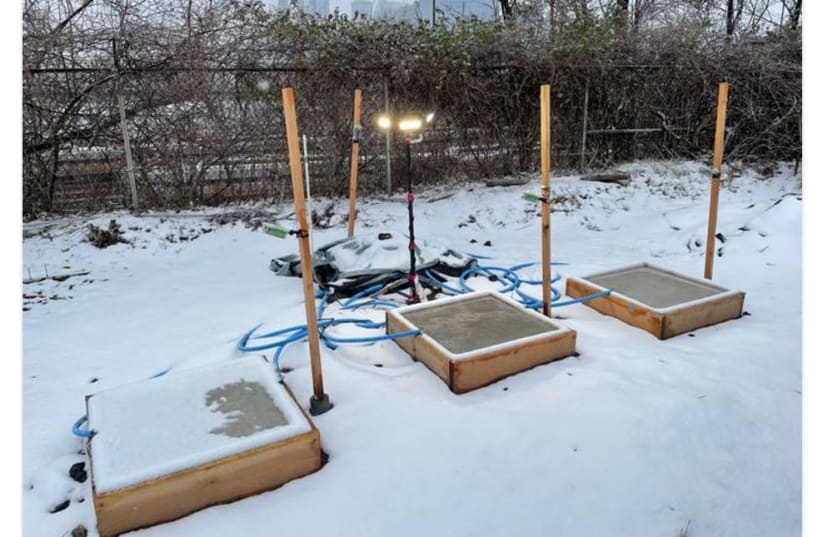
Technology News: Self-heating concrete will make snow shovels obsolete

Self-heating concrete will make snow shovels obsolete 

 The self-heating concrete is the latest in an ongoing effort to create more environmentally responsive and resilient infrastructure, particularly in the northern regions of the US. 
Thursday, March 21, 2024

Defense News: U.S. to Supply Javelin Anti-Tank Missile Systems to Morocco


U.S. to Supply Javelin Anti-Tank Missile Systems to Morocco


 U.S. to Supply Javelin Anti-Tank Missile Systems to Morocco

By Eyal Boguslavsky, Israel Defense, 21/03/2024 

U.S. Army Javelin anti-tank missile system, Photo: Lockheed Martin website

The U.S. State Department has approved the sale of Javelin anti-tank missile systems to Morocco at an estimated total cost of $260 million. As part of this sale, Morocco will be supplied with 612 Javelin FGM-148F missiles, which include 12 fly-to-buy missiles, along with 200 Javelin lightweight command launch units (LWCLUs).

British Army Javelin Anti-Tank Missile System. By Photo: Stuart A Hill AMS/UK MOD


According to the U.S. State Department, this proposed sale will support the foreign policy and national security objectives of the United States by enhancing the security of a major non-NATO Ally. Morocco is recognized as an important force for political stability and economic progress in North Africa. It is emphasized that the proposed sale of this equipment and support will not disrupt the fundamental military balance in the region.

First-of-Its-Kind 'Quantum Tornado' Achieves Record-Breaking Black Hole Mimicry

21 March 2024, ByM. STARR

A quantum tornado in a helium superfluid.

A superfluid vortex controlled in a lab is helping physicists learn more about the behavior of black holes.

A whirlpool generated in helium cooled to just a fraction above absolute zero mimics the gravitational environment of these objects to such high precision that it's giving unprecedented insight into how they drag and warp the space-time around them.

"Using superfluid helium has allowed us to study tiny surface waves in greater detail and accuracy than with our previous experiments in water," explains physicist Patrik Švančara of the University of Nottingham in the UK, who led the research.

"As the viscosity of superfluid helium is extremely small, we were able to meticulously investigate their interaction with the superfluid tornado and compare the findings with our own theoretical projections."

Black holes are quite probably the weirdest, most extreme objects in a whole Universe of very weird things. They're also notoriously difficult to study. They don't emit any radiation we can detect; we can only see light from the space immediately around them. But we have some very good theoretical studies that can describe their observed behavior quite accurately.

One way we can learn more about them is by creating black hole analogs. These are experiments that can recreate the theory of black holes to elucidate other aspects of their behavior. One type of black hole analog is a vortex or whirlpool.

Any material that comes close enough to a black hole starts to swirl around it, and then fall onto it, like water circling and gurgling down a drain.

So apt is this comparison that scientists have even built water vortices to study black hole behavior. Švančara and his colleagues, however, wanted to take this a step further – with superfluid helium.

This is an isotope of helium – helium-4 – that has been cooled to -271 degrees Celsius (-456 Fahrenheit), just slightly above absolute zero. At this extremely cold temperature, the bosons in helium-4 slow down enough to overlap and behave as one super-atom – a fluid with zero viscosity, or superfluid.

The team's experiment, with a vortex swirling around the helium superfluid.
 (Leonardo Solidoro)


The team harnessed the unusual quantum properties of superfluid helium-4 to generate a sort of 'quantum tornado'.

"Superfluid helium contains tiny objects called quantum vortices, which tend to spread apart from each other," Švančara says. "In our set-up, we've managed to confine tens of thousands of these quanta in a compact object resembling a small tornado, achieving a vortex flow with record-breaking strength in the realm of quantum fluids."

By studying this tornado, the researchers were able to identify similarities between the vortex flow and the influence of a spinning black hole on the curved space-time around it. In particular, the researchers observed standing waves analogous to black hole bound states, and excitations analogous to the ringdown of a newly formed black hole.

And this is just the start. Now that the researchers have demonstrated that their experiment works the way they intended, the vortex is poised to unlock a new area of black hole science.

"When we first observed clear signatures of black hole physics in our initial analog experiment back in 2017, it was a breakthrough moment for understanding some of the bizarre phenomena that are often challenging, if not impossible, to study otherwise," says physicist Silke Weinfurtner of the University of Nottingham.

"Now, with our more sophisticated experiment, we have taken this research to the next level, which could eventually lead us to predict how quantum fields behave in curved spacetimes around astrophysical black holes."


Recommend this post and follow
Sputnik's Orbit

Wednesday, March 20, 2024

Astrophysicist explains science behind once-in-a-lifetime nova outburst that will light up the sky this year

Mar. 19, 2024, by C. Mello-Klein, Northeastern U.

Credit: Pixabay/CC0 Public Domain

The total solar eclipse isn't the only reason to keep your eyes to the sky this year. For the first time in 80 years, a star system 3,000 light years away will be visible to the naked eye thanks to a once-in-a-lifetime nova outburst.

NASA announced that the nova, which will create a "new" star in the night sky, will light up the night sky some time between now and September and be as bright as the North Star. One of only five recurring novae in our galaxy, it will be visible for a week before it fades back down.

Jonathan Blazek, an assistant professor of physics at Northeastern University, says this is an exciting moment for amateur astronomers and astrophysicists alike. It's not technically a new star, just a star that is now bright enough for people to see more clearly, Blazek says, but it provides an opportunity to see and understand the cosmos in a new way.

What exactly is a nova?

"There's a broad class of these sorts of events, and they typically share the trait of having two objects, or sometimes more than two objects, close to each other, and you're transferring mass from one to the other," Blazek says. "Eventually, you build up enough mass on usually the hotter object that it ignites, in this case undergoing fusion, and then suddenly you get a very rapid release of energy so it gets much, much brighter."

The star system in question is T Coronae Borealis, or T CrB, and it contains a white dwarf and red giant, two stars that create the perfect conditions for a nova outburst.

A red giant is what happens when a star, like our sun, runs out of fuel and becomes larger and cooler, turning red instead of the white or yellow of a hot star. A white dwarf is what a red giant turns into when it runs out of even more fuel: a very compact star.

What happens when these two stars co-orbit one another is that the white dwarf steadily strips away the atmosphere of the expanding red giant.

"The white dwarf is much smaller and much more compact, so you build up a little disk of mostly hydrogen and maybe some helium as well sitting on the white dwarf," Blazek says. "Eventually enough of it builds up and basically ignites. It's not literally burning in the sense of fire; it's thermonuclear burn and you have hydrogen undergoing a fusion reaction."

As it undergoes that runaway thermonuclear reaction, the white dwarf gets hotter, bigger and brighter, making it easier for us to see it back on Earth. This entire process is part of the natural lifecycle of these stars and why they happen every 80 years. After a white dwarf like this goes nova, it goes back to stripping gas away from the red giant, building up gas at the same rate before eventually another outburst occurs.

Outside of the novelty of these novae,, Blazek says systems like T CrB are particularly interesting for astrophysicists because they are prime candidates for Type 1a supernovae, even larger stellar explosions that are integral to mapping the cosmos.

When a star like T CrB's white dwarf hits a certain mass after repeated novae and it can't support its own mass, it starts to collapse and erupts into a massive, bright explosion, known as a supernova. Novae occur every 80 years, but supernovae are one-time events because they are so powerful that they end up destroying a star. Type 1a supernovae are even more notable because they seem to always have the same brightness, which means they likely always happen to stars of the same mass, Blazek says.

"These are cosmologically super interesting because you can see them really, really far away, and because they're almost always the same brightness, you can use them as very particular probes of the universe," Blazek says. "You can basically map out how bright something is at different distances away and use that to say, "How is the universe changing at different distances?" This is actually how they discovered dark energy."

This is why organizations like NASA and astrophysicists across the globe will likely be pointing countless telescopes at the sky to monitor this nova, Blazek says.

"We're at the stage where we have discovered dark energy using the supernova, but if we want to go to the next level of precision, we need to do a better job of really understanding deep down what these things are, how much variance there is between different objects and things like that," Blazek says.

As for the rest of us, looking up into the night sky and seeing a new source of light in the night sky will be enough. Luckily, it's so bright that this might be one of the few times where city dwellers might have an advantage when it comes to stargazing.

"Obviously, you'll get a better view if you go somewhere dark, but if you go somewhere dark, you'll see a lot of stuff up there," Blazek says. "If you want to have an easier time finding it, stay somewhere bright and then you can only see the really bright stuff, so it'll pop out behind the Boston glow."


Recommend this post and follow
Sputnik's Orbit


Posted by Chucklifeofearth/

Monday, March 18, 2024

Medical Technology News: New wearable neck patch invention allows people to speak with no vocal cords


New wearable neck patch invention allows people to speak with no vocal cords

Looking forward, the research team plans to continue enlarging the vocabulary of the device through machine learning and to test it in people with speech disorders.

Sunday, March 17, 2024

Defense News: Report: Elbit Supplies Philippines with First Batch of Guarani APCs


Report: Elbit Supplies Philippines with First Batch of Guarani APCs


The vehicles are part of a $46-million deal signed in February 2021, aimed at delivering 28 Guaranis to the Philippine Army

                         Guarani APC for the Philippine Army, Photo: Elbit Systems website

Israeli defense giant Elbit Systems has dispatched the initial batch of Guarani 6×6 armored personnel carriers (APCs) to the Philippine Army. According to the Defense Post website, five APCs were unveiled for the first time during a ceremony in Santa Lucia, Tarlac. These vehicles are slated for use by the Philippine Army’s Armor Division.

The vehicles are part of a $46-million deal signed in February 2021 to deliver 28 Guaranis to a then-undisclosed country in the Asia Pacific region.

In March 2023, reports surfaced indicating that the implementation of the deal to supply Guarani APCs to the Philippine army faced obstacles and was halted.

Reports from Brazil suggested that the primary challenge stemmed from Germany’s veto on this supply – as a response to Brazil’s refusal to supply Ukraine with 35 mm ammunition for the Gepard anti-aircraft system, which Germany had provided the Ukrainians. Now, it appears that this obstacle has been overcome, and the supply to the Philippines has begun.

Saturday, March 16, 2024

Defense News: Stratolaunch sets sights on hypersonic speeds for next Talon-A test


Stratolaunch sets sights on hypersonic speeds for next Talon-A test


By Courtney Albon, Defense News, March 15th 2024

                A Talon-A test vehicle separates from its launch system. (Ethan Wagner/Stratolaunch)

Following a successful test flight in which its Talon-A vehicle reached near-hypersonic speeds, Stratolaunch is preparing for its next mission to reach or surpass the milestone of five times the speed of sound.


The March 9 test hit all of its primary objectives, according to Stratolaunch CEO Zachary Krevor. Taking off from Stratolaunch’s manufacturing and test facility at Mojave Air and Space Port in California, the uncrewed vehicle separated from its carrier craft and reached high supersonic speeds before dropping into the Pacific Ocean.


“This was really focused on risk reduction for our platform,” Krevor told C4ISRNET in a March 11 interview. “We got through acceleration, through the transonic phase into the supersonic phase — that was our primary objective.”


An aircraft achieves hypersonic speeds when it reaches Mach 5, and Krevor said the first powered Talon-A got close to that rate. The company would not disclose the altitude or exact speed of the test flight.


For Stratolaunch’s second powered Talon-A mission, scheduled for the second half of this year, it wants to push the uncrewed aircraft’s envelope further. The goal is to reach hypersonic speeds and to demonstrate reusability, landing the system on a runway.


The vehicle, dubbed TA-2, won’t undergo any structural changes before the flight, Krevor said, noting that the first mission validated the aircraft’s design and construction. The company is, however, considering operational lessons from the TA-1 vehicle.


“There’s certainly some operational lessons that we’ve learned regarding our propellant management and how can we continue to improve,” he said. “We are a company that believes strongly in continuous improvement.”


A successful Talon-A test campaign has significant implications for the Defense Department’s hypersonic efforts, which are focused on fielding the advanced weapons and defending against similar systems that China and Russia are building.


DoD is working to increase its testing rigor, setting a goal in 2022 to eventually conduct one flight each week. Talon-A could provide the department with a reusable, more affordable platform to test and validate high-speed components, subsystems and other technologies.


Talon-A’s first powered flight provided some data to U.S. Defense Department customers, including the Pentagon’s Test Resource Management Center, which is developing an airborne hypersonic test capability called SkyRange.


The next flight will take that partnership a step further, with SkyRange’s advanced sensors tracking the mission. It will also be the first flight to support the Pentagon’s Multi-Service Advanced Capability Hypersonics Test Bed program, or MACH-TB. The flying testbed effort is designed to validate hypersonic subsystems, advanced materials and other technologies.


The next mission is one of five Talon-A test flights that will carry MACH-TB payloads as part of a contract inked in November.


The company is also working to ensure its behemoth Talon-A carrier vehicle, dubbed Roc, is prepared for its next mission. The aircraft, which has a wingspan of 385 feet and can fly 500,000 pounds of payload, will perform a series of flights aimed at increasing its altitude for the next Talon-A mission.


The flights are part of mandatory Federal Aviation Administration inspections to validate Roc’s airworthiness.


Krevor noted that for the TA-1 mission, Roc’s 14th flight, the aircraft demonstrated a two-week turnaround time and brought its total flight time to around 60 hours.


“Roc really is turning into a dependable aircraft that’s going to be a national asset for the United States to perform missions that, frankly, were unable to be accomplished previously,” he said.


Stratolaunch is also preparing its second carrier aircraft — a Boeing 747 owned by Virgin Orbit before the company declared bankruptcy last spring — to support Talon A missions next year. The company is performing modifications on the platform to ensure it is compatible with its data systems and interfaces.


The aircraft will support some classified DoD testing before it starts flying Talon A missions.


“I can’t talk in great detail about it, but the 747 will support additional customer flight testing in the fourth quarter of this year,” Krevor said.


Friday, March 15, 2024

Defense News: India approves full development of fifth-generation fighter


India approves full development of fifth-generation fighter


By Gordon Arthur, Defense News, March 13th 2024

This photo shows a scale model of India’s AMCA twin-engine stealth fighter, whose development through to full prototype stage has been approved. (Gordon Arthur/Staff)


CHRISTCHURCH, New Zealand — India’s Cabinet Committee on Security has given a green light to continue development of the Advanced Medium Combat Aircraft, India’s indigenous fifth-generation fighter jet.


The state-run Aeronautical Development Agency and Hindustan Aeronautics Ltd. are leading this development effort. The committee early this month granted the project 150 trillion rupees (U.S. $1.8 billion) to fund the twin-engine AMCA’s full-scale design and development, flight testing and certification.


Krishna Rajendra, AMCA project director at the Aeronautical Development Agency, said five prototypes are expected. He also confirmed the fighter’s maiden flight should occur before the end of 2028.


The Indian Air Force previously said it would like seven squadrons of these stealthy fighters. Although the government has not formally stated when AMCA will commence series production, Indian media are quoting a date of 2035.


K.P Sanjeev Kumar, a former Indian naval aviation test pilot and aviation commentator, told Defense News “an optimistic and realistic timeframe for final operational clearance would be 2040 or beyond.” Final operational clearance refers to an aircraft attaining its full capabilities so it is ready for service.


The Air Force’s first two AMCA squadrons will receive Mk-1 aircraft, powered by General Electric F414 engines that produce 22,000 pounds of thrust.


Later, the next five squadrons will receive the AMCA Mk-2, with bigger engines producing nearer 25,000 pounds of thrust for a supersonic cruising capability. The new engine with thrust vector control will be co-developed with a foreign partner.


Development of the AMCA commenced in 2008, and its design was finalized in 2022. Last December, it successfully passed a platform-level critical design review.


This is India’s second domestic fighter program. However, the preceding Tejas fighter’s maiden flight occurred in 2001, and the first Tejas entered an operational squadron 15 years later — suggesting AMCA’s timeline may shift. India also suffered a costly failure when it attempted to develop the Kaveri engine for the Tejas light fighter.


Sanjeev Kumar stressed the importance of the AMCA to India.


“[They are] required as of yesterday, given the woefully short numbers of squadrons with gen-four aircraft and below, plus the looming threat of growing Chinese aggression,” he said.