Thursday, November 23, 2023

Several Solar Eruptions, Ozone Issues

S0 News Nov.23.2023
https://youtu.be/AtATiDrXXvA?si=urJbb8h-VGrXttOq


Seems like the Sun is coming around.


Recommend this post 

and follow

Sputnik's Orbit


Posted by Chuck


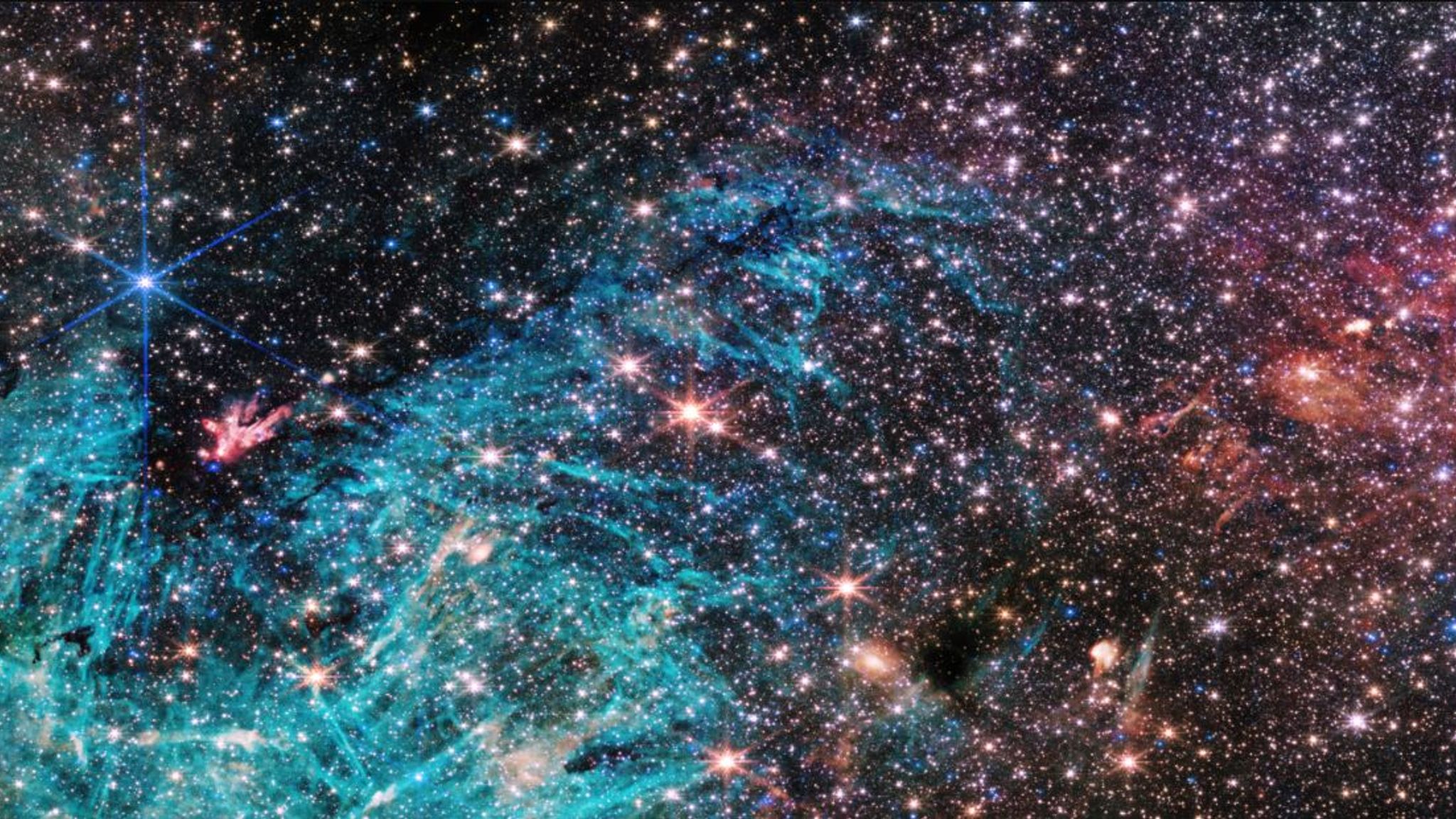
Space News: Image from James Webb telescope captures heart of Milky Way in 'unprecedented detail'


Image from James Webb telescope captures heart of Milky Way in 'unprecedented detail'

A new image from the James Webb Space Telescope shows a region 25,000 light years from Earth and will allow astronomers to learn more about how stars are formed in an "extreme cosmic environment".

By Sky News, Wednesday 22nd November 2023

James Webb Space Telescope reveals a 50 light-years-wide portion of the Milky Way's dense centre. Pic: NASA, ESA, CSA, STScI, Samuel Crowe (UVA)


A new image from NASA's James Webb Space Telescope reveals never-before-seen features at the centre of the Milky Way. 

It shows a portion of the centre of our galaxy about 25,000 light years from Earth in "unprecedented detail".

t will allow astronomers to learn more about how stars are formed in an "extreme cosmic environment", NASA said.

"The image from Webb is stunning, and the science we will get from it is even better," said the observation team's principal investigator Samuel Crowe, an undergraduate student at the University of Virginia in Charlottesville.

"Massive stars are factories that produce heavy elements in their nuclear cores, so understanding them better is like learning the origin story of much of the universe."

The image shows more than 50,000 stars and a cluster of protostars - stars that are still forming and gaining mass.

At the heart of this young cluster is a massive protostar over 30 times the mass of our Sun.

The star-forming region, named Sagittarius C, is close enough to study individual stars with the Webb telescope, allowing astronomers to gather information on how stars form in this environment.

"There's never been any infrared data on this region with the level of resolution and sensitivity we get with Webb, so we are seeing lots of features here for the first time," Mr Crowe said.

Rubén Fedriani, a co-investigator of the project at the Instituto Astrofísica de Andalucía in Spain, said: "The galactic centre is a crowded, tumultuous place.

"There are turbulent, magnetised gas clouds that are forming stars, which then impact the surrounding gas with their outflowing winds, jets, and radiation.

"Webb has provided us with a ton of data on this extreme environment, and we are just starting to dig into it."


Tuesday, November 21, 2023

Chinese company gives leftover hotpot oil second life as jet fuel

Nov. 21, 2023, by R. Bailey, with J. X. Teng in Shanghai

A company in China is refining leftover hotpot oil so it can be transformed into sustainable jet fuel.

At an upmarket restaurant in the hotpot-loving Chinese city of Chengdu, diners plunge sliced meat and vegetables into cauldrons of spicy, oily broth, largely unaware that their leftovers are set to take on a second life as jet fuel.

With around 150,000 tonnes of used hotpot oil thrown out by restaurants in the city each year, local business Sichuan Jinshang Environmental Protection has found a niche in processing the greasy waste and exporting it to be turned into aviation fuel.

"Our motto is, let oil from the gutter soar in the sky," Ye Bin, the company's general manager, told AFP.

Ye said his company, which launched in 2017, was now producing up to 150,000 tonnes of industrial-grade oil annually from a combination of hotpot restaurants and other eateries across Chengdu, including KFC outlets.

On a typical night, collectors hired by Jinshang visit hundreds of these restaurants around the southwestern metropolis.

The process begins right after customers leave, with waiters emptying their hotpot broth—so rich it is used purely as a cooking medium—into a special filter that separates oil from water.

Donning thick aprons and elbow-length rubber gloves, collectors then arrive to pick up jerrycans of the scarlet grease.

"It's a great job—I play mahjong during the day and work at night," one collector named Zheng told AFP as he packed a minivan with containers of the pungent sludge.

The leftover hotpot broth goes through a special filter that separates oil from water.

That sludge is then ferried to a business park on the city's outskirts where Jinshang's mostly spotless plant is based.

The only trace of the oil there is a faint scent of hotpot at the unloading dock and telltale orange stains at the bottom of some equipment.

The oil is piped into massive vats and undergoes a refining process that removes remaining water and impurities, resulting in a clear, yellow-tinged industrial-grade oil.

That is exported to clients based mainly in Europe, the United States and Singapore, who further process it to make what industry insiders call "sustainable aviation fuel" (SAF).

SAFs are critical to decarbonizing the aviation sector, which was responsible for two percent of global energy-related CO2 emissions in 2022, according to the International Energy Agency.

But they are still not widely used—making up less than 0.1 percent of all aviation fuels consumed—because of processing costs and the relatively small number of suppliers.

The International Air Transport Association estimates their widespread adoption could "contribute around 65 percent of the reduction in emissions needed by aviation to reach net-zero in 2050".

Jinshang has plans to expand into its own SAF-producing facility soon, using equipment from US firm Honeywell to produce 300,000 tonnes annually.

Collectors who work with Jinshang pick up the grease from restaurants and ferry it to the company's facility.

Food waste problem

Jinshang's business model is part of wider efforts in China to tackle the mountains of food waste generated by its population of 1.4 billion.

Around 350 million tonnes of farm produce—over a quarter of annual output—goes to waste in the country each year, discarded by restaurants, supermarkets or consumers, according to a 2021 Nature study.

In landfills, rotting food waste emits atmosphere-warming methane gas more quickly than most other materials, according to the US Environmental Protection Agency.

It's a massive headache for Chinese cities and a major threat to global climate goals—one Beijing has vowed to tackle in a recent methane emissions plan that calls for the construction of innovative food waste processing projects across the country in the next few years.

In Shanghai, municipal waste treatment facilities have turned to the humble black soldier fly to turn tonnes of food waste each year into fertilizer and animal feed.

At the Laogang waste treatment plant, a cavernous sealed room houses 500 million maggots, which chomp their way through up to 2,500 tonnes of food waste each day, according to plant deputy director Wu Yuefeng.

Samples of used oil in various stages of the refining process are displayed at Jinshang's plant.


The wriggling grubs excrete a fine, black, dirt-like substance that is repurposed as fertilizer, while the larvae themselves are killed and harvested at peak plumpness to be turned into livestock feed.

Back in Chengdu, the thought that his dinner will have a long, productive afterlife brings comfort to hotpot fan Dong.

"This utilization and circulation of waste throughout the whole of society is more beneficial," he told AFP.


Recommend this post and follow
Sputnik's Orbit


Posted by greasy Chuck

Monday, November 20, 2023

First-Ever Solar Energetic Particle Event Detected on the Surfaces of Earth, Moon, and Mars

By U. OF SCIENCE AND TECH. OF CHINA, Nov. 20, 2023

New research highlights the risks posed by space radiation to lunar and Martian exploration, focusing on a recent Solar Energetic Particle event. It underscores the varying levels of natural protection against such radiation on Earth, the Moon, and Mars, and stresses the importance of developing effective shielding for astronaut safety in future space missions.

Space radiation poses a significant challenge to humanity’s ambitions in space exploration, particularly in missions to the Moon and Mars. This radiation, primarily from solar energetic particles (SEPs) produced by solar flares, can significantly elevate radiation levels, posing a health risk to astronauts.

Additionally, intense SEP events can trigger ground-level enhancements (GLEs), further raising radiation levels on the surfaces of celestial bodies.

Research on Space Radiation Effects

A research team led by Prof. Guo Jingnan of the University of Science and Technology of China (USTC) of the Chinese Academy of Sciences (CAS), collaborated with researchers from Germany, Bulgaria, and the United States focused on analyzing a SEP event that occurred on October 28, 2021, whose energy was sufficient to cause a GLE event on Earth’s surface.

Additionally, the Chang’e 4 lunar mission on the lunar surface and the Curiosity rover on the Martian surface both detected this high-energy particle event.

This is the first GLE event detected on the surfaces of three planetary bodies. By combining measurement and modeling approaches, the team studied the potential radiation risks posed by SEPs that future humans may face on the Moon and Mars. The results were recently published in the journal Geophysical Research Letter.

Earth’s Protection from SEPs

Earth’s magnetic field and atmosphere provide protection against space-charged particles with lower energy. The GLE the team studied, known as GLE73, is the most recent GLE event that people have ever detected. And although Earth’s shielding mitigates the risks, the Moon and Mars lack similar protection.

The Moon lacks a global magnetic field and atmosphere, making it vulnerable to SEP particles. China’s Chang’e-4 lunar mission and NASA’s Lunar Reconnaissance Orbiter (LRO) observed the GLE73 event, but the radiation doses measured were within safe limits.

However, simulations suggest that without adequate shielding, future lunar missions could face radiation risks during approximately one out of every five SEP events, which will further pose a serious threat to the lives of astronauts.

Radiation Challenges on Mars

Mars, positioned between the Moon and Earth, lacks a global magnetic field but possesses a thin atmosphere that can absorb high-energy particles. The recent GLE73 event, observed by instruments on the ESA ExoMars TGO and NASA’s MSL, showed that radiation levels in Mars orbit were approximately 30 times higher than on the Martian surface.

This indicates the Martian atmosphere’s strong absorption of radiation induced by SEPs. However, it provides limited shielding against background galactic cosmic rays (GCR). Simulations reveal that past GLE events on the Martian surface remained below the acute radiation syndrome (ARS) threshold.

Nevertheless, extreme SEP events during the journey to Mars or in Martian orbit pose a significant radiation risk for future deep space missions.

In conclusion, when the solar high-energy particles reach the Earth, the moon, and Mars, their fates and radiation effects are not the same. The recent detection of a SEP event on the lunar and Martian surfaces highlights the need to address these challenges. Therefore, further research and effective shielding measures are crucial for astronaut safety.


Recommend this post and follow
Sputnik's Orbit


Posted by Chuck

Defense News: Eurotrophy Produces Dozens of Trophy Systems Each Month


Eurotrophy Produces Dozens of Trophy Systems Each Month


In addition to being supplied to the IDF, the systems are being delivered to Germany and Norway armies Leopard main battle tanks


By Eyal Boguslavsky, Israel Defense, 19/11/2023

              German Army Leopard tank fitted with Trophy system (Photo: EuroTrophy website)


EuroTrophy’s Managing Director, Dan Kalfus, provided production and delivery figures for the Trophy active protection system (APS) at the Future Armored Vehicles Survivability (FAVS) 2023 conference held in London this week.

According to Kalfus, the joint European venture of the Israeli company Rafael, the German KMW, and General Dynamics Land Systems Europe (GDELS) is producing 40 Trophy APSs and 500 countermeasures per month. In addition to being supplied to the Israel Defense Forces (IDF), the system is delivered to Germany and Norway.

        German Army Leopard tank fitted with Trophy system (Israel M.O.D. photo)

One Trophy system has been supplied to Germany for integration tests on a Leopard 2A4 main battle tank (MBT), 23 have been qualified and have entered service on German Army Leopard 2A7A1s, and 23 and 54 of the systems, respectively, have been ordered for Leopard 2A8s being procured by Germany and Norway. The Trophy is standard equipment for the Leopard 2A8.

In addition to Trophy production by Rafael Defense Systems for the IDF, the APS has been manufactured by Frankfurt-based EuroTrophy in Kassel and Kaiserslautern in Germany since earlier this year.

Saturday, November 18, 2023

Bold China Mission to Mars Will Obtain Samples Years Before NASA

13 November 2023 ,By M. WILLIAMS, UNIVERSE TODAY

China's Tianwen-1 spacecraft in orbit above the Martian north pole. (CNSA/PEC)

China continues to take great strides as part of its goal to become a superpower in space and a direct competitor with NASA.

In addition to its proposed expansion of the Tiangong space station and the creation of the International Lunar Research Station (ILRS), China is also planning on sending crewed missions to Mars in the coming decade.

In preparation for the arrival of taikonauts on the Red Planet, China is gearing up to return samples of Martian soil and rock to Earth roughly two years ahead of the proposed NASA-ESA Mars Sample Return (MSR).

This mission will be the third in the China National Space Administration's (CNSA) Tianwen program (Tianwen-3) and will consist of a pair of launches in 2028 that will return samples to Earth in July 2031.

According to a new study recently published in the journal Chinese Science Bulletin, Chinese scientists announced that they have developed a new numerical model to simulate the atmospheric environment of Mars. Known as the Global Open Planetary atmospheric model for Mars (aka. GoPlanet-Mars, or GoMars), this model offers research support in preparation for the Tianwen-3 mission.

The paper, titled "Development of a new generation of Mars atmosphere model GoPlanet-Mars," was performed by researchers from the Institute of Atmospheric Physics Chinese Academy of Sciences (IAP-CAS), the State Key Laboratory of Numerical Simulation of Atmospheric Science and Geohydrodynamics (LASG), and the School of Earth and Planetary Sciences at the University of Chinese Academy of Sciences (SEPS-UCAS).

The study was led by Wang Bin, a Senior Researcher with the CAS-IAP who specializes in climate modeling.

In the past two decades, the number of missions and space agencies engaged in the exploration of Mars has increased considerably.

At present, ten robotic missions are exploring its surface and atmosphere, including seven orbiters, two rovers, and one helicopter. And with many more destined for Mars in the next decade (as well as crewed missions), the demand for Martian weather forecasts is growing.

As they indicate in their paper, "The world's aerospace powers have developed Mars atmosphere models to provide meteorological environment protection for landing exploration."

To provide information on the meteorological conditions around the Tianwen-3 mission's potential landing sites, the research team built a global open planetary atmospheric model for Mars. They then used this model to replicate the three critical cycles of the Martian atmosphere: dust, water, and carbon dioxide.

They then tested the model using the Open access to Mars Assimilated Remote Soundings (OpenMARS) dataset, a global record of Martian weather from 1999 to 2015, as well as observations made by China's Zhurong rover (part of China's Tianwen-1 mission) and NASA's Viking 1 and 2 landers.

Their results showed that the GoMars model successfully reproduced the unique characteristics of surface pressure on Mars and provided good simulation performance for the surface temperature, zonal wind, polar ice, and dust.

According to Wang, the Tianwen-3 mission will expand upon Tianwen-1 by adding the additional tasks of landing, sampling, and returning, which requires detailed information about Mars' atmospheric conditions. This is crucial given how sandstorms caused multiple missions to be lost, such as Opportunity, Insight, and Zhurong – all due to the buildup of dust on their solar panels.

In addition, the Perseverance rover suffered damage to one of its wind sensors during a sandstorm due to airborne pebbles colliding with it. Since observation data is in short supply for Mars, the model also has applications for virtual reality simulations.

This is necessary when prepping missions to remote planets, which helps them design vehicles and select appropriate landing sites. In this respect, a "virtual Mars" program that incorporates GoMars and future observations could take a lot of the guesswork out of future mission planning.

Since the 1960s, when the Soviet and American space programs began sending probes to Mars, scientists have been developing Martian atmospheric models in the hopes of overcoming the "Mars Curse." With a growing number of nations sending missions to Mars, the need for climate modeling has become all the more crucial.

In the end, dust and weather can have a significant impact on the entry, descent, and landing (EDL) phase. They can also affect surface operations, particularly where solar panels, communications, and sensitive instruments are concerned.

They can also be a problem during the ascent phase, where missions attempt to reach orbit and return to Earth – for example, as part of a sample return mission. As Wang commented in an interview with the Xinhua News Agency:

"The dust cycle on Mars is as important as the water cycle on Earth. GoMars can be used to simulate the dust activity before and after the rover's dormancy, which can provide atmospheric environment data to analyze the possible causes of the dormancy.

For example, GoMars can simulate the temperatures of the landing zone, and scientists can use these data to design materials that are suitable for building Mars rovers to cope with extreme cold."

Early in the next decade, NASA and the ESA also intend to send the Mars Sample Return (MSR) mission to retrieve samples obtained by the Perseverance rover. This will consist of a NASA Sample Retrieval Lander, two Sample Recovery Helicopters, a Mars Ascent Vehicle, and an ESA Earth Return Orbiter.

NASA and the ESA currently expect this mission to launch no sooner than 2033, coinciding with NASA's first crewed mission to Mars leaving Earth. Clearly, the new Space Race extends beyond the Moon and now includes reaching Mars!


Recommend this post and follow
Sputnik's Orbit


Posted by Chucker

Thursday, November 16, 2023

Defense News: Assessment: Israeli Navy Uses Elbit’s “Seagull” During Current War


Assessment: Israeli Navy Uses Elbit’s “Seagull” During Current War


This sophisticated USV was developed in order to detect naval mines, subsea infrastructure, and submarines


By Ami Rojkes Dombe, Israel Defense, 16/11/2023

                                                   Elbit Systems "Seagull" USV

As part of the Israeli Navy's operations during the War of Attrition, it can be assumed that the “Seagull”, an unmanned surface vessel (USV) developed and manufactured by Elbit Systems, was also deployed. This USV is designed to detect naval mines, subsea infrastructure, and submarines.

Since the “Seagull” was introduced several years ago, at least one vessel was purchased by the IDF and is used for naval missions.

During the current war, the Navy dealt with Hamas' underwater and submersible attack vessels. On the day of the massacre, October 7th, the Navy thwarted attempts to enter from the sea towards Israeli territory.

However, despite the efforts of the Navy on Saturday morning and the maritime barrier installed in the Zikim area at the end of 2021, Hamas militants managed to breach Israel's shores.

Some of the terrorists succeeded in killing civilians and soldiers before being neutralized. The Navy reportedly eliminated some of the terrorists, but it was unable to prevent Hamas from infiltrating Israel in those early hours.

The “Seagull,” as a complementary tool to the Navy's defense measures, serves as an unmanned addition that does not endanger the soldiers. It enables high-risk operations such as mine detection.

PLEASE RECOMMEND THIS PAGE & FOLLOW THE SPUTNIKS ORBIT AT HTTPS://DISQUS.COM/HOME/FORUM/THESPUTNIKSORBIT-BLOGSPOT-COM

Wednesday, November 15, 2023

Scientists uncover aurora-like radio emission above a sunspot

Nov. 13, 2023, by J. Jenkins, New Jersey Inst. of Tech.

Scientists uncover prolonged radio emissions above a sunspot, akin to those previously seen in the polar regions of planets and certain stars, which may reshape our understanding of intense stellar radio bursts. 
Credit: Sijie Yu

In a study published in Nature Astronomy, astronomers from New Jersey Institute of Technology's Center for Solar-Terrestrial Research (NJIT-CSTR) have detailed radio observations of an extraordinary aurora-like display occurring 40,000 km above a relatively dark and cold patch on the sun, known as a sunspot.

Researchers say the novel radio emission shares characteristics with the auroral radio emissions commonly seen in planetary magnetospheres such as those around Earth, Jupiter and Saturn, as well as certain low-mass stars.

The discovery offers new insights into the origin of such intense solar radio bursts and potentially opens new avenues for understanding similar phenomena in distant stars with large starspots, according to the study's lead author and NJIT-CSTR scientist Sijie Yu.

"We've detected a peculiar type of long-lasting polarized radio bursts emanating from a sunspot, persisting for over a week," said Yu. "This is quite unlike the typical, transient solar radio bursts typically lasting minutes or hours. It's an exciting discovery that has the potential to alter our comprehension of stellar magnetic processes."

Famous auroral light shows that are visible across the sky of Earth's polar regions, like the Aurora Borealis or Aurora Australis, occur as solar activities disturb Earth's magnetosphere, which facilitates the precipitation of charged particles to the Earth's polar region where the magnetic field converges, and interacts with oxygen and nitrogen atoms in the high atmosphere. Accelerating toward the north and south poles, such electrons can generate intense radio emissions at frequencies around a few hundred kHz.

Yu's team says the newly observed solar radio emissions, detected over a vast sunspot region temporarily forming where magnetic fields on the sun's surface are particularly strong, differ from previously known solar radio noise storms—both spectrally and temporally.

"Our spatially, temporally and spatially resolved analysis suggests that they are due to the electron-cyclotron maser (ECM) emission, involving energetic electrons trapped within converging magnetic field geometries," explained Yu.

"The cooler and intensely magnetic areas of sunspots provide a favorable environment for the ECM emission to occur, drawing parallels with the magnetic polar caps of planets and other stars and potentially providing a local solar analog to study these phenomena."

"However, unlike the Earth's auroras, these sunspot aurora emissions occur at frequencies ranging from hundreds of thousands of kHz to roughly 1 million kHz—a direct result of the sunspot's magnetic field being thousands of times stronger than Earth's."

"Our observations reveal that these radio bursts are not necessarily tied to the timing of solar flares either," added Rohit Sharma, a scientist from the University of Applied Sciences Northwestern Switzerland (FHNW) and co-author of the study. "Instead, sporadic flare activity in nearby active regions seems to pump energetic electrons into large-scale magnetic field loops anchored at the sunspot, which then power the ECM radio emission above the region."

The "sunspot radio aurora" is thought to exhibit rotational modulation in sync with the solar rotation, producing what Yu describes as a "cosmic lighthouse effect."

"As the sunspot traverses the solar disk, it creates a rotating beam of radio light, similar to the modulated radio aurora we observe from rotating stars," Yu noted. "As this sunspot radio aurora represents the first detection of its kind, our next step involves retrospective analysis. We aim to determine if some of the previously recorded solar bursts could be instances of this newly identified emission."

The solar radio emissions, albeit weaker, are likened to stellar auroral emissions observed in the past and may suggest that starspots on cooler stars, much like sunspots, could be the sources of the certain radio bursts observed in various stellar environments.

"This observation is among the clearest evidence of radio ECM emissions we have seen from the sun. The characteristics resemble some of those observed on our planets and other distant stars, leading us to consider the possibility that this model could be potentially applicable to other stars with starspots," said Bin Chen, NJIT-CSTR associate professor of physics and a co-author.

The team says the latest insight, linking the behavior of our sun and the magnetic activities of other stars, could have implications for astrophysicists to rethink their current models of stellar magnetic activity.

"We're beginning to piece together the puzzle of how energetic particles and magnetic fields interact in a system with the presence of long-lasting starspots, not just on our own sun but also on stars far beyond our solar system," said NJIT solar researcher Surajit Mondal.

"By understanding these signals from our own sun, we can better interpret the powerful emissions from the most common star type in the universe, M-dwarfs, which may reveal fundamental connections in astrophysical phenomena," added Dale Gary, NJIT-CSTR distinguished professor of physics.

The research team—including collaborators Marina Battaglia from FHNW and Tim Bastian of the National Radio Astronomy Observatory—used broadband dynamic radio imaging spectroscopy observations from the Karl G. Jansky Very Large Array to achieve the discovery.


Recommend this post and follow
Sputnik's Orbit


Posted by Chuck

Defense News: US seeks to fund Israeli laser as Army considers Iron Beam’s potential


US seeks to fund Israeli laser as Army considers Iron Beam’s potential


By Jen Judson, Defense News, Nov 13, 2023

Israeli company Rafael has created Iron Beam, a high-energy laser weapon. (Courtesy of Rafael Advanced Defense Systems)


WASHINGTON — The Biden Administration’s budget package of roughly $106 billion in emergency supplemental funding includes a $1.2 billion investment in Israel’s directed energy weapon system, “Iron Beam,” which the U.S. Army could consider as an alternative laser weapon for its own needs, according to the service’s acquisition chief.


The Iron Beam technology is “intriguing,” Doug Bush told reporters last week. “If [the Israelis] are successful, that certainly could be something the Army could think about leveraging.”


Congress has yet to pass the supplemental funding aimed to support U.S. and allies’ defense needs, including Ukraine and Israel. A growing number of House Republicans oppose additional Ukraine aid and have instead pushed for a stand-alone $14 billion Israel supplemental.


Bush said he’d seen the first prototype of the directed energy technology meant to augment the Iron Dome air defense system capability in Israel on his last trip to the country, and added that he was “pleased” to see the supplemental include the U.S. investment in developing Iron Beam.


The Army is working on its own high-energy laser weapon capability as part of the Indirect Fire Protection Capability, or IFPC, to defend against rockets, artillery, and mortars as well as cruise missiles and drones. That system overall has experienced delays due to supply chain issues, but the Army is in the process of receiving the first prototypes from its maker Leidos’ Dynetics.

Army’s laser weapon pursuit

The laser weapon portion of the IFPC system is being developed by Lockheed Martin and the Army awarded a contract to Lockheed last month to deliver two 300-kilowatt-class laser weapon systems for the IFPC prototypes program with an option for two additional units.


“The Israeli system is a slightly different approach technologically,” Bush said, “so, it’s actually a nice complement because we’re kind of going down one path, they’ve gone down a slightly different one. I think, yes, there’s potential, if theirs works well, it could be something we could think about leveraging for our needs in that space, so that’s really a benefit of that funding is, I mean, we can explore multiple paths here and see what works.”


While Bush said he could not go into specifics about the technology, the differences have to do with “how the laser beam is formed and aimed” and each uses different power levels.


“They have a very specific problem they’re trying to solve with rockets and things like that, where the Army system goes a little broader — cruise missiles perhaps, things like that,” he added.


                                                              Rafael's Iron Beam system 

Israel’s laser development

Mark Montgomery, a defense analyst at the Foundation for Defense of Democracies in Washington said he hopes that if the supplemental funding is passed that the U.S. has a deal with the Israeli government that intellectual property needs to be owned by both American and Israeli companies involved – presumably US-based RTX and Israel’s Rafael Advanced Defense Systems, which worked together to co-develop Iron Dome.


Those companies should be able to “immediately turn it around and build stuff for us because this is a serious investment in laser and non-kinetic directed energy weapons,” Montgomery told Defense News in a recent interview.


Then-Israeli Prime Minister Naftali Bennett announced in early 2022 the country’s plan to create a “laser wall” to shift from investing in large numbers of interceptors to using less-costly lasers and said the system would be operational by next year. Later in 2022, the Israeli government said it could likely deploy the system in two years.


While the system is not yet operational, Israel announced in April 2022 that it had successfully intercepted mortars, rockets and anti-tank missiles in recent tests in the Negev Desert the month prior. And Iron Beam was displayed in February 2023 at the IDEX defense exhibition in the United Arab Emirates.


Experts have highlighted the technological challenge lasers have handling large salvos of rockets because lasers take time to heat up a target to destroy it. A laser might need to hit a target steadily for two to three seconds to kill a rocket, for instance.


The Hamas-Israel war has already shown, according to reports from both sides, that Hamas has potentially doubled its rocket rate of fire compared to the war between Israel and Hamas in May 2021. In 2021, Hamas could fire roughly 125 rockets in salvos over several minutes. In the attack on October 7, reports state that Hamas fired anywhere from 3,000 to 5,000 rockets into Israel over a 20-minute time period.


Rafael's Iron Beam system


PLEASE RECOMMEND THIS PAGE & FOLLOW THE SPUTNIKS ORBIT AT HTTPS://DISQUS.COM/HOME/FORUM/THESPUTNIKSORBIT-BLOGSPOT-COM