Thursday, February 22, 2024

Space News: Dwarf planets at Solar System's fringes may be geologically active - study


Dwarf planets at Solar System's fringes may be geologically active - study


The dwarf planets in question, Eris and Makemake, are both found in the Kuiper Belt past Neptune's orbit and are far from the Sun's warmth, similar to fellow dwarf planet Pluto. 
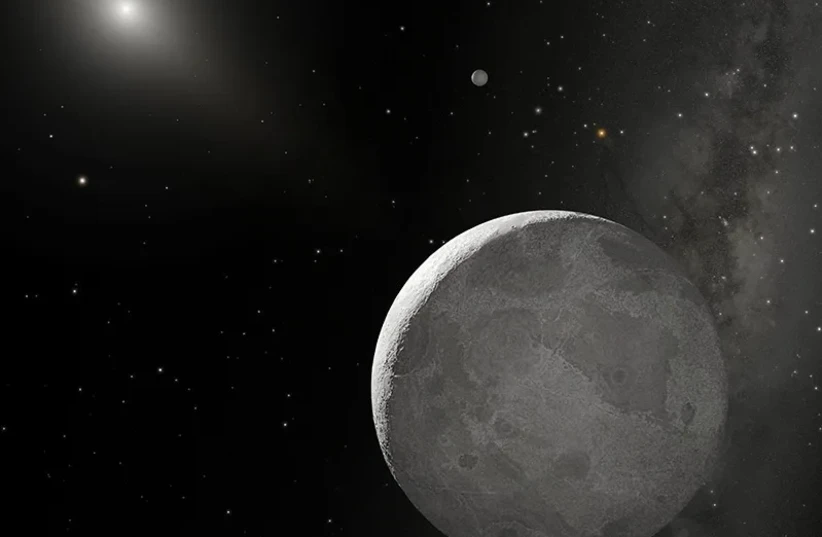

Two relatively small icy dwarf planets in the outermost edges of the Solar System are geologically active, meaning they have the potential to support life, according to two new recent studies.

The dwarf planets in question, Eris and Makemake, are both found in the Kuiper Belt past Neptune's orbit and are far from the Sun's warmth, similar to fellow dwarf planet Pluto. 

The findings of these studies were published in the academic journal Icarus.

Life past Neptune? The Kuiper Belt and geothermal Activity

So why is this so important? There are three important factors that first need to be understood: What is the Kuiper Belt, what are dwarf planets, and what is geothermal activity? 

First, the Kuiper Belt. 
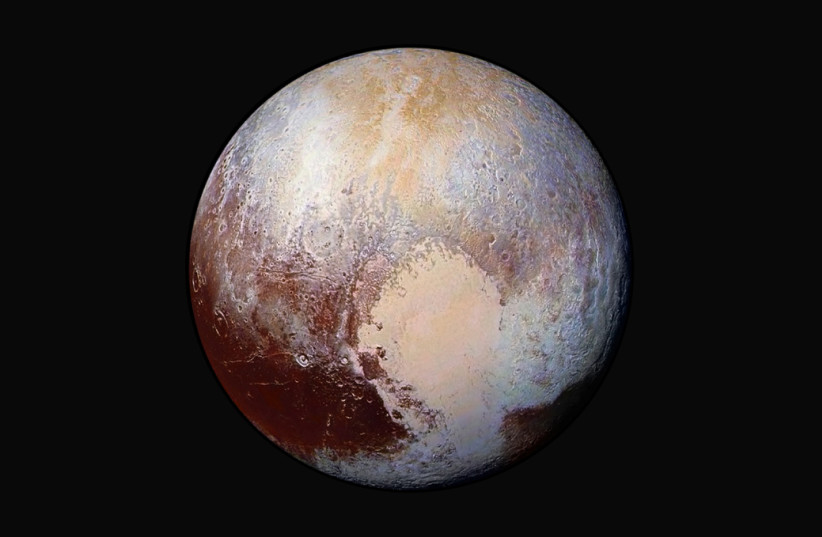
            An image of Pluto captured by the New Horizons spacecraft in 2015 (credit: NASA)


There are different regions of the Solar System, with the Sun surrounded by the orbit of the eight planets and the asteroid belt. But beyond the final planet from the Sun, Neptune is an icy ring known as the Kuiper Belt. This is a vast, largely unknown region of the Solar System, on the fringes before an even more distant and icy region known as the Oort Cloud. 

Like the asteroid belt, this is filled with the fragments of the creation of the Solar System, the last relics that never managed to form into planets. Only a few of these icy bodies, Pluto and Arrokoth, have ever been visited by spacecraft.

Some of these objects in the Kuiper Belt, like Pluto, are called dwarf planets. These objects are theoretically large enough enough to be considered planets and have been rounded out by gravity, but they can't be considered planets because their orbits around the Sun aren't clear, a phenomenon dubbed orbital dominance. 

Now, geothermal activity. This term essentially means that things are happening beneath a planet's surface - or that of a moon or dwarf planet - that creates heat similar to the Earth's core.

To put it another way, if there is geothermal activity, then there is heat - and not just heat limited to what is provided by the Sun. 

For anything far out in the Kuiper Belt, there isn't a lot of sunlight to go around. Any heat must, therefore, be geothermal. But could that be possible?

The answer to that is yes, and we've seen it before. Pluto, the most famous dwarf planet of all and formerly the ninth planet of the Solar System, is known to be geologically active. When scientists gathered data after the flyby of the New Horizons mission in 2015, they were able to determine a number of vast and diverse geological features indicative of geothermal activity. It is even possible that a vast subsurface ocean exists underneath the surface, with some of the mountain peaks on the surface being cryovolcanoes, which, despite being "ice" volcanoes, still require heat.

But now, let's take a look at the two dwarf planets that are the focus of the recent studies: Eris and Makemake.

For a dwarf planet, Eris is huge, even more massive than Pluto. Makemake is smaller, being the third-largest dwarf planet after Pluto. 

These two have not been visited by any spacecraft before, so less information is known about them, but scientific consensus seemed to point to them being dead, that is to say, devoid of any geothermal activity.

But now, scientists seem to think otherwise. 

This is all thanks to NASA's James Webb Space Telescope, which is equipped with an array of advanced scientific tools, including the means to analyze chemical compositions. This is done by studying the sunlight reflected off the dwarf planets and seeing how the different chemicals influence the wavelengths of the light.

Sure, scientists have done this before, but the James Webb Space Telescope can go even deeper, seeing a greater range of the infrared spectrum.

What they found was methane and carbon. Or, more specifically, methane, which has one of its hydrogen atoms replaced with deuterium.

Deuterium is a hydrogen isotope believed to have been formed by the Big Bang. Studying the ratio of deuterium can indicate where the methane came from. 

The idea is that the methane had a very high amount of deuterium, it would be what was known as primordial methane, meaning it likely came from comets or other external sources.

But the deuterium ratio was far too low for that to be the case. Rather, most of the methane must have been produced on the planet itself, which itself would require geothermal activity. 

So what does this mean? It could mean that these icy dwarf planets could be so warm that they may have active cryovolcanoes or even oceans of liquid water beneath the surface. 

Since geothermal power is essential for determining a world's possible activity, it means that places previously thought to be utterly inhospitable may have more potential than previously believed.

Of course, this is still speculation and would need to be confirmed by further research. But it does go to show that we have a lot more to learn about the objects of the Kuiper Belt and reaffirms the potential of the James Webb Space Telescope to shed light on many more of the mysteries of the universe around us.     


Tuesday, February 20, 2024

Cathedral termite mounds inspire lunar structure design

Feb. 14, 2024, by K. Smith, U. of Arizona
https://phys.org/news/2024-02-cathedral-termite-mounds-lunar.html

UArizona aerospace engineering students, from left: Min Seok Kang, Athip Thirupathi Raj, Chad Jordan Cantin, Sivaperuman Muniyasamy and Korbin Aydin Hansen display a smart sandbag structure. Cantin and Hansen are undergraduates. 
Credit: College of Engineering


NASA has big plans for its Artemis program—to return Americans to the moon for the first time since 1972 and establish a lunar base for humans by the end of the decade.

A team of University of Arizona engineers is using robot networks to create termite-inspired structures that will help astronauts survive the moon's harsh environment.

Associate professor Jekan Thanga and his students in the Department of Aerospace and Mechanical Engineering, in the College of Engineering, have developed prototypes of their lunar sandbag structures and the underlying concept for a network of robots that can build them. The structures contain sensors that aid in construction, then alert astronauts to changes in environmental conditions.

Tech Launch Arizona, the university's commercialization arm, worked with Thanga to file patents on the distributed computer processing networks that the team developed to link these structures and robots together.

Sivaperuman Muniyasamy, an aerospace engineering doctoral student, and Thanga presented a paper detailing the technology on Feb. 1 at the American Astronautical Society Guidance, Navigation and Control Conference.

"By publishing the paper at the conference, we're gaining feedback from other experts that really helps us move forward," said first author Muniyasamy.
Teaming up for moon landings

Thanga estimates astronauts will first land on the moon as part of Artemis in 2026 or 2027. In a consortium called LUNAR-BRIC, his team is partnering with NASA's Jet Propulsion Laboratory at Caltech and MDA, a space robotics company, to develop technology for Artemis moon landings.

"It's no accident this team has an academic partner, a commercial partner and a government agency," Thanga said. "Given the challenges, part of the path is for us to collaborate."

The moon structures are just a start for Thanga's university team and LUNAR-BRIC in their quest to support a space economy. Within a few years of the first successful landing, he said, NASA will look to building facilities for long-term habitation and industry, such as environmentally responsible moon and asteroid mining.

Moon dwellers will need semi-permanent safe shelters while they search for optimal locations to erect permanent buildings, Thanga said, adding that he is confident the fundamentally simple sandbag structures will be employed.

Insect inspiration

Thanga was first intrigued by a YouTube video showing the work of Nader Khalili. In the 1980s, the late architect presented to NASA the idea of sandbag structures for lunar and space habitation. Then Khalili developed SuperAdobe sandbag construction for homes around the world.

Thanga layered onto Khalili's ideas the concepts of insect skyscrapers. These cathedral termite mounds common in African and Australian deserts regulate the subterranean nest environment.

"In the case of the termites, it's very relevant to our off-world challenges. The extreme desert environments the termites face are analogous to lunar conditions," Thanga said. "Importantly, this whole approach doesn't rely on water. Most of the moon is bone-dry desert."

Thanga has long been interested in applying the architecture of insect social systems—like a termite colony constructing and maintaining a large, complicated mound—to distributed robot networks, in which machines work together cooperatively without human intervention.

"Learning about that helped direct me toward distributed systems for construction," he said.

Thanga's team investigated whether sandbags filled with regolith, soil and mineral fragments from the moon's surface, could replace traditional building materials for lunar housing, warehouses, control towers, robot garages, landing pads, protective jackets for robots, and blast walls to protect assets during turbulent takeoffs and landings.

The quickly and easily robot-assembled sandbag shelters reduce the material that must be transported to the moon, provide good climate control, and protect against moonquakes and other hazards.

Robots embed sensors and electronics in the sandbags and fill them with lunar regolith before assembling the structures in place. Some sensors provide location data to help the robots place the sandbags. Others supply environmental information and communication capabilities to warn of danger.

On the moon, temperatures range from -298° to 224° Fahrenheit; micro-meteors bombard the surface at an average of 60,000 mph; and solar radiation and lunar dust threaten exploration.


Recommend this post and follow
Sputnik's Orbit

Space News: Record-breaking quasar 500 trillion times brighter than the sun discovered


Record-breaking quasar 500 trillion times brighter than the sun discovered


The quasar is 12 billion light years away and its black hole is growing at the fastest rate ever seen


Sky News, Monday 19 February 2024

                      An artist's illustration of the quasar. Pic: M. Kornmesser/ESO via AP


A quasar 500 trillion times brighter than the sun has been discovered by astronomers who say it may be the brightest and "most violent" place in the universe.

The huge black hole powering it is said to be between 17 and 19 billion times the mass of the sun and growing at the fastest rate ever seen.

Quasars are the bright cores of 'active galaxies' - those that have supermassive black holes consuming huge amounts of matter.

The record-breaking quasar, discovered by an Australian-led team, is swallowing the equivalent of a sun a day as it pulls in vast amounts of gas.

The rotating disc of gas around its black hole has been likened to a cosmic hurricane - which experts say emits so much energy it's more than 500 trillion times more luminous than the sun.

"This quasar is the most violent place that we know in the universe," said lead author Christian Wolf, from the Australian National University.

It was thought to be a star when first spotted in 1980, but got reclassified as a quasar last year following observations in Australia and Chile's Atacama Desert.

Astronomers now think it's consuming the equivalent of 370 suns a year, about one a day, making it the fastest-growing black hole to date, according to the European Southern Observatory (ESA).

The quasar is known as J0529-4351 and is 12 billion light years away (a light year is 5.8 trillion miles).

"The exciting thing about this quasar is that it was hiding in plain sight and was misclassified as a star previously," said Yale University astrophysicist Priyamvada Natarajan - who was not involved in the study.

The research is published in the journal Nature Astronomy.


Monday, February 19, 2024

Scientists map the largest magnetic fields in galaxy clusters using synchrotron intensity gradient

Feb 15, 2024, **FEATURE** , by T. Gururaj , Phys.org

A high-resolution image of the magnetic field in the El Gordo cluster, including the Chandra X-ray image (blue part of the image), the NASA JWST infrared image (background galaxies of the image), and the measured magnetic fields (streamlines). 
Credits: Chandra X-ray: NASA/CXC/Rutgers; JWST infrared: NASA/ESA/CSA; Magnetic field lines: Yue Hu.

In a new study, scientists have mapped magnetic fields in galaxy clusters, revealing the impact of galactic mergers on magnetic-field structures and challenging previous assumptions about the efficiency of turbulent dynamo processes in the amplification of these fields.

Galaxy clusters are large, gravitationally bound systems containing numerous galaxies, hot gas, and dark matter. They represent some of the most massive structures in the universe. These clusters can consist of hundreds to thousands of galaxies, bound together by gravity, and are embedded in vast halos of hot gas called the intracluster medium (ICM).

ICM, consisting mainly of ionized hydrogen and helium, is held together by the gravitational pull of the cluster itself. Magnetic fields in large-scale structures, like galaxy clusters, play pivotal roles in shaping astrophysical processes. They influence the ICM, impact galaxy formation and evolution, contribute to cosmic ray transport, participate in cosmic magnetization, and serve as tracers of large-scale structure evolution.

Prior studies and simulations have suggested that magnetic fields within clusters evolve, indicating their susceptibility to the dynamics of the cluster and experiencing amplification during merging events.

The study, published in Nature Communications, uses a method called synchrotron intensity gradient (SIG) to map magnetic fields in clusters, especially during galaxy mergers. This method provides a unique perspective on magnetic field structures and offers a tool to compare numerical expectations from simulations with observational data.

The study was led by Yue Hu, student at UW-Madison. Co-author of the study, Prof. Alex Lazarian from UW-Madison, spoke to Phys.org about his motivation to study magnetic fields in galaxy clusters, saying, "The focus of my research lies in understanding the role of magnetic fields in astrophysical environments, particularly in magnetized and turbulent media."

"Over the past two decades, I've extensively studied magnetic turbulence and reconnection processes in collaboration with my students. The technique used to map magnetic fields in galaxy clusters is grounded in the theoretical and numerical insights gained from years of research."

Synchrotron intensity gradient

Synchrotron intensity refers to the radiation emitted by charged particles, typically electrons, as they spiral along magnetic field lines at relativistic speeds. This phenomenon is known as synchrotron radiation.

The SIG method introduces a unique perspective by mapping magnetic fields through a process rooted in the synchrotron intensity gradient. The basic principle behind the applied technique involves utilizing the interactions between magnetic fields and conductive fluids, specifically ionized gas or plasma.

The key idea is that magnetic fields influence the motion of these fluids, and their resistance to bending makes it easier to discern their direction. Prof. Lazarian explained, "These motions result in velocity gradients, and magnetic field fluctuations are perpendicular to the magnetic field. By measuring these gradients, one can obtain the direction of the magnetic field."

This approach represents a novel way of measuring magnetic fields, developed by Prof. Lazarian's group based on fundamental studies of magnetohydrodynamics.

"It utilizes data initially deemed irrelevant for magnetic field studies, allowing us to derive significant results from diverse archival datasets collected for purposes unrelated to magnetic field investigations," said Prof. Lazarian.
Mapping magnetic fields

The researchers obtained maps of magnetic fields at the largest scales ever studied, specifically in the halos of galaxies within galaxy clusters.

"We confirmed the accuracy of this technique by comparing the magnetic field directions obtained with our technique with those obtained with the traditional one based on measuring polarization. We also gauged the accuracy of SIGs with numerical simulations," said Prof. Lazarian.

The study demonstrated that SIGs open a new avenue to map magnetic fields over unprecedentedly large scales. The complexity of plasma motion within merging galaxy clusters was revealed through the structure of the magnetic field.

The findings have implications for our understanding of cluster dynamics and evolution, offering unique insights into the role of magnetic fields in key processes within galaxy clusters.
Overcoming depolarization

In traditional synchrotron polarization measurements, depolarization challenges mapping magnetic fields in galaxy cluster regions, except for relics. Unlike other methods, SIGs remain unaffected by depolarization. This study aimed to verify if SIGs and polarization indicate the same magnetic field directions where polarization is present.

First author Ph.D. student Yue Hu, with Italian scientists Dr. Annalisa Bonafede and Dr. Chiara Stuardi, successfully tested magnetic field measurements within relics, confirming the reliability of SIG magnetic field maps. Prof. Lazarian's Ph.D. student Ka Wai Ho's fluid dynamics simulations further affirmed map accuracy.

SIGs provide a unique way to address longstanding questions about the origin, evolution, and effects of magnetic fields in galaxy clusters without facing the challenges that traditional measurements do.

Heat conduction in ICM

SIGs also allow researchers to test and validate existing theories regarding heat conduction in the ICM and the development of cooling flows, a poorly understood process.

"Heat conduction in intracluster plasma (fully ionized gas) of ICM is significantly reduced in the direction perpendicular to the magnetic field. Thus, the ability of heat to be transported in different directions depends on the structure of the magnetic field. The changes in heat conductivity control the formation of cold gas streams surrounded by hot gas, the so-called cooling flows," explained Prof. Lazarian.
Cosmic ray acceleration

Cosmic rays are high-energy charged particles that strongly interact with magnetic fields in galaxy cluster halos. Dr. Gianfranco Brunetti, a co-author of the paper, is the leading expert in the processes of cosmic ray acceleration in galaxy clusters. He is excited about revealing the earlier enigmatic structure of magnetic fields.

"Clusters of galaxies are known to accelerate cosmic rays through the interaction of cosmic rays with moving magnetic fields. The picture of this acceleration is still unclear and depends on magnetic field dynamics," said Prof. Lazarian.

Additionally, cosmic rays follow the paths of magnetic field lines, meaning that their escape from the clusters is influenced by the specific structure of these magnetic fields.

The dynamics of the magnetic fields within the clusters can now be mapped using the SIG technique, helping us understand the operation of the largest particle accelerators in the universe.

Concluding thoughts

SIGs, with their ability to map magnetic fields in regions where polarization information is lost, offer invaluable insights into the halos of galaxy clusters and even larger synchrotron-emitting structures, the recently discovered Megahalos.

Gigantic bubbles, 30 times the volume of the largest galactic halo, were recently identified by an international team, including Dr. Brunetti from the European Low-Frequency Array (LOFAR), a low-frequency interferometer spanning multiple European countries. These structures, referred to as SIGs, provide the sole method to map magnetic fields within these immense cosmic bubbles using LOFAR data. Italian and Wisconsin researchers consider this discovery a crucial advancement in uncovering the enigmatic secrets of the universe's magnetism.

As the astrophysical community eagerly awaits the Square Kilometer Array (SKA) telescope's commissioning in 2027, the future of magnetic field mapping in galaxy clusters looks promising. The SKA will provide synchrotron intensity for the SIG technique as well as polarization that can be employed by other techniques developed by Prof. Lazarian's group to study the detailed 3D structure of astrophysical magnetic fields.

Prof. Lazarian said, "The gradient technique is a practical fruit of a better understanding of fundamental magnetohydrodynamical processes, propelling us to delve deeper into these essential processes. While the benefits of fundamental studies may not always be immediately apparent, advances in understanding key physical processes induce tectonic changes that affect many aspects of science and engineering."


Recommend this post and follow
Sputnik's Orbit

Space News: Japan: New H3 flagship rocket reaches orbit in key test after failed debut last year


Japan: New H3 flagship rocket reaches orbit in key test after failed debut last year


On its debut last March, H3's second-stage engine failed to ignite because of possible electrical issues, and the rocket had to be destroyed 14 minutes after lift-off, along with its payload.


Sky News, Saturday 17 February 2024

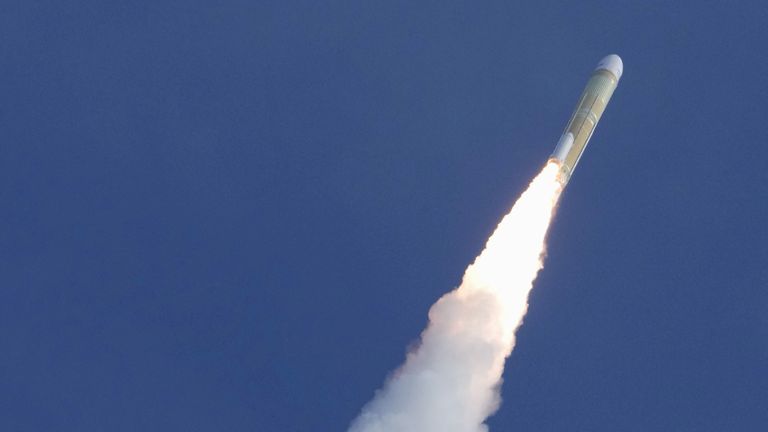
                       The H3 rocket lifted off from Japan on Saturday. Pic: Reuters


Japan's new H3 flagship rocket has reached orbit following a successful launch - in a key test almost a year after its debut flight failed.

H3 lifted off from the Tanegashima Space Centre in the southwest of the country on Saturday morning, after a two-day delay due to bad weather.

The rocket reached orbit at an altitude of about 420 miles (670km) and released two satellites, the Japan Aerospace Exploration Agency (JAXA) said.

A second test model of H3 rocket rises into the air after blasting off from the launching pad at Tanegashima Space Center on the southwestern island of Tanegashima, Kagoshima Prefecture, Japan February 17, 2024, in this photo taken by Kyodo. Mandatory credit Kyodo via REUTERS ATTENTION EDITORS - THIS IMAGE WAS PROVIDED BY A THIRD PARTY. MANDATORY CREDIT. JAPAN OUT. NO COMMERCIAL OR EDITORIAL SALES IN JAPAN
Image:Pic: Reuters

On its debut last March, H3's second-stage engine failed to ignite because of possible electrical issues. And the rocket had to be destroyed 14 minutes after lift-off, along with its payload, the advanced land observation satellite (ALOS-3).

Following the success of the second H3, JAXA president Hiroshi Yamakawa told a news conference: "We feel so relieved to be able to announce the good results."

Mr Yamakawa said they "made a big first step" towards achieving H3's goals of securing independent access to space and proving it could compete with other countries in the growing international market for satellite launches.

Saturday's launch continues Japan's space programme's recent successful run, including sending an unmanned spacecraft to the Moon last month.

H3 will succeed Japan's current mainstay rocket, H-2A, which is set to be retired after two more flights.

As the rocket soared and released its first payload successfully, project members at the JAXA command centre cheered and hugged each other in livestreaming footage, some crying with joy and relief, NHK television said.

JAXA H3 project manager Masashi Okada called the result "perfect", saying H3 cleared all missions set for Saturday's flight and told reporters: "I now feel a heavy load taken off my shoulders."

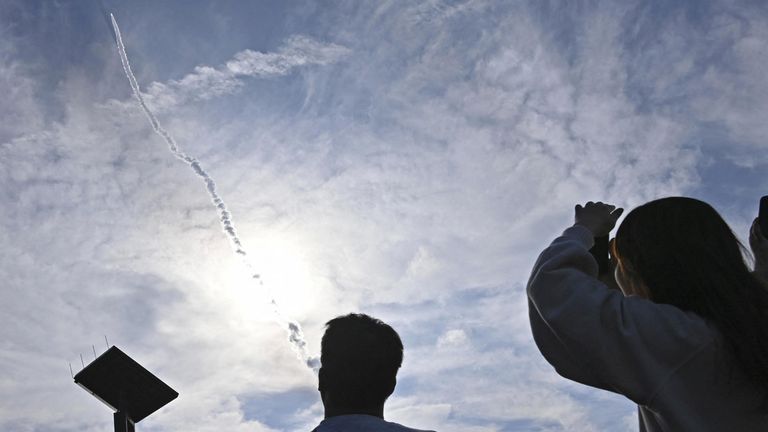
A second test model of H3 rocket rises into the air after blasting off from the launching pad at Tanegashima Space Center while people look on, on the southwestern island of Tanegashima, Kagoshima Prefecture, Japan February 17, 2024, in this photo taken by Kyodo. Mandatory credit Kyodo via REUTERS ATTENTION EDITORS - THIS IMAGE WAS PROVIDED BY A THIRD PARTY. MANDATORY CREDIT. JAPAN OUT. NO COMMERCIAL OR EDITORIAL SALES IN JAPAN
Image:Spectators watch the launch. Pic: Reuters

The rocket was decorated with thousands of stickers carrying messages sent from well-wishers around the country.

Two microsatellites - observation satellite CE-SAT-IE, and TIRSAT - were launched on H3.

The rocket also carried a mock-up of the ALOS satellite, called VEP-4, which was not designed to be released.


Sunday, February 18, 2024

Defense News: Brazil: Minas Gerais Military Police Set to Upgrade Equipment with Arad 7 Rifles


Brazil: Minas Gerais Military Police Set to Upgrade Equipment with Arad 7 Rifles


The police will bolster itself with 1,310 assault rifles in caliber 7.62x51 mm worth app. $3.1 million, from Israel’s IWI


Eyal Boguslavsky, Israel Defense, 18/02/2024

                                                        Arad 7 rifle Photo: IWI website

Israel’s IWI will supply the Military Police of Minas Gerais (Brazil) with Arad 7 assault rifles. The Spanish website Defensa.com reported that last week the Police signed a contract with Israel Weapons Industries )IWI) for approximately 3.1 million dollars, for the supply of a batch of 1,310 ARAD 7 assault rifles in caliber 7.62 x 51 mm.

IWI won this tender over the following companies: B&T (United States), Ceska Zbrojovka - CZ (Czech Republic), Lewis Machine Tools – LMT (United States), and Kale Kalip (Turkey).

The ARAD 7 assault rifles for the Minas Gerais Military Police, which will be delivered before the end of 2024, will be supplied with ten 20-round magazines, a tactical strap, a front grip with bipod, and a Picatinny rail (MIL STD 1913) on the top and flat-top on both sides and bottom, aiming organs (dash and rear sight) and Flip-up type folding with Tritium

The report also notes that the 7.62 x 51 mm ARAD 7 is in service with the Israeli Yaman Special Police Unit, in units of the IDF in the Operations against Hamas IN Gaza, and in the Tanzanian Army. Added to these are the Sao Paulo Civil Police and shortly the Peruvian Army, which acquired 10,000 rifles that are being assembled by the Army Weapons and Ammunition Factory (FAME SAC).

IWI confirms the transaction and states that the assault rifles have successfully passed all NATO standard tests and that this transaction is a continuation of the company's ongoing activities in Brazil in particular and Latin America in general.

Saturday, February 17, 2024

Robotics News: Scientists build robot based on creature that lived 500 million years ago


Scientists build robot based on creature that lived 500 million years ago


The researchers' approach, which they dubbed as “paleobionics,” using extinct animals to inform soft robotic design, has the potential to increase understanding of evolution and biomechanics. 


A team of scientists is creating robots with the movement of ancient animals, such as pleurocystitids, a sea creature that lived around 500 million years ago, the Biophysical Society announced last week.

Richard Desatnik, a scientist at Carnegie Mellon University, collaborated with paleontologists from Europe to build these robots, called “soft robots.”

Soft robots are created from soft materials and designed to have mechanical properties similar to those of living tissues, which provides robots with flexibility and increases safety in human interactions. These robots are suited for use in medical devices and enhancing efficiency in various tasks, among other activities.

Additionally, since these robots are more flexible, they may be beneficial for ocean or space exploration or doing certain jobs in those environments, according to the report by the Biophysical Society. 

“We've learned a lot from modern creatures, but that's only 1% of the animals that have existed during our planet’s history, and we want to see if there is something we can learn from the other 99% of creatures that once roamed the earth,” Desatnik said. 

Fossil flower of Symplocos kowalewskii (Symplocaceae) from Baltic amber – to date, by far the largest floral inclusion discovered from any amber. (credit: CAROLA RADKE, MFN (MUSEUM FÜR NATURKUNDE BERLIN))

“There are animals that were very successful for millions of years, and the reason they died out wasn't from a lack of success from their biology," he continued. "There may have been a massive environmental change or extinction event.”

Process of building the robots

The scientists began building the robots using fossils of the extinct creature, which used a muscular stem, similar to a tail, to propel themselves forward. The scientists used CT scans to understand the creature’s shape and computer simulations to illustrate how it moved. Based on this data, they built a soft robot that accurately portrayed the prehistoric creature, most similar to modern-day sea stars and sea urchins.

These underwater soft robots may help in the future, “whether it's geologic surveying or fixing all the machinery that we have underwater,” Desatnik points out.

The researchers' approach, which they dubbed “paleobionics,” using extinct animals to inform soft robotic design, has the potential to increase understanding of evolution and biomechanics.      

Thursday, February 15, 2024

Which came first: Black holes or galaxies?

Feb 10, 2024, by R. Molar Candanosa, Johns Hopkins U.

An illustration of a magnetic field generated by a supermassive black hole in the early universe, showing turbulent plasma outflows that turn gas clouds into stars. 
Credit: ROBERTO MOLAR CANDANOSA / JHU

Black holes not only existed at the dawn of time, they birthed new stars and supercharged galaxy formation, a new analysis of James Webb Space Telescope data suggests.

The insights upend theories of how black holes shape the cosmos, challenging classical understanding that they formed after the first stars and galaxies emerged. Instead, black holes might have dramatically accelerated the birth of new stars during the first 50 million years of the universe, a fleeting period within its 13.8 billion-year history.

"We know these monster black holes exist at the center of galaxies near our Milky Way, but the big surprise now is that they were present at the beginning of the universe as well and were almost like building blocks or seeds for early galaxies," said lead author Joseph Silk, a professor in the Department of Physics and Astronomy at Johns Hopkins University and at Institute of Astrophysics, Paris, Sorbonne University. "They really boosted everything, like gigantic amplifiers of star formation, which is a whole turnaround of what we thought possible before—so much so that this could completely shake up our understanding of how galaxies form."

The work is newly published in the Astrophysical Journal Letters.

Distant galaxies from the very early universe, observed through the Webb telescope, appear much brighter than scientists predicted and reveal unusually high numbers of young stars and supermassive black holes, Silk said.

Conventional wisdom holds that black holes formed after the collapse of supermassive stars and that galaxies formed after the first stars lit up the dark early universe. But the analysis by Silk's team suggests that black holes and galaxies coexisted and influenced each other's fate during the first 100 million years. If the entire history of the universe were a 12-month calendar, those years would be like the first days of January, Silk said.

"We're arguing that black hole outflows crushed gas clouds, turning them into stars and greatly accelerating the rate of star formation," Silk said. "Otherwise, it's very hard to understand where these bright galaxies came from because they're typically smaller in the early universe. Why on earth should they be making stars so rapidly?"

Black holes are regions in space where gravity is so strong that nothing can escape their pull, not even light. Because of this force, they generate powerful magnetic fields that make violent storms, ejecting turbulent plasma and ultimately acting like enormous particle accelerators, Silk said. This process, he said, is likely why Webb's detectors have spotted more of these black holes and bright galaxies than scientists anticipated.

"We can't quite see these violent winds or jets far, far away, but we know they must be present because we see many black holes early on in the universe," Silk explained. "These enormous winds coming from the black holes crush nearby gas clouds and turn them into stars. That's the missing link that explains why these first galaxies are so much brighter than we expected."

Silk's team predicts the young universe had two phases. During the first phase, high-speed outflows from black holes accelerated star formation, and then, in a second phase, the outflows slowed down. A few hundred million years after the big bang, gas clouds collapsed because of supermassive black hole magnetic storms, and new stars were born at a rate far exceeding that observed billions of years later in normal galaxies, Silk said. The creation of stars slowed down because these powerful outflows transitioned into a state of energy conservation, he said, reducing the gas available to form stars in galaxies.

"We thought that in the beginning, galaxies formed when a giant gas cloud collapsed," Silk explained. "The big surprise is that there was a seed in the middle of that cloud—a big black hole—and that helped rapidly turn the inner part of that cloud into stars at a rate much greater than we ever expected. And so the first galaxies are incredibly bright."

The team expects future Webb telescope observations, with more precise counts of stars and supermassive black holes in the early universe, will help confirm their calculations. Silk expects these observations will also help scientists piece together more clues about the evolution of the universe.

"The big question is, what were our beginnings? The sun is one star in 100 billion in the Milky Way galaxy, and there's a massive black hole sitting in the middle, too. What's the connection between the two?" he said. "Within a year we'll have so much better data, and a lot of our questions will begin to get answers."

Authors include Colin Norman and Rosemary F. G. Wyse of Johns Hopkins; Mitchell C. Begelman of University of Colorado and National Institute of Standards and Technology; and Adi Nusser of the Israel Institute of Technology.


Recommend this post and follow
Sputnik's Orbit