Thursday, June 20, 2024

Defense News: Israeli Navy receives second of new US-built landing craft


Israeli Navy receives second of new US-built landing craft


2,500-ton INS Komemiyut docks at Haifa Naval Base following lengthy voyage, months after first vessel delivered


By EMANUEL FABIAN, Times of Israel, 16 June 2024

INS Komemiyut landing craft is seen being escorted into Israel's territorial waters by other Navy vessels, June 16, 2024. (Israel Defense Forces)


The Israeli Navy on Sunday received the second of two new landing craft from a shipyard in the United States, with the vessel mooring at the Haifa Naval Base after making a lengthy voyage to the country.

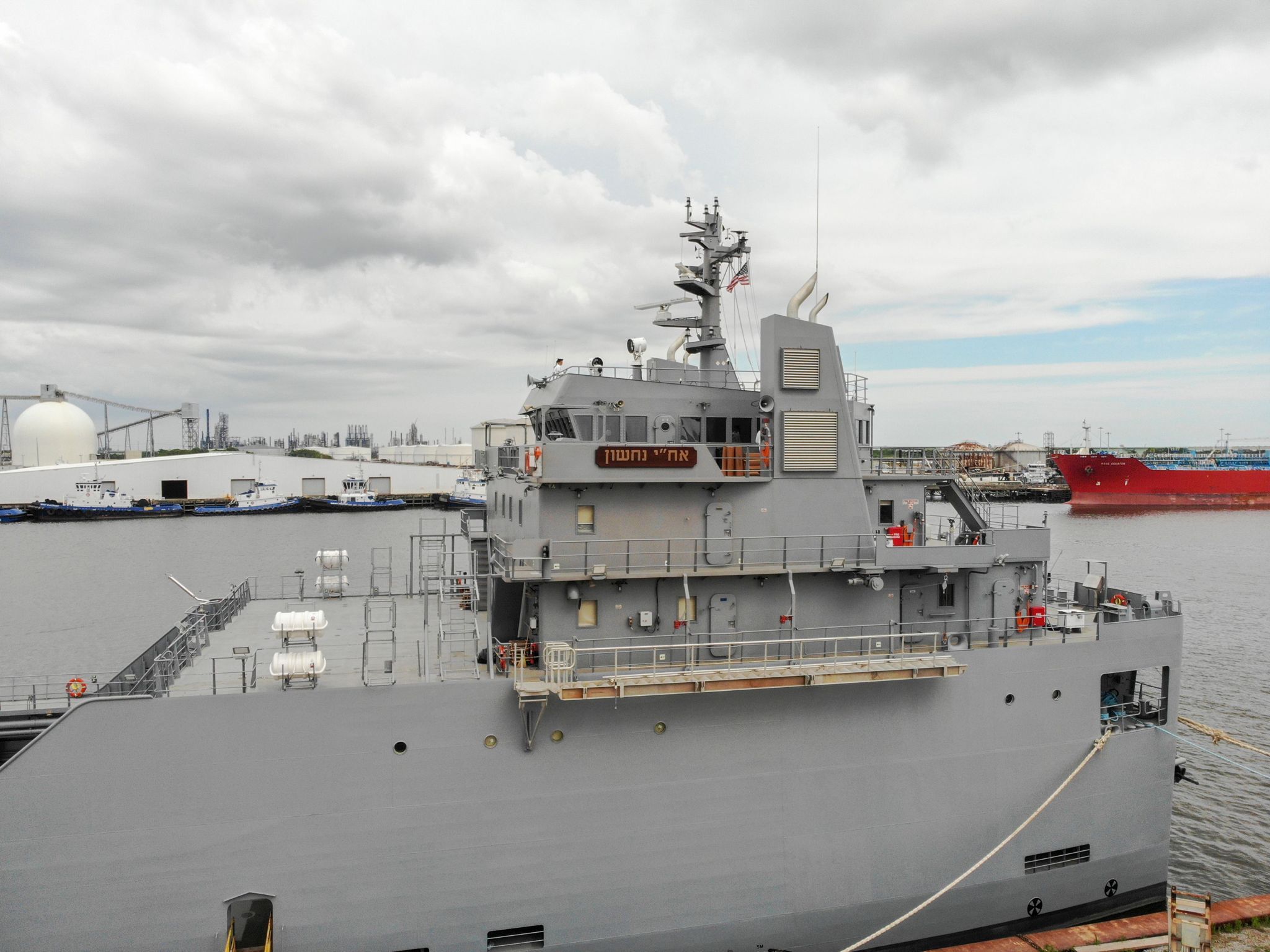
The US-built INS Komemiyut was the Navy’s second landing craft, after the INS Nahshon, which was received in early October last year.

As the INS Komemiyut arrived in Israel’s territorial waters, it was escorted by a flotilla of other Navy ships, with one vessel symbolically leaving the formation as a salute to the slain soldiers of the war, the military said.

The Israel Defense Forces has previously said that the vessels, which weigh 2,500 tons each and are approximately 95 meters (311 feet) in length and 20 meters (65 feet) wide, will “act as a central pillar in adapting the Israeli Navy to the modern and multi-arena battlefield.”

The vessels were procured using funds from US military aid to Israel.

“Today, at the same time as IDF soldiers are engaged in intense fighting in the various arenas, the Navy received a vessel of strategic significance for the State of Israel. During these historic moments, we salute our brothers in arms who fell during their mission to maintain the security of the State of Israel,” the chief of the Navy, Vice Adm. David Sa’ar Salama, said in remarks released by the military on Sunday.

Vice Adm. David Sa’ar Salama, head of the Israeli Navy, speaks at a ceremony at Atlit Naval Base, July 10, 2023. (Israel Defense Forces)

“Sailors of the INS Komemiyut, today you have completed a voyage of thousands of miles. The end of the voyage is the beginning of the journey for you. Your future actions will strengthen the cooperation between the IDF branches, expand the range of military operations, and maintain the security of the State of Israel,” he added.

The Navy expects to declare the INS Nahshon operational during 2024. No timeline was given for INS Komemiyut.

Each landing craft team consists of dozens of combat sailors, a quarter of them female soldiers and officers, the IDF said previously. The ship will be commanded by a Navy officer with the rank of lieutenant commander — the Ground Forces equivalent of a major.

The Israeli Navy INS Nahson landing craft is seen at the Pascagoula Shipyard, Mississippi, August 8, 2023. (Israel Defense Forces)

Landing craft are primarily used to transport troops and equipment across the sea and deploy them on the shore during an amphibious assault.

The Israeli Navy used such vessels since its inception in 1948 and until 1993, when the last of the aging landing crafts were decommissioned, with the military assessing at the time that it had no use for newer models.

The new procurement of the landing crafts for the Israeli Navy began some four years ago.

THIS PAGE WAS POSTED BY SPUTNIK ONE OF THE SPUTNIKS ORBIT BLOG   

HTTPS://DISQUS.COM/HOME/FORUM/THESPUTNIKSORBIT-BLOGSPOT-COM/

Wednesday, June 19, 2024

Cheap yet ultrapure titanium metal might enable widespread use in industry

JUNE 17, 2024, by U. of Tokyo

Researchers from the Institute of Industrial Science, The University of Tokyo, have efficiently removed oxygen from high-oxygen-concentration titanium, which might help reduce the production cost of an otherwise versatile metal.
 Credit: Institute of Industrial Science, The University of Tokyo

Titanium is the ninth most abundant element in the Earth's crust, yet products based on pure titanium are uncommon because it's expensive to remove the oxygen from titanium ore. Reducing costs would encourage manufacturers to take advantage of the highly useful properties of titanium in their products.

Now, in a study published in Nature Communications, researchers from the Institute of Industrial Science, The University of Tokyo, have developed a procedure that reduces the cost of producing titanium that's almost entirely free of oxygen. This oxygen removal protocol might benefit technological development and environmental sustainability.

Titanium is an incredibly versatile material because not only does it typically resist chemical damage, it's strong yet light. For example, its light weight compared with other metals is why the base frame of modern iPhones consists of titanium alloy, despite the increased cost.

Unfortunately, producing ultrapure titanium is significantly more expensive than manufacturing steel (an iron alloy) and aluminum, owing to the substantial use of energy and resources in preparing high-purity titanium. Developing a cheap, easy way to prepare it—and facilitate product development for industry and common consumers—is the problem the researchers aimed to address.

"Industry mass-produces iron and aluminum metal—but not titanium metal, because of the expense of removing the oxygen from the ore," explains Toru H. Okabe, lead author of the study. "We use an innovative technology based on rare-earth metals that removes oxygen from titanium to 0.02% on a per-mass basis."

A critical step in the researchers' protocol is reacting molten titanium with yttrium metal and yttrium trifluoride or a similar substance. The end result is a low-cost, solid, de-oxygenated titanium alloy. The reacted yttrium can be recycled for further use. A highlight of the researchers' work is that even titanium scrap that contains large amounts of oxygen can be processed in this manner.

"We're excited by the versatility of our protocol," says Toru H. Okabe. "The lack of intermediate compounds and straightforward procedures will facilitate adoption in industry."

This work is an important step forward in making more efficient use of high-purity titanium than at present. A limitation of this work is that the resulting de-oxygenated titanium contains yttrium, up to 1% by mass; yttrium can influence the mechanical and chemical properties of titanium alloy. After solving the yttrium contamination problem, applications to industrial manufacturing will be straightforward.


Recommend this post and follow
Sputnik's Orbit

Defense News: Congress wants to restore nukes on conventional B-52 bombers

Congress wants to restore nukes on conventional B-52 bombers 

By Bryant Harris and Stephen Losey, Defense News, June 18, 2024

https://www.defensenews.com/air/2024/06/18/congress-wants-to-restore-nukes-on-conventional-b-52-bombers/

A B-52 Stratofortress assigned to the 2nd Bomb Wing at Barksdale Air Force Base, La., takes off in support of a Bomber Task Force mission from Navy Support Facility, Diego Garcia, March 26, 2024. Congress is moving to restore the ability to carry and release nuclear weapons from about 30 B-52s, which were converted to only carry conventional weapons as part of the New START treaty. (Master Sgt. Staci Kasischke/Air Force)


Congress is laying the groundwork to restore nuclear weapon capabilities on roughly 30 B-52H Stratofortress bombers that had been converted to drop only conventional munitions as part of the New START arms control treaty with Russia.


Both the Senate and House defense policy bills for fiscal 2025 would require the Air Force to once again make these conventional bombers part of the nuclear triad nearly a decade after removing those capabilities to comply with limits under the New START treaty. The current treaty is set to expire in February 2026.


Lawmakers are eager to beef up the U.S. nuclear arsenal given Russia’s suspension of the treaty and China’s rapidly expanding strategic warhead production. Opponents of the measure argue that the directives will make it more difficult to negotiate a new treaty while complicating efforts to significantly extend the lifespan of the B-52 bomber fleet first introduced during the Cold War.


“The treaty expires in 2026, and the prospect of Russia coming to the table for serious arms control discussions is incredibly unlikely,” House Armed Services Chairman Mike Rogers, R-Ala., said last week upon introducing the amendment to the FY25 defense policy bill, legislation the House passed 217-199 on Friday. “We need to be prepared to face a nuclear environment without any treaty limitations.”


The House bill would require the Air Force to begin reconverting the bombers within a month after the current treaty expires and complete the restoration of their nuclear capabilities by 2029. The House passed the B-52 amendment by voice vote over opposition from Rep. Adam Smith of Washington, the top Democrat on the Armed Services Committee.


“The Department of Defense is not interested in doing this,” said Smith. “What they’re interested in doing is investing in the B-21, which is the next generation nuclear-capable bomber. This would cost a great deal of money. Also, they’re currently trying to extend the life of a number of B-52s out to 2050, which they think they can do. This would be another added expense to that.”


The Senate Armed Services Committee voted 22-3 on Friday to advance its version of the bill with a similar provision directing the restoration of nuclear capabilities across the entire B-52 fleet.


The Air Force’s 76 B-52s are the oldest bombers in its fleet and have been flying since the early 1960s. During the Cold War, the Air Force flew nuclear-armed Stratofortresses along the edge of Soviet airspace.


Today, it remains one of the key elements of the U.S. nuclear triad, and is capable of carrying the AGM-86B air-launched cruise missile, or ALCM, nuclear weapon.


The weapon systems officer station in the belly of a B-52H Stratofortress contains the controls to release the conventional — and in some cases, nuclear — weapons the six-decade-old bomber can carry. (Stephen Losey/Defense News)


Not all B-52s have that capability. The Air Force in 2015 began removing nuclear capabilities from about 30 B-52Hs to comply with New START requirements.


The Senate ratified New START in 2010. The treaty limits both countries to 1,550 deployed warheads. Although Washington and Moscow agreed to extend the treaty for five years in 2021, Russia suspended its participation in New START in 2023 amid heightened tensions with NATO over its invasion of Ukraine.


Air Force Global Strike Command declined to comment about the potential restoration of nuclear capabilities to the rest of the B-52 fleet.


Mark Gunzinger, a former B-52 pilot and director of future concepts and capability assessments at the Mitchell Institute for Aerospace Studies, said that if it does happen, the reconversions would probably take place during depot maintenance at Tinker Air Force Base in Oklahoma, as the B-52 fleet receives top-to-bottom upgrades.


Later this decade, the Air Force will begin a sweeping overhaul of the B-52 fleet, giving the six-decade-old bombers new engines, radar, avionics, digital cockpit displays, wheels and brakes, and other improvements.


The modernization is so significant that the service plans to redub these bombers the B-52J. The service eventually plans to have a fleet of two bombers, with the B-52J flying alongside the new B-21 Raider once the Air Force retires the B-1 Lancer and B-2 Spirit.


Deployed warheads

President Joe Biden’s arms control adviser Pranay Vaddi told the annual Arms Control Association conference in Washington this month that the U.S. has reached out to Russia about negotiating a follow-on agreement to New START but that Moscow has been unwilling to engage.


He said the Biden administration does not currently plan to increase the number of deployed warheads, though those decisions would be contingent on Russian and Chinese actions ahead of New START’s expiration.


“The reasons for having an increase in your day-to-day deployed nuclear weapons has to be pretty compelling for a decision to be made to do that,” said Vaddi. “One of the main triggers for that or the latest indicators that we have to pay attention to is what the [People’s Republic of China] ends up doing.”


“Those are important considerations for us to bear in mind as we march toward February 1, 2026.”


The U.S. deploys some 1,770 strategic nuclear warheads while Russia deploys around 1,822, according to the Nuclear Threat Initiative. China currently has around 500 operational warheads and the Pentagon expects Beijing will reach 1,500 by 2035.


Daryl Kimball, the executive director of the Arms Control Association, argued the B-52 amendment and other measures in the defense bill could make negotiating a follow-up treaty with Russia more difficult.


“This provision as well as some other provisions that are in the bills that purpose steps to increase the number of deployed strategic nuclear weapons are extremely premature, counterproductive and – given the skyrocketing cost of the existing nuclear weapons modernization program – they’re cost prohibitive,” Kimball told Defense News. “Some members of Congress unnecessarily panic and are looking for ways to increase the US stockpile without a clear national security rationale.”


Another provision in the Senate defense policy bill from Sen. Deb Fischer of Nebraska, the top Republican on the Strategic Forces panel, would require a plan to develop an additional 50 Sentinel Intercontinental Ballistic Missiles on top of 400 ICBMs already deployed.


Gunzinger said that with Russia no longer adhering to the New START treaty, it makes sense to bolster the B-52 fleet’s nuclear capabilities given the potential threats the United States could face from China and Russia, as well as Iran and North Korea.


“We’re now facing a situation where there’s two nuclear peers,” Gunzinger told Defense News. “We have a nuclear triad that’s sized for a single nuclear peer, Russia.”


Gunzinger said the restoration could probably be done without much difficulty. The necessary wiring is probably still in place, he said, and physical components that had been removed could be re-installed.


“It’s doable, and that’s the beauty of maintaining bombers that can be re-equipped with the appropriate [nuclear weapons] components,” he said. “It’s a hedge against future uncertainty, and we are now in a future where it’s not one that we expected, even just a few short years ago.”



THIS PAGE WAS POSTED BY SPUTNIK ONE OF THE SPUTNIKS ORBIT BLOG   

HTTPS://DISQUS.COM/HOME/FORUM/THESPUTNIKSORBIT-BLOGSPOT-COM/

Tuesday, June 18, 2024

Defense News: Eurosatory 2024: Polish Borsuk IFV Debuts with Spike Anti-Tank Missiles


Eurosatory 2024: Polish Borsuk IFV Debuts with Spike Anti-Tank Missiles

As of today, four vehicles have been supplied to the Polish army units and they are currently undergoing testing

Eyal Boguslavsky, Israel Defense, 17/06/2024  

https://www.israeldefense.co.il/en/node/62318


A Borsuk (Badger) serving with the Polish armed forces 15th Mechanized Infantry Brigade 


Photo: Mathew Foster via Wikimedia Commons


Polish company PGZ Group unveils its Borsuk infantry fighting vehicle (IFV) for the first time outside of Poland. This armored vehicle is currently on display at the company's booth at the Eurosatory 2024 exhibition in Paris. The Borsuk features a pair of Spike LR/LR2 anti-tank missile launchers manufactured by Israel's Rafael.

In addition to the Spike launchers, the Borsuk is equipped with the ZSSW-30 remotely controlled turret system. This turret features a 30 mm Mk 44S Bushmaster cannon and a coaxial 7.62 mm UKM-2000C general-purpose machine gun.

As of today (Monday), four vehicles have been supplied to Polish army units, which are currently undergoing testing.


THIS PAGE WAS POSTED BY SPUTNIK ONE OF THE SPUTNIKS ORBIT BLOG   

HTTPS://DISQUS.COM/HOME/FORUM/THESPUTNIKSORBIT-BLOGSPOT-COM/

Saturday, June 15, 2024

Satellite 'megaconstellations' may jeopardize recovery of ozone hole

JUNE 12, 2024, by American Geophysical Union

Thousands of satellites in “megaconstellations” have been launched to meet demand for global internet service, and thousands more will be launched in the near future. But these small satellites have a short lifespan and, when they burn up on reentry, will release ozone-destroying pollutants. A new study in Geophysical Research Letters quantifies this pollution for the first time. 
Credit: SpaceX/public domain

When old satellites fall into Earth's atmosphere and burn up, they leave behind tiny particles of aluminum oxide, which eat away at Earth's protective ozone layer. A new study finds that these oxides have increased 8-fold between 2016 and 2022 and will continue to accumulate as the number of low-Earth-orbit satellites skyrockets.

The study is published in the journal Geophysical Research Letters.

The 1987 Montreal Protocol successfully regulated ozone-damaging CFCs to protect the ozone layer, shrinking the ozone hole over Antarctica with recovery expected within fifty years. But the unanticipated growth of aluminum oxides may push pause on the ozone success story in decades to come.

Of the 8,100 objects in low Earth orbit, 6,000 are Starlink satellites launched in the last few years. Demand for global internet coverage is driving a rapid ramp up of launches of small communication satellite swarms. SpaceX is the frontrunner in this enterprise, with permission to launch another 12,000 Starlink satellites and as many as 42,000 planned. Amazon and other companies around the globe are also planning constellations ranging from 3,000 to 13,000 satellites, the authors of the study said.

Internet satellites in low Earth orbit are short-lived, at about five years. Companies must then launch replacement satellites to maintain internet service, continuing a cycle of planned obsolescence and unplanned pollution.

Aluminum oxides spark chemical reactions that destroy stratospheric ozone, which protects Earth from harmful UV radiation. The oxides don't react chemically with ozone molecules, instead triggering destructive reactions between ozone and chlorine that deplete the ozone layer. Because aluminum oxides are not consumed by these chemical reactions, they can continue to destroy molecule after molecule of ozone for decades as they drift down through the stratosphere.

Yet little attention has yet been paid to pollutants formed when satellites fall into the upper atmosphere and burn. Earlier studies of satellite pollution largely focused on the consequences of propelling a launch vehicle into space, such as the release of rocket fuel. The new study, by a research team from the University of Southern California Viterbi School of Engineering, is the first realistic estimate of the extent of this long-lived pollution in the upper atmosphere, the authors said.

"Only in recent years have people started to think this might become a problem," said Joseph Wang, a researcher in astronautics at the University of Southern California and corresponding author of the new study. "We were one of the first teams to look at what the implication of these facts might be."

https://www.youtube.com/watch?v=1YXdv4Ry2XY
A satellite solar array drive mechanism meets a fiery end in a wind tunnel simulation of burn-up during atmospheric reentry. 
Credit: European Space Agency/German Aerospace Center

Sleeping threat

Because it's effectively impossible to collect data from a spacecraft that's burning up, previous studies used analyses of micrometeoroids to estimate potential pollution. But micrometeoroids contain very little aluminum, the metal that makes up 15% to 40% of the mass of most satellites, so these estimates didn't apply well to new "swarm" satellites.

To get a more accurate picture of pollution from satellite re-entry, the researchers modeled the chemical composition of and bonds within satellites' materials as they interact at molecular and atomic levels. The results gave the researchers an understanding of how the material changes with different energy inputs.

In 2022, reentering satellites increased aluminum in the atmosphere by 29.5% over natural levels, the researchers found. The modeling showed that a typical 250-kilogram (550-pound) satellite with 30% of its mass being aluminum will generate about 30 kilograms (66 pounds) of aluminum oxide nanoparticles (1-100 nanometers in size) during its reentry plunge. Most of these particles are created in the mesosphere, 50-85 kilometers (30-50 miles) above Earth's surface.

The team then calculated that based on particle size, it would take up to 30 years for the aluminum oxides to drift down to stratospheric altitudes, where 90% of Earth's ozone is located.

The researchers estimated that by the time the currently planned satellite constellations are complete, every year, 912 metric tons of aluminum (1,005 U.S. tons) will fall to Earth. That will release around 360 metric tons (397 U.S. tons) of aluminum oxides per year to the atmosphere, an increase of 646% over natural levels.


Recommend this post and follow
Sputnik's Orbit

Defense News: No 30-year-old drone wingmen: US Air Force eyes regular CCA overhauls


No 30-year-old drone wingmen: US Air Force eyes regular CCA overhauls


By Stephen Losey, Defense News, Jun 15, 2024


A conceptual design of low-cost, attritable drones serving as wingmen for a crewed fighter jet. (U.S. Air Force)


The Air Force’s aircraft fleet is replete with fighters, bombers, tankers and other aircraft that are still flying after decades or even generations.


But the service’s planned collaborative combat aircraft — drones that will fly alongside crewed fighters — probably won’t last even a single generation before they need to be replaced or heavily overhauled, Chief of Staff Gen. David Allvin said Thursday.


Allvin, speaking at the Air and Space Forces Association in Arlington, Virginia, said planning from the start to regularly replace CCAs is the best way to keep their missions simple and costs down, so the service can field them in significant numbers.


“I don’t want a set of collaborative combat aircraft that’s going to last for 25 to 30 years,” Allvin said. “If it’s going to last 25 or 30 years, then it’s gotta do everything but make you toast in the morning.”


Making CCAs into complex, multi-mission aircraft will inevitably drive up the cost, Allvin said, meaning the Air Force could only buy a limited number of them. '


Air Force officials have regularly talked about the need for CCAs to augment its crewed fighters and provide what they call “affordable mass.” A smaller fleet of more expensive drone wingmen, as Allvin is trying to avoid, would make achieving that affordable mass goal harder to reach.


Allvin instead envisions technology advancing quickly enough that after a decade, a class of CCAs might be outdated and ready to be replaced – or heavily updated with new technologies.


“That CCA won’t be as relevant — but it might be adaptable, and that’s why we’re building in the modularity,” Allvin said.


Air Force Secretary Frank Kendall has told the service to plan for a CCA fleet of about 1,000 drones to fly alongside the F-35A Joint Strike Fighter and the service’s planned Next Generation Air Dominance fighter. The missions CCAs would carry out will likely vary and include strike operations, gathering intelligence and reconnaissance, conducting electronic warfare, and serving as decoys.


Kendall also made affordability a requirement for the CCA program, and has said each drone must cost a fraction of an F-35′s price tag.


In April, the Air Force announced it had selected Anduril and General Atomics to further develop designs for their CCA concepts, and then build production-representative test aircraft.


At Thursday’s event, Allvin noted the financial stresses the Air Force is facing, including inflation and limited budgets.


“All of those pressures are coming to bear against us, and we do have to ask the fundamental question: What does an effective Air Force look like in the future and how much of that is dependent on external resources?” Allvin said.

General Atomics has developed an autonomous drone called Gambit that it is pitching for the Air Force's collaborative combat aircraft program. General Atomics and Anduril are the two companies that have been selected to move forward on designing, building and testing CCAs. (General Atomics)


Anduril and General Atomics have been selected to continue designing, building and testing autonomous collaborative drones as part of the Air Force's collaborative combat aircraft program. Anduril has proposed its Fury aircraft, shown here, as the Air Force's first generation of CCA. (Anduril)

But when asked if the service will be able to produce NGAD as it has planned, Allvin did not explicitly commit to the sixth-generation fighter.


“We’re going to have to make those choices, make those decisions across the landscape,” Allvin said. “That’s going to probably play out in the next couple of years.”


THIS PAGE WAS POSTED BY SPUTNIK ONE OF THE SPUTNIKS ORBIT BLOG   

HTTPS://DISQUS.COM/HOME/FORUM/THESPUTNIKSORBIT-BLOGSPOT-COM/

Friday, June 14, 2024

Technology News: AI can now detect if cats are in pain by scanning feline faces


AI can now detect if cats are in pain by scanning feline faces


An app has been trained to detect pain in cats faces by scanning thousands of pictures of felines. The developers of the artificial intelligence app say it is more than 95% accurate.


Sky News, Thursday 13 June 2024

https://news.sky.com/story/ai-can-now-detect-if-cats-are-in-pain-by-scanning-feline-faces-13152363

Which cat is in pain? The AI is trained to spot that the one on the left is not in pain whereas the ginger cat on the right is. Pic: Careology


Artificial intelligence (AI) can now detect whether your cat is in pain by looking at its face, using an app built by vets and developers in Japan.

The AI app was trained using 6,000 pictures of cats, and developers say it is more than 95% accurate.

The head of the Animal Medical Centre at Nihon University worked on the app. He said vets like him can tell to a certain degree whether an animal is in pain or not, but it's harder for owners.

"More than 70% of elderly cats have arthritis or pain, but only 2% of them actually go to a hospital," said Professor Edamura.

"So rather than a final diagnosis, we use [the app] as a tool to make owners aware of whether the situation is normal or not."

More than 230,000 people have used the app since it launched in Japan last year.

The cat photos used to train the AI app were designed to enable it to tell when a cat is feeling pain. Pic: Reuters


Mayumi Kitakata lives in Tokyo with her 14-year-old cat Chi. She uses the app to read his face each day.

"He is at an age where more and more diseases are going to appear," said Ms Kitakata.

The head of Nihon University Animal Medical Center, Professor Kazuya Edamura, gives a lecture to students on the diagnosis of pain in cats. Pic: Reuters

Pets are very popular in the country, with the Japan Pet Food Association estimating there were almost 16 million pet cats and dogs in the country last year, more than the number of children under 15.

The app, called CatsMe!, was developed by Careology and researchers at Nihon University.

THIS PAGE WAS POSTED BY SPUTNIK ONE OF THE SPUTNIKS ORBIT BLOG   

HTTPS://DISQUS.COM/HOME/FORUM/THESPUTNIKSORBIT-BLOGSPOT-COM/