
Muon telescopes set to map Khafre’s pyramid from the King’s Chamber

Two complementary trackers
Detector 1 consists of two 61 × 61 × 2 cm polyvinyl-toluene (PVT) plates. Each face carries sixty wavelength-shifting fibres per axis, read out by silicon photomultipliers. Simulations—and upcoming bench tests—indicate a position resolution better than one centimetre once stray reflections are suppressed with black paint. The prototype is now being characterised at the Egypt-Japan University of Science and Technology in Alexandria.
Detector 2, assembled in Romania, stacks four layers of narrow polystyrene bars at right angles. A valid event requires one bar hit in every layer, allowing a straight-line track to be reconstructed. Monte-Carlo studies give the telescope an angular acceptance of 1.82 steradians when the upper and lower pairs are separated by 90 centimetres, expanding to 5.71 steradians if the layers are compressed. Laboratory images of lead shapes, water tanks and cable rolls confirm that the system resolves density differences after two-day exposures once open-sky backgrounds are subtracted.
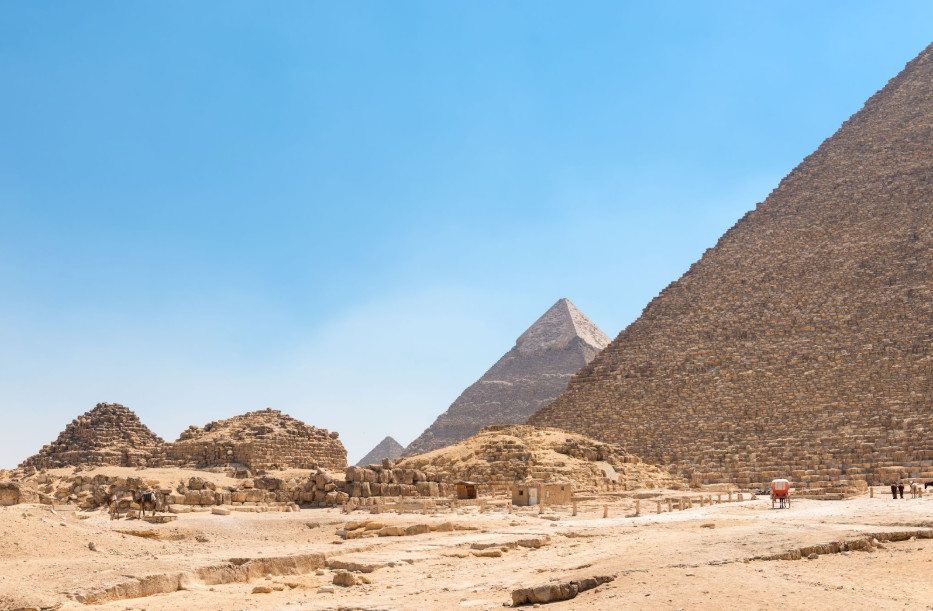 |
A Geant4 framework combines detailed detector geometries with a CAD model of Khafre’s pyramid. Using standard cosmic-ray spectra, the authors calculate a flux of about 1.44 muons per second per square metre in the burial chamber—enough to collect the 10^8 tracks needed to reveal a void comparable to the 30-metre cavity found in Khufu’s pyramid in 2017. The same models suggest that an upward-looking telescope placed in the chamber and a second unit outside the northern face could together generate a three-dimensional density map.
Next steps
Once commissioning in Egypt is complete, ScIDEP plans to lower at least one tracker into the king’s chamber and position its partner outside. The collaboration is also finalising FPGA-based read-out electronics to replace commercial boards that proved unreliable during early testing. Muon-data reconstruction and imaging algorithms are under active development in the same simulation environment that set the 10^8-muon sensitivity benchmark.
The project follows half a century of pyramid muography—from Luis Alvarez’s pioneering spark-chamber search in 1970 to the ScanPyramids discovery of Khufu’s “big void” and north-face corridor. By combining modern scintillators with high-rate silicon photomultipliers, ScIDEP hopes to show whether Khafre’s apparently simple interior conceals overlooked passages or chambers—one cosmic particle at a time.
Written with the help of a news-analysis system.


No comments:
Post a Comment