
Scientists detect the most massive black hole merger ever observed
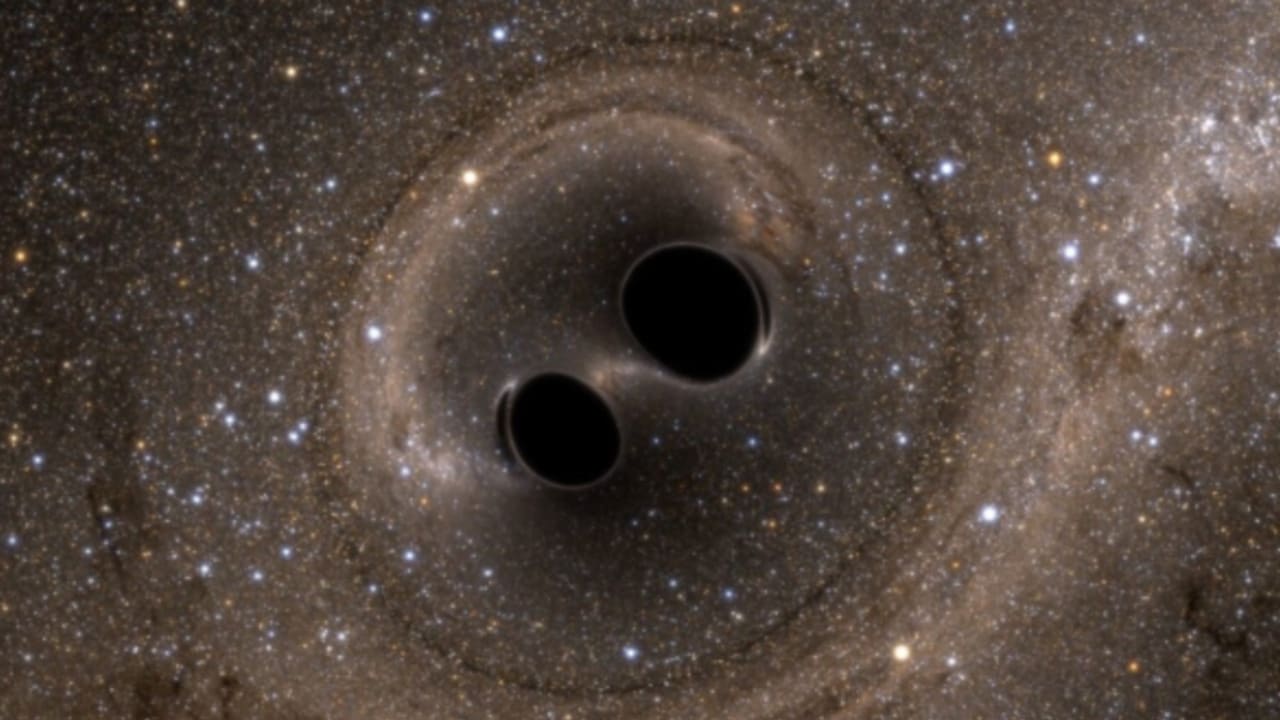 |
| Scientists detect the most massive black hole merger ever observed. (photo credit: Caltech-LIGO) |
Scientists have detected the most massive black hole merger ever recorded, located over 10 billion light-years away from Earth. On November 23, 2023, gravitational waves from the event, known as GW231123, reached Earth, with detectors capturing signals of the colossal collision, according to Space.com.
The merger, observed by the LIGO/Virgo/KAGRA collaboration, involved two black holes with masses of approximately 103 and 137 times that of the Sun, making them the heaviest black holes reliably recorded. The black holes finally collided to form a single, larger black hole, estimated to be about 265 times greater than the mass of the Sun, making it the most massive black hole produced in a merger detected in gravitational waves.
"These are the largest black holes we have confidently measured using gravitational waves," said Professor Mark Hannam, noting the unusual mass range of these black holes, according to Space.com. He added, "This is the largest black hole pair we have ever observed with gravitational waves, and it is a serious challenge to our understanding of black hole formation."
The gravitational wave signal, GW231123, lasted only 0.1 seconds, making it challenging for scientists to interpret the data, especially due to the high rotation speeds of the black holes involved. The two black holes were spinning at extreme speeds, with the larger black hole spinning at 90 percent of its maximum possible speed and the other at 80 percent, as reported by The Indian Express.
Researchers believe that the merged black holes in the GW231123 event are products of previous mergers, which explains their large mass and rapid spin. Such a scenario suggests a hierarchical formation process, where smaller black holes merge to form larger ones, which then continue to combine in densely populated stellar environments.
"These black holes fall into a mass gap that challenges conventional wisdom on how black holes form," noted the research team. According to current stellar evolution models, black holes of this size should not form directly from collapsing stars due to a phenomenon known as pair-instability supernova, which prevents the formation of black holes between 60 and 130 solar masses.
Hannam explained that such large black holes cannot be accounted for by standard models. "But for really massive stars, our theories say that the collapse is unstable, and most of the mass is blasted away in supernova explosions, and a black hole cannot form," he said, according to Live Science. "We don't expect black holes to form between about 60 and 130 times the mass of the Sun."
The high mass and rapid spin of the black holes have pushed the limits of gravitational-wave detection technology, making the signal much more difficult to interpret. "That makes the signal difficult to model and interpret. It's an excellent case study for pushing forward the development of our theoretical tools," said Charlie Hoy, a member of the LIGO Scientific Collaboration at the University of Portsmouth, according to Futurism.
The detection demonstrates the capabilities of the LIGO/Virgo/KAGRA network in capturing such extreme cosmic events. Since its first observing run in 2015, the collaboration has detected over 300 black hole mergers, including more than 200 in the fourth observational cycle alone. Each discovery provides valuable insights into the nature of black holes and the workings of the universe.
The GW231123 event also underscores the importance of continued advancements in gravitational-wave astronomy. "The detectors we are planning for the next 10 to 15 years will be able to see all the black hole mergers in the universe, and perhaps some surprises we didn't expect," Hannam remarked.
Scientists are particularly interested in the rotation speeds of the black holes in GW231123, as they are close to the maximum possible allowed by Einstein's General Theory of Relativity. This may help determine whether black holes are more likely to collide and merge in certain astrophysical environments.
"This event pushes our instrumentation and data-analysis capabilities to the edge of what's currently possible," said Sophie Bini, an LVK member and researcher at the California Institute of Technology, according to Space.com. "It's a powerful example of how much we can learn from gravitational-wave astronomy—and how much more there is to uncover."
The signal's brief duration and complexity present a unique challenge to scientists. "It will take years for the community to fully unravel this intricate signal pattern and all its implications," noted Gregorio Carullo, an LVK team member from the University of Birmingham.
The record-breaking merger not only provides a wealth of data for scientists to analyze but also prompts a reevaluation of existing theories. The discovery may help refine models of black hole formation and evolution, potentially opening new directions in theories of gravity, astrophysics, and cosmology.
Researchers are continuing to refine their analysis and improve the models used to interpret such extreme events. As more observations of similar high-spin mergers are made, scientists hope to better understand the processes that lead to the formation of massive black holes like those observed in GW231123.
"This is just the beginning," Hannam said. "Usually, what happens in science is that when you look at the universe in a different way, you discover things you weren't expecting, and your whole picture transforms."
this article was assisted by a news-analysis system.


No comments:
Post a Comment