Friday, October 9, 2020

Technology News: Driverless car company Waymo expands service — without backup drivers


Driverless car company Waymo expands service — without backup drivers


by Associated Press, October 8, 2020


Waymo CEO John Krafcik, Getty Images

Waymo is allowing the general public to hitch a ride in its driverless autonomous vehicles in Phoenix, expanding a service it had been quietly offering to a select group of riders for the past year.

The service launches to the general public Thursday. The vehicles, which will have no back-up drivers behind the wheel to take over in sticky situations, will serve an area of 50 square miles. There won’t be anyone watching remotely who can take over in an emergency and drive the car.

Before the coronavirus struck, which reduced demand for rides, Waymo was providing 1,000 to 2,000 rides in autonomous vehicles per week. Most of the rides had a backup driver behind the wheel, but 5 percent to 10 percent of the rides were fully virtual, available only to a smaller group of riders who signed non-disclosure agreements. Waymo did not disclose how many fully autonomous vehicles will be available to the public in the Phoenix area.

I took a ride in Waymo’s fully driverless car, the Verge, Dec 9, 2019


“We are worried about our ability to meet demand with the capabilities of the vehicle we have right now,” CEO John Krafcik said in a conference call with reporters.

Waymo is hoping to eventually expand the service into California, but does not yet have concrete expansion plans to announce, Krafcik said.

Waymo, a unit of Google parent Alphabet, has been running an autonomous vehicle service with selected riders since 2018.

A ride in a Waymo driverless car, TechCrunch, Nov.1, 2019

TechCrunch contributor Ed Niedemeyer gets a ride in Waymo's driverless Chrysler Pacifica minivan in the Phoenix suburb of Chandler. The company is starting to match members of its early rider program with driverless rides as it starts scaling up its robotaxi service.

To help encourage safety during the pandemic, Waymo provides wipes and sanitizing gel in the car and asks riders to confirm in a checklist that they haven’t been exposed to the coronavirus. Waymo requires riders to wear masks and checks that masks are being worn using cameras inside the car. The vehicles also have an air circulation feature that helps remove germs that other riders may have introduced.

For the next several weeks, every Waymo ride in the Phoenix area will be without a backup driver. After that, Waymo will re-introduce human backup drivers behind the wheel in some of the vehicles so the company can work on expanding its service area.

Please recommend this page & follow the Sputniks Orbit 

SPACE - S0 - 20201009 - Single Recurrent Novae, Plasma Cosmology

SPACE - S0 - 20201009 - Single Recurrent Novae, Plasma Cosmology

Good Morning, 0bservers!


Looks like that rise in solar wind speeds yesterday petered out pretty quickly, spending most of the day dropping back down from a high of 420 KPS to a low of just under 300 KPS before midnight. Current speeds are in the 300-330 KPS range. Temperature and particle density also dropped down some, although not as precipitously. the KP-Index went even lower, with an even mix of KP-1s and KP-0s. X-Ray Flux readings remain in the low Class A flare range, and the Electron Flux stayed under the threshold. The lithosphere was active; we had a Mag 5.1 about 36 miles ESE of Nokolski Alaska, a Mag 5.0 a bit over 100 miles ESE of Kirakria in the Solomon Islands, a Mag 5.2 South of Katabu Indonesia, and a Mag 5.3 NNE of Saint Kitts and Nevis.

Please Recommend this page and be sure to follow the Sputnik's Orbit 


AND WHILST YOU ARE HERE BE SURE TO FOLLOW AND RECOMMEND THE COCONUT WHISPERER https://disqus.com/home/forum/the-coconut-whisperer/

Defense News: Elbit to supply Sabrah light tanks to Philippine Army


Elbit to supply Sabrah light tanks to Philippine Army


The Southeast Asian country's military decided early this year to acquire the tank but the spread of COVID-19 has delayed the signing of the deal, a report says

By Eyal Boguslavsky, Israel Defense, 10/08/2020

The Sabrah tank. Photo: Elbit 

Philippine blog MaxDefense reports that the country's military decided in early 2020 to purchase the Sabrah light tank produced by Israel's Elbit Systems. However, the spread of the coronavirus epidemic is said to be preventing the final signing of the agreement. The blog estimates that the value of the first shipment is about $30 million.

Elbit's competitors for the Philippine Army Light Tank tender were the Turkish-South Korean joint venture Hanwha-Otokar's K21-105 tracked light tank, the Arma 105 tank destroyer, and the Harimau medium tank produced by Indonesia's PT Pindad.

In its original proposal, Elbit Systems offered a version of the ASCOD 2 medium main battle tank (MMBT) and the Pandur II tank destroyer. Elbit used the same Oto Melara Hitfact 105mm tank turret found on the ASCOD 2 MMBT, but with the gun and subsystems from Elbit Systems. Elbit also incorporated the ASCOD turret into the Pandur II tank destroyer, all in order to meet the requirements of the Philippine Army acquisition project.

MaxDefense reported that at one point the Philippine Army preferred to award the project to Hanwha-Otokar, mainly because the venture offered not only the largest number of units relative to the price, but also assembly of some of the tanks in the Philippines. The blog said there were also various technical and regulatory reasons for the Army's preference.

Following this development, Elbit Systems revised its offer and proposed the new Sabrah light tank instead, abandoning the Hanwha-Otokar turret and developing a new turret with the assistance of the Merkava tank directorate and a South African turret manufacturer. The new light tank still uses ASCOD 2 and Pandur II as platforms, but now with a higher elevation arc and auto loading system compatible with those found on the K21-105, Amra 105 and Harimau MT. Although proving to the Philippine Army that a well-trained loader can load 6 rounds per minute and that a fourth crew member is more helpful and less dangerous than removing it in favor of an automatic loading system, Elbit decided to simply follow the Philippine Army requirement for 3 crew members, according to the report.

The blog noted that one of Elbit's main selling points, which apparently gave them the lead in the project, is the use of Elbit's C4 system, including the Battle Management System (BMS), and the Combat NG fire control and command system. These are already in service in the Philippine Army's upgraded M113A2 APCs, 155mm towed howitzers, ATMOS 155mm self-propelled howitzers, and in the M113 mortar-carrying APCs about to reach the Philippine Army. Elbit's recent winning of a contract, which Israel Defense reported this week, to supply E-Lynx software-based radios compatible with C4 systems installed in Sabrah light tanks is seen as increasing the likelihood of Elbit winning the light tank tender.

Israel offers Sabrah light tank for the Philippine Army, Defense Upgrade PH, Oct 9, 2020


Please recommend this page & follow the Sputniks Orbit 

Thursday, October 8, 2020

Astronomers find evidence planets start to form while infant stars are still growing

OCTOBER 7, 2020, by Max Planck Society
https://phys.org/news/2020-10-astronomers-evidence-planets-infant-stars.html

The dense L1709 region of the Ophiuchus Molecular Cloud, mapped by the Herschel Space Telescope, which surrounds and feeds material to the much smaller IRS 63 proto-star and planet-forming disk (location marked by the black cross). 
Credit: MPE/D. Segura-Cox, Herschel data from ESA/Herschel/SPIRE/PACS/D. Arzoumanian

Astronomers have found compelling evidence that planets start to form while infant stars are still growing. The high-resolution image obtained with the Atacama Large Millimeter/submillimeter Array (ALMA) shows a young proto-stellar disk with multiple gaps and rings of dust. This new result, just published in Nature, shows the youngest and most detailed example of dust rings acting as cosmic cradles, where the seeds of planets form and take hold.

An international team of scientists led by Dominique Segura-Cox at the Max Planck Institute for Extraterrestrial Physics (MPE) in Germany targeted the proto-star IRS 63 with the ALMA radio observatory. This system is 470 light years from Earth and located deep within the dense L1709 interstellar cloud in the Ophiuchus constellation. Proto-stars as young as IRS 63 are still swaddled in a large and massive blanket of gas and dust called an envelope, and the proto-star and disk feed from this reservoir of material.

In systems older than 1,000,000 years, after the proto-stars have finished gathering most of their mass, rings of dust have been previously detected in great numbers. IRS 63 is different: at under 500,000 years old, it is less than half the age of other young stars with dust rings and the proto-star will still grow significantly in mass. "The rings in the disk around IRS 63 are so young," emphasizes Segura-Cox. "We used to think that stars entered adulthood first and then were the mothers of planets that came later. But now we see that proto-stars and planets grow and evolve together from early times, like siblings."


The ALMA image of the young planet-forming dust rings surrounding the IRS 63 proto-star, which is less than 500,000 years old. 
Credit: MPE/D. Segura-Cox


Planets face some serious obstacles during their earliest stages of formation. They have to grow from tiny dust particles, smaller than household dust here on Earth. "The rings in the disk of IRS 63 are vast pile-ups of dust, ready to combine into planets," notes co-author Anika Schmiedeke at MPE. However, even after the dust clumps together to form a planet embryo, the still-forming planet could disappear by spiraling inwards and being consumed by the central proto-star. If planets do start to form very early and at large distances from the proto-star, they may better survive this process.

The rings and gaps in the IRS 63 dust disk compared to a sketch of orbits in our own Solar System at the same scale and orientation of the IRS 63 disk. The locations of the rings are similar to the locations of objects in our Solar System, with the inner ring about the size of the Neptune orbit and the outer ring a little larger than the Pluto orbit. 
Credit: MPE/D. Segura-Cox

The team of researchers found that there is about 0.5 Jupiter masses of dust in the young disk of IRS 63 further than 20 au from its center (at a distance similar to the Uranus orbit in our solar system). That is not counting the amount of gas, which could add up to 100 times more material. It takes at least 0.03 Jupiter masses of solid material to form a planet core that will efficiently accrete gas and grow to form a giant gas planet. Team member Jaime Pineda at MPE adds, "These results show that we must focus on the youngest systems to truly understand planet formation." For example, there is growing evidence that Jupiter may have actually formed much farther out in the Solar System, beyond the Neptune orbit, and then migrated inwards to its present location. Similarly, the dust surrounding IRS 63 shows that there is enough material far from the proto-star and at a stage young enough that there is a chance for this Solar System analog to form planets in the way that Jupiter is suspected to have formed.

"The size of the disk is very similar to our own Solar System," Segura-Cox explains. "Even the mass of the proto-star is just a little less than our Sun's. Studying such young planet-forming disks around proto-stars can give us important insights into our own origins."


Recommend this post and follow Sputnik's Orbit
https://disqus.com/home/forum/thesputniksorbit-blogspot-com/

SPACE - S0 - 20201008 - Major Climate News, Super Flare Science, Last Chance

SPACE - S0 - 20201008 - Major Climate News, Super Flare Science, Last Chance

Good Morning, 0bservers!


Had a rise in solar wind speeds, from a low of almost 300 KPS at midday to a peak of nearly 420 KPS near midnight, with a current speed in the range of 360-380 KPS. Preceding this was a rise in particle density and temperature. The Phi Angle is a bit destabilized as well, but in spite of all this the KP-Index is still quite low, mostly KP-1 readings with a couple KP-2s in the mid-evening. There was a brief boost over the threshold for the Electron Flux, but X-Ray Flux readings continue to drop, nearly out of the Class A flare range. The video images from the Sun are showing some minor coronal hole development in the lower latitudes, and some small bright spots appearing in the Southern hemisphere at around 35°. Those bright spots are showing some minor magnetic complexity on the SDO HMI Magnetogram, so we have a higher potential for flare/ejection activity. We didn't have much beyond blot echo activity yesterday, although there was a Mag 5.1 temblor about 35 miles ESE of Cruz Bay, US Virgin Islands, and a Mag 5.0 quake about 70 miles NW of Olonkinbyen, Svalbard and Jan Mayen (sounds like a Swedish law firm...).

Please Recommend this page and be sure to follow the Sputnik's Orbit 


AND WHILST YOU ARE HERE BE SURE TO FOLLOW AND RECOMMEND THE COCONUT WHISPERER https://disqus.com/home/forum/the-coconut-whisperer/

Wednesday, October 7, 2020

Technology News: Israel's Gadfin joins hands with energy firm Enel on developing capabilities of VTOL drone


Israel's Gadfin joins hands with energy firm Enel on developing capabilities of VTOL drone

By Israel Defense, 10/07/2020

 Gadfin's Spirit One electrical Vertical Take-Off and Landing (eVTOL) vehicle, photo by Gadfin

Israel's Gadfin, a manufacturer of drones for aerial surveys and deliveries, has signed an agreement with Italy-based electricity infrastructure company Enel under which they will jointly develop the inspection capabilities of Gadfin's Spirit One electrical Vertical Take-Off and Landing (eVTOL) vehicle.

Enel and Gadfin are to work together through INFRALAB, the innovation lab set up by Enel and Israel's Shikun&Binui construction and infrastructure group, located in the city of Haifa. The two companies plan to develop innovative inspection solutions and work together to enable the surveying of 800,000km of the multinational power company's voltage lines, according to Gadfin.

After demonstrating the Spirit One's long-range performance capabilities to ENEL, Gadfin was chosen from among 35 companies as the most innovative solution to solve the challenge of inspecting electrical infrastructures with efficient and sustainable technology, Gadfin said. The company estimated that the project could be worth up to $12 million per annum.   

The selection of Gadfin, a breakthrough in the company’s international activities, was based on the capability of its unmanned long range eVTOL autonomous aircraft to cover long distances quickly, efficiently and safely. This capability assures ENEL of advanced service that amounts to significant savings on ENEL operating teams and handling breakdowns in remote, hard-to-access areas, while providing continuous electrical flow to its clients worldwide, according to the Israeli company. 

Gadfin says that it is offering the world, for the very first time, an 25Kg MTOW-category eVTOL unmanned vehicle with a flight range of more than 250 km. The Spirit One is said to be in line with the strictest international safety standards and capable of flying at high speed and in almost any type of weather. The aircraft is operated autonomously with almost no human intervention.

Gadfin's Spirit One eVTOL vehicle taking off.   photo by Gadfin

Gadfin's CEO Eyal Regev said “The agreement with INFRALAB and ENEL choice once again proves Gadfin’s technological advantages and the outstanding solutions it offers for long flight range, low operational costs, and high levels of safety. I am sure that we will see similar contracts in the future, which will leverage the company’s ability to improve the efficiency and service for many companies in the world, which in the end translates into savings for each and every one of us."

Early this year, Gadfin became the first company to receive a permit from Israel’s Civil Aviation Authority for urban airspace deliveries, enabling the linking of hospitals, laboratories, and other organizations and institutions by drones. 

Gadfin was established in 2018 by Eyal Regev, Ran Kleiner and Ilan Yuval. It specializes in developing drones of various sizes for aerial infrastructure surveys and B2B drone delivery needed by organizations such as hospitals and medical laboratories.

Gadfin Presenting the next generation of Air Cargo Drones, Sep 8, 2020


Please recommend this page & follow the Sputniks Orbit 

EU’S EARTH OBSERVATION PROGRAM FINDS OZONE HOLE OVER ANTARCTICA IS AMONG THE LARGEST EVER RECORDED

 OCTOBER 7, 2020 CAP ALLON

https://electroverse.net/observation-program-finds-ozone-hole-over-antarctica-is-among-largest-ever-recorded/

The European Union’s Earth observation program said Tuesday that the ozone hole over Antarctica has swelled to its largest size and deepest level in at least 15 years, to become among the most notable ever recorded.

Clare Nullis of the WMO explains that the ozone hole begins to expand every August –at the start of the Antarctic spring– and reaches a peak around October. “The air has been below minus 78 degrees Celsius, and this is the temperature which you need to form stratospheric clouds — and this is quite a complex process,” said Nullis at a U.N. briefing. “The ice in these clouds triggers a reaction which then can destroy the ozone. So, it’s because of that that we are seeing the big ozone hole this year.”

These findings completely contradict the science behind the international accord (the Montreal Protocol) devised to phase out the use of ozone-depleting substances (OSDs). In addition, they also confirm what NASA has been saying for years: that the upper atmosphere is cooling.

OSDs have been on the decline since their peak in 2000 (shown below), and the “hole” growing –to among the largest ever recorded– a full 20 years later shows the correlation between OSDs and ozone is minor, at best.


Past and predicted levels of controlled gases in the Antarctic atmosphere, quoted as equivalent effective stratospheric chlorine (EESC) levels, a measure of their contribution to stratospheric ozone depletion.

The formation of stratospheric ozone is initiated by ultraviolet (UV) radiation coming from the Sun. As a result, an increase in the Sun’s radiation output increases the amount of ozone in Earth’s atmosphere. The Sun’s radiation output and sunspot number vary over the well-documented 11-year solar cycle. Observations over several solar cycles since the 1960s show that global total ozone levels vary by 1 to 2% between the maximum and minimum of a typical cycle. However, ‘global’ total ozone levels aren’t necessarily what we’re interested in here. Evidence suggests that ozone depletion during times of low solar activity is far greater above the poles than elsewhere on the planet, a phenomenon we’re seeing today, at both the Antarctic and Arctic.

This could well be the true cause of Polar Amplification. Climate alarmists, of course, love to claim that CO2 is disproportionately warming the Arctic, but they have no agreed-upon mechanism as to how this could occur. It is fantasy. On the other hand, a positive correlation between decreasing solar activity and ozone depletion above the Arctic fits almost perfectly, as does the negative correlation between ozone depletion and rising surface temps.

There is another important forcing to factor into all this: volcanic eruptions.

Explosive volcanic eruptions inject sulfur gases directly into the stratosphere, causing new sulfate particles to be formed. The particles initially form in the stratosphere downwind of the volcano and then spread throughout the hemisphere or globally as air is transported by stratospheric winds. One method of detecting the presence of volcanic particles in the stratosphere uses observations of the transmission of solar radiation through the atmosphere. When large amounts of new particles are formed in the stratosphere over an extensive region, solar transmission is measurably reduced (as are terrestrial temperatures). The eruptions of Mt. Agung (1963), El Chichón (1982), and Mt. Pinatubo (1991) are the most recent ‘sizable’ examples of sulfur injections that temporarily reduced solar transmission.

Chile’s Calbuco volcanic eruption (2015) is another. This stratospheric injection played a role in enhancing the size of the ozone hole back in 2015.


Average ozone concentrations over the southern hemisphere during October 1-15, 2015, when the Antarctic ozone hole for that year was near its maximum extent. The red line shows the boundary of the ozone hole.


At its maximum size, the 2015 hole was the fourth-largest ever observed. It was in the top 15% in terms of the total amount of ozone destroyed. Only 2006, 1998, 2001 and 1999 had more ozone destruction, whereas other recent years (2013, 2014 and 2016) ranked near the middle of the observed range.

2020’s hole appears even larger that 2015’s, clear indication that factors other than ODSs are key to ozone depletion above the poles — namely, surprise-surprise, solar and volcanic activity.

Unfortunately, the U.N. and its fraudulent little offshoot, the WMO, remains chained to the Montreal Protocol. Clare Nullis says that despite this year’s growing hole, experts still believe the ozone layer is slowly recovering after adoption of the accord in 1987, and she urges nations to stick to the measures, citing climate projections that indicate that the ozone layer will return to 1980 levels in 2060.

Link to mainstream article added by CC:  https://phys.org/news/2020-10-eu-largest-ozone-hole-antarctica.html


Recommend this post and follow Sputnik's Orbit.
https://disqus.com/home/forum/thesputniksorbit-blogspot-com/

SPACE - S0 - 20201007 - Predicting Nova, Storm Watch, Winning Sim

SPACE - S0 - 20201007 - Predicting Nova, Storm Watch, Winning Sim

Good Morning, 0bservers!


Solar winds have calmed further from yesterday's report, now in the 320-340 KPS region. However, particle density is much higher. That surge yesterday, along with the Phi Angle, caused the KP-Index to hop up into the yellow range. Not the case today. Despite the elevated levels, the KP-Index dropped down to KP-1 levels throughout the day and night. The Electron Flux is still below the threshold, and the X-Ray Flux has also dropped further to near the bottom of the Class A flare range. No coronal holes on the surface this morning, and no new bright spots as yet. About the only activity were some prominences on the lim (pretty to look at, but not a risk to Earth). We had a ton of blot echo activity yesterday, but only one temblor of note - a Mag 5.4 in the South Shetland Islands.

 *** 

Apologies for such a short report today, folks. Feels like I went 10 rounds with the dentist yesterday. Jaw's still sore after he had to wrestle two back teeth. Knew I was in trouble when he hooked up the winch on his pickup truck... ;) 

Please Recommend this page and be sure to follow the Sputnik's Orbit 


AND WHILST YOU ARE HERE BE SURE TO FOLLOW AND RECOMMEND THE COCONUT WHISPERER https://disqus.com/home/forum/the-coconut-whisperer/

Tuesday, October 6, 2020

Canada halts sale of drone gear to Turkey over alleged use in Nagorno-Karabakh, Ankara dubs it 'double standards'

6 Oct, 2020, byRT Russian news.
https://www.rt.com/news/502653-turkey-canada-weapons-karabakh/

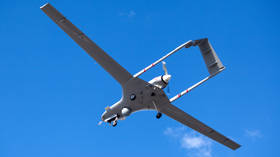
Turkish UAV TB2 Bayraktar © BIROL BEBEK / AFP

Canada has halted sales of drone sensors to Turkey over fears they could be used to help Baku fight Armenians in disputed Nagorno-Karabakh. Ankara responded by recalling Ottawa's arms exports to states involved in the Yemeni war.

The surprise decision by the Canadian government – announced by Foreign Affairs Minister Francois-Philippe Champagne on Monday – "is an indication of the double-standard approach of this country," the Turkish Foreign Ministry said in a statement on Tuesday.

Turkish diplomats also recalled that Ottawa has been less principled when it comes to exporting arms to other warring parties around the world. Canada "did not see any problem in exporting weapons to countries that were militarily involved in the crisis in Yemen, which was one of the greatest humanitarian tragedies of this century," Ankara noted.

Thriving Canadian weapons exports to Saudi Arabia have almost doubled since 2018, amounting to $2.9 billion in 2019, according to estimates. Riyadh is leading an air campaign by the coalition of Gulf states in war-torn Yemen against Houthi rebels. The UN recently accused Canada – along with France, the UK, the US, and Iran – of perpetuating the conflict that has killed roughly 112,000 people, among them 12,000 civilians, since its outbreak in 2014, creating a humanitarian crisis.

"There can be no explanation for preventing exports of defense products," Turkish diplomats insisted.

Champagne, meanwhile, justified the suspension of arms sales to Turkey by reference to concerns over Canadian technology "being used in the military conflict in Nagorno-Karabakh." Since September 27, the ethnic-Armenian-populated region has been engaged in heavy hostilities against Azerbaijan – which has the unwavering the support of Turkey.

"In line with Canada's robust export control regime and due to the ongoing hostilities, I have suspended the relevant export permits to Turkey, so as to allow time to further assess the situation," the minister's announcement read.

The move was reportedly made in response to calls from arms control advocates who alleged that Canadian-made drone optics and laser targeting systems were mounted on the TB2 Bayraktar, the Turkish armed unmanned aerial vehicle (UAV). The Azerbaijani military announced that it sought to purchase the drone back in June, although details of its operations with the air force are unclear.

Previously, Azerbaijani President Ilham Aliyev told TRT broadcaster that Turkish-made drones have helped the military to reduce human losses. Yerevan reported downing several Azerbaijani drones in combat. 

Turkish UAV TB2 Bayraktar © Birol BEBEK / AFP

Meanwhile, Armenian diplomats have piled pressure on Israel, one of Baku's major arms vendors. Last week, Yerevan recalled its ambassador to the Jewish state for consultation, demanding that it stop selling arms to Azerbaijan.

The demarche apparently yielded some results, with Ambassador Armen Smbatyan saying on Monday that Israel had given "a verbal promise" to halt arms supplies in the coming days.


Recommend this post and follow
Sputnik's Orbit
https://disqus.com/home/forum/thesputniksorbit-blogspot-com/

SPACE - S0 - 20201006 - Air Force: It's The Sun, Global Warming Oops

SPACE - S0 - 20201006 - Air Force: It's The Sun, Global Warming Oops

Good Morning, 0bservers!


Solar winds stayed mostly in the 340-380 KPS range yesterday, but did a bit of a slowdown after midnight UTC to around 320 KPS. There was a rise in particle density and temperature, but those appear due to Phi Angle activity. That activity actually increased the KP-Index into the minor solar storm category, with two KP-4 (yellow) readings in mid-evening and the early morning hours. You can see the effect as well on the GOES Magnetometer, where the field strength peaked near the same time at almost 140 nanoTeslas. The X-Ray Flux has calmed a bit to the lower end of the Class A flare range. And the Electron Flux has finally dropped below the threshold after four solid days above it. Not seeing any new sunspot or magnetic anomalies on the SDO HMI Magnetogram or the Solar Visible Disc images. The videos are showing very little in the bright spot range on the current facing disc, with the Northern bright spot crossing the Western lim today. Lots of incoming glow on the Eastern lim, but nothing fully showing as yet. There's also very little in the way of coronal hole development. So, let's enjoy this breather while we can. No such pause from the lithosphere, though, with a Mag 5.2 off New Caledonia, another Mag 5.2 along the Pacific-Antarctic Ridge, a third Mag 5.2 in the South Shetland Islands, a FOURTH Mag 5.2 (must've been a sale...) about 90 miles East of Leh, India, a Mag 5.6 along the Northern Mid-Atlantic Ridge, and a Mag 5.8 about 30 miles Southeast of Sand Point Alaska with a Mag 5.6 aftershock shortly afterward.

Please Recommend this page and be sure to follow the Sputnik's Orbit 


AND WHILST YOU ARE HERE BE SURE TO FOLLOW AND RECOMMEND THE COCONUT WHISPERER https://disqus.com/home/forum/the-coconut-whisperer/

Monday, October 5, 2020

Reappraisal of the climate impacts of ozone‐depleting substances

Olaf Morgenstern, Fiona M. O'Connor, Ben T. Johnson, Guang Zeng, Jane P. Mulcahy, Jonny Williams, João Teixeira, Martine Michou …First published: 28 September 2020
https://agupubs.onlinelibrary.wiley.com/doi/10.1029/2020GL088295

Added by CC from https://scied.ucar.edu/ozone-layer, 

Abstract

We assess the effective radiative forcing due to ozone‐depleting substances using models participating in the Aerosols and Chemistry and Radiative Forcing Model Intercomparison Projects (AerChemMIP, RFMIP). 
A large inter‐model spread in this globally averaged quantity necessitates an ``emergent constraint" approach whereby we link the radiative forcing to ozone declines measured and simulated during 1979‐2000, excluding two volcanically perturbed periods. 

During this period ozone‐depleting substances were increasing, and several merged satellite‐based climatologies document the ensuing decline of total‐column ozone.

Using these analyses we find an effective radiative forcing of ‐0.05 to 0.13 Wm‐2. Our best estimate (0.04 Wm‐2) is on the edge of the ``likely" range given by the 5th Assessment Report of IPCC of 0.03 to 0.33 Wm‐2, but is in better agreement} with two other literature results.

Plain Language Summary

Chloroflourocarbons and other compounds involved in ozone depletion are also powerful greenhouse gases, but their contribution to global warming is reduced due to the cooling effect of the ozone loss which they induce.
Models informing an upcoming climate report disagree on the ozone loss and thus on the climate influence of these gases. Here we use observed ozone loss to reduce the resultant uncertainty in their overall climate influence and infer a larger cooling. 
Here we use observed ozone loss to reduce the resultant uncertainty in their overall climate influence and infer a smaller warming influence of these substances than was considered likely in a 2013 climate report. 

The result implies a smaller benefit to climate due to their phase‐out, mandated under the Montreal Protocol, than would have been the case under previous understanding.


Recommend this post and follow
Sputnik's Orbit
https://disqus.com/home/forum/thesputniksorbit-blogspot-com/

Defense News: Huge contract for Israel's RADA: US Army procuring dozens of IM-SHORAD vehicles


Huge contract for Israel's RADA: US Army procuring dozens of IM-SHORAD vehicles


The vehicle is said to be able to deter, neutralize or destroy low-altitude aerial threats. Its radar is manufactured by the Israeli defense technology company

By Eyal Boguslavsky, Israel Defense, 10/04/2020

The IM-SHORAD vehicle with quadruple Stinger anti-aircraft missile launcher, 30 mm cannon & 2 Hellfire anti-tank missiles , right side view Photo: General Dynamics

The US Army announced last week that it has given the green light for initial production of an Interim Maneuver Short-Range Air Defense (IM-SHORAD) system, and awarded General Dynamics Land Systems (GDLS) a $1.2 billion contract to build the new vehicles. 

The army did not specify the number of vehicles that will be produced but said the deal will run through the end of September 2025. The IM-SHORAD's tracking systems are produced by Israeli tactical radar manufacturer RADA.. 

The IM-SHORAD vehicle with quadruple Stinger anti-aircraft missile launcher, 30 mm cannon & 2 Hellfire anti-tank missiles , left side view Photo: General Dynamics

Janes.com reported that GDLS declined to discuss the program but Don Kotchman, the company's vice president and general manager, told Janes that GDLS is “pleased to be able to partner with the army to bring this much-needed capability to US soldiers”.

The IM-SHORAD vehicle undergoing test firing a Hellfire anti-tank missile. Photo: US Army

The IM-SHORAD will operate in direct support of brigade combat teams to deter, neutralize or destroy low-altitude aerial threats, including Group 3 UAS, rotary wing and fixed wing aircraft. The new system, which is based on the Stryker A1 platform, includes the Leonardo DRS ground-to-air and ground-to-ground mission equipment package. Armed with Hellfire and Stinger missiles and a 30mm cannon, the new system will support the Army’s short-range air defense operational gap. 

Stryker A1 IM-SHORAD: Precise Short-Range Air Defense, General Dynamics Land Systems,Oct 14, 2019


The system includes kinetic and non-kinetic defeat capabilities and an on-board radar providing 360-degree air defense protection of the Stryker and armor brigade combat teams throughout the range of military operations.

Please recommend this page & follow the Sputniks Orbit 


SPACE - S0 - 20201005 - Big Ozone News, Crust Activation, Electric COVID

SPACE - S0 - 20201005 - Big Ozone News, Crust Activation, Electric COVID

Good Morning, 0bservers!


We've seen a continued drop in solar wind speeds, from yesterday's ride along the line of 400 KPS down to a low of  320 KPS, currently in the 340-360 KPS range. That drop started around mid-evening, but it was a minor slide compared to the drop in temperature, which went down a full order of magnitude in the span of a couple hours. There was also a dip in particle density around then, but that seemed to recover pretty quickly. None of those drops seemed to be generated by the Phi Angle, which showed no major disturbances or shifts throughout the day. The KP-Index was pretty calm yesterday, with KP-1 readings dominating, and a couple of KP-0 readings thrown in both before and after midnight UTC. Electron Flux readings remain well above the threshold. Those coronal holes I mentioned yesterday never fully formed, and their potential network seemed to be reabsorbed into the solar surface. Bright spots in the lower left of the video image are coming through now. The magnetometer readings aren't showing any magnetic complexity or actual sunspots underneath them, however.  There was a stack of blot echo activity since yesterday, including a Mag 5.6 near Tingloy Philippines (85 miles deep). Beyond those, we had two Mag 5.0 temblors, one about 75 miles East of Pangai Tonga, the other about 130 miles SSW of Lajes das Flores, Portugal. Those were followed by a Mag 5.2 about 115 miles East of Tandine, New Caledonia.

Please Recommend this page and be sure to follow the Sputnik's Orbit 


AND WHILST YOU ARE HERE BE SURE TO FOLLOW AND RECOMMEND THE COCONUT WHISPERER https://disqus.com/home/forum/the-coconut-whisperer/

Technology News: Tesla breaks quarterly vehicle delivery record but stock drops 7 percent


Tesla breaks quarterly vehicle delivery record but stock drops 7 percent


By Nicholas Vega,  New York Post, October 2, 2020


Tesla Model 3, AFP/Getty Images

Tesla on Friday announced that it set a new quarterly record for vehicle deliveries — but the good news did nothing to help the stock, which fell 6 percent.

The electric automaker’s said it delivered 139,300 in the third-quarter, surpassing the 137,000 forecast by Wall Street, and beating its previous high-water mark of 119,000, which it set at the end of 2019.

The more affordable Model 3 and Model Y models led the way, with 124,100 making their way to customers, while the Model S and Model X cars moved 15,200 units.

The company produced just over 145,000 vehicles in the quarter, and said that inventory has declined as it continues “to improve our delivery efficiency.”

2020 Tesla Model 3 - In Depth Review!, Car TV , Apr 13, 2020


Despite the good news, Tesla shares were dropped more than 7 percent Friday amid signs of a worsening economy at a time when the President of the United States has tested positive Covid-19.

“We think some of this was priced in because there were whispers of an above-consensus total over the next several days,” CFRA Research analyst Garrett Nelson told The Post.

Nelson added that Tesla, which is expected to announce its third quarter earnings later this month, appears poised to maintain profitability and make its case for inclusion in the S&P 500 index.

Tesla Model 3: The Complete Guide, Car and Driver, May 20, 2020


“We don’t see another quarterly loss in sight, absent more Covid shutdowns or some kind of production disruption,” Nelson said. “We do think their addition to the S&P 500 is an eventuality. We can speculate the reasons why they were not added, but it could be that the committee wanted to see another quarter of results.

Also on Friday, CEO Elon Musk tweeted that Tesla will enter India by 2021.

“Next year for sure,” Musk tweeted in response to a post with a picture of a T-shirt reading “India wants Tesla.”

“Thanks for waiting,” he added.

Please recommend this page & follow the Sputniks Orbit