Saturday, December 28, 2019

SPACE - S0 - 20191228 - Geomagnetism, Global Circuit, Sneaky Galaxy

SPACE - S0 - 20191228 - Geomagnetism, Global Circuit, Sneaky Galaxy

Good Morning, 0bservers!


The solar wind speed continued its slow slide downward from yesterday, now hovering around 360 KPS. We've had about two straight days of KP-1s but we're getting more KP-0s, so keep an eye out for the possibility of a Zero Day Alert. The bright spot and the coronal hole are only now reaching the meridian, so we'll see about a possible uptick in the next 72 hours. The lithosphere was very quiet, nothing of note to report...

Another extra video on the meaning and impact of nearby stellar superflares...


Please Recommend this page and be sure to follow the Sputnik's Orbit 


AND WHILST YOU ARE HERE BE SURE TO FOLLOW AND RECOMMEND THE COCONUT WHISPERER https://disqus.com/home/forum/the-coconut-whisperer/

China to complete Beidou competitor to GPS with new launches

DECEMBER 27, 2019

Credit: CC0 Public Domain

China said Friday its Beidou Navigation Satellite System that emulates the U.S. Global Positioning System will be competed with the launch of its final two satellites in the first half of next year.

Project director Ran Chengqi told reporters that the core of the positioning system was completed this month with the launch additional satellites bringing its total constellation to 24.

That was up from 19 the year before, making it one of rising space power China's most complex projects.

Ran described the system at a rare news conference as having "high performance indicators, new technology systems, high localization, mass production networking and a wide range of users."

"Before June 2020, we plan to launch two more satellites into geostationary orbit and the Beidou-3 system will be fully completed," Ran said.

The latest launches mark the third iteration of Beidou, meaning "Big Dipper," the first of which was decommissioned in 2012. Future plans call for a smarter, more accessible and more integrated system with Beidou at its core, to come online by 2035, Ran said.

"As a major space infrastructure for China to provide public services to the world, the Beidou system will always adhere to the development concept of 'China's Beidou, the world's Beidou, and the first-class Beidou,' serving the world and benefiting mankind," Ran said.

China's space program has developed rapidly along all lines over the past two decades and developing independent high-tech capabilities—and even dominating in fields such as 5G data processing—is a major government priority.

In 2003, China became just the third country to independently launch a manned space mission and has since constructed an experimental space station and sent up a pair of rovers to the surface of the moon. Future plans call for a fully-functioning permanent space station, a mission to mars and a possible crewed flight to the moon.


Recommend this post and follow Sputniks Orbit

Friday, December 27, 2019

SPACE - S0 - 20191227 - Weather Swings, Geomagnetic Jerk Forecast, Climate

SPACE - S0 - 20191227 - Weather Swings, Geomagnetic Jerk Forecast, Climate

Good Morning, Observers!


It's 52°F in Fort Wayne, IN, with a high of 49°F. Actually had a record high of 63°F yesterday, which climate scientists claimed as proof that Epstein Didn't Kill Himself...
   
The KP Index was low and stable, with all but one reading in the past 24 hours as KP-1 (the odd man out was a brief KP-0). Solar wind speeds peaked at 420 KPS and proceeded to slowly slide downward after yesterday's Phi-angle shift to a current level of 380 KPS. A number of bright spots faded in and out of existence, but the "biggie" in the Southern hemisphere should reach the midpoint later today, along with a coronal hole right along the equator. A pair of Mag 5.3 quakes struck north of Visokoi Island and two hours west of Palana Russia. Everything else was either blot echo quakes or lower level temblors.
   
Here's the followup of Ben Davidson's recent video on timing the arrival of the Galactic Current Sheet Impact, which will have a deleterious effect on our own star...
   
   
Please Recommend this page and be sure to follow the Sputnik's Orbit 


AND WHILST YOU ARE HERE BE SURE TO FOLLOW AND RECOMMEND THE COCONUT WHISPERER https://disqus.com/home/forum/the-coconut-whisperer/

Thursday, December 26, 2019

SPACE - S0 - 20191226 - Record Cold/Snow, Magnetic Shift Signal - STEVE?

SPACE - S0 - 20191226 - Record Cold/Snow, Magnetic Shift Signal - STEVE?

Good Morning, Observers!


Particle density rose about 12 hours ago, as well as a Phi-angle shift, and the solar winds started to climb slowly following this after staying steady most of yesterday, pushing toward 400 KPS. The KP Index did finally get off the floor yesterday with KP-1s and KP-2s, with a brief KP-3 reported around midnight UTC. That said, we did receive a Cosmic Ray Advisory around noon (EST) with the 26-hour KP Index averaging out at KP-0.25, so that risk has been thankfully blown away (literally) overnight. The sunspot in the Southern hemisphere remains active, but is showing some signs of decay, and is heading toward the meridian. A pair of Mag 5.1 quakes hit around New Caledonia and Fiji, with New Caledonia getting a Mag 5.5 later in the day, and there was a Mag 5.8 along the Southern East Pacific Rise (literally, the middle of nowhere).
   
Please Recommend this page and be sure to follow the Sputnik's Orbit 


AND WHILST YOU ARE HERE BE SURE TO FOLLOW AND RECOMMEND THE COCONUT WHISPERER https://disqus.com/home/forum/the-coconut-whisperer/

Wednesday, December 25, 2019

SPACE - S0 - 20191225 - Cascadia Unstable, Galactic Superflare, Cosmic Ray Alert

SPACE - S0 - 20191225 - Cascadia Unstable, Galactic Superflare, Cosmic Ray Alert

Merry Christmas, Observers!


Solar winds dropped down to a low of 300 KPS yesterday afternoon, but after midnight UTC it slowly rose up to a current level of 350 KPS The KP Index has been at KP-0 for 21 hours now, so watch out for any Zero Day Alerts (get the Disaster Prediction app from Suspicious0bservers, it's worth it for this alone). Coronal holes, both North and South, crossed the meridian, but they're not what you'd call "organized" so I can't be sure of what we're going to end up with from those. That very active bright spot in the Southern hemisphere is getting closer to the midpoint (probably in 24-36 hours) and you can see magnetic prominences but (so far) no bursts or CMEs. This one, keep watch over, because it DOES have underlying sunspots. Another off-shore Canadian quake hit overnight, Mag 6.2, and in almost exactly the same spot, so there's something brewing down there and it ain't Maxwell House. Columbia got whacked with a series of quakes, at Mag 6.0 and 5.8 within 15 minutes of each other, with a 5.1 several hours later. And Argentina experienced a Mag 6.0 in the low velocity zone, a blot echo 560 KM deep. Busy day in the lithosphere, that's for sure!
   
Oh, here's yesterday's new video from Ben Davidson. Well worth a look...
  
   
Allow me to wish all of you a very Merry Christmas a Happy Hanukkah, a Happy New Year, and a Hearty Huevos Rancheros for our Spanish-speaking friends...
   
Please Recommend this page and be sure to follow the Sputnik's Orbit 


AND WHILST YOU ARE HERE BE SURE TO FOLLOW AND RECOMMEND THE COCONUT WHISPERER https://disqus.com/home/forum/the-coconut-whisperer/

Tuesday, December 24, 2019

The Last Mars Panorama Sent by Opportunity Is So Beautiful We Could Cry

MIKE MCRAE, 24 DEC 2019

(NASA/JPL-Caltech/Cornell/ASU)

Before its circuits ran cold in the shadow of a Martian dust storm, Opportunity took one long look at its surroundings and saved it for posterity.

The image represents a poignant conclusion to the rover's mission; a detailed panorama combining the most recent tracks of its marathon journey with a glimpse of the sands it would never touch.

Forget the science for a moment. Just look at it.

(NASA/JPL-Caltech/Cornell/ASU)

Opportunity wasn't intended to run as long as it did. A mere 90 days eventually stretched into 15 solid years of rolling over the Martian sands, pumping out snapshots like a tourist who's forgotten all about their retirement.

The 360-degree image was taken from the rover's final resting place in May last year. Over 29 days, Opportunity soaked up its surroundings in a series of 354 individual snapshots before beaming them back to NASA for piecing together.

While most of them provide a colourful view of the landscape, the handful of black and white blocks in the corner were taken with fading energy, denying Opportunity the time it needed to capture the last of the scene in shades of green and violet.

"This final panorama embodies what made our Opportunity rover such a remarkable mission of exploration and discovery," says John Callas from NASA's Jet Propulsion Laboratory in Pasadena, California.

"To the right of centre you can see the rim of Endeavor Crater rising in the distance. Just to the left of that, rover tracks begin their descent from over the horizon and weave their way down to geologic features that our scientists wanted to examine up close.

"And to the far right and left are the bottom of Perseverance Valley and the floor of Endeavour crater, pristine and unexplored, waiting for visits from future explorers."

Whoever – or whatever – those future explorers will be is left to be seen.

No doubt one day a future space traveller of either human or robotic kind will rendezvous with the aged rover, and possibly even find a way to make it operational again.

Until then, the picture will go down in history with other famous snapshots of space exploration, serving as our eyes on another world.

Recommend this post and follow Sputniks Orbit

SPACE - S0 - 20191224 - Sunspots, Earthquakes, Climate Fight, Special Video

SPACE - S0 - 20191224 - Sunspots, Earthquakes, Climate Fight, Special Video

Merry Christmas Eve, Observers!


There was a miniature CME (more a "pop" actually) in the SouthWest approaching the lim, but there wasn't enough strength or direction to be a risk to Earth. A new bright spot came up on the SouthEast lim and that had some beautiful activity. Eyes open on that one as it approaches the midpoint. Solar winds remain relatively calm, hovering around 330 KPS, but there was a boost in particle density in the last couple of hours which is usually the precursor of a wind speed increase, so we'll see. KP Indexes remain in the KP-1 to KP-2 range, with a few KP-0s thrown in for good measure (but no cosmic ray hits on the detectors. Electron levels are generally flat. The ocean off the west coast of Canada was busy yesterday with a series of quakes building intensity from a Mag 5.1 to Mag 6.0 three quakes later, almost all in the same exact spot.Guatemala also got pranged with a Mag 5.8, as did Micronesia (same magnitude). 

By the bye, check out the NORAD Santa Tracker here:
   
   
Please Recommend this page and be sure to follow the Sputnik's Orbit 


AND WHILST YOU ARE HERE BE SURE TO FOLLOW AND RECOMMEND THE COCONUT WHISPERER https://disqus.com/home/forum/the-coconut-whisperer/

Monday, December 23, 2019

Defense - Next-Generation Anti-Ship Missile Achieves Operational Capability with Super Hornets

Next-Generation Anti-Ship Missile Achieves Operational Capability with Super Hornets

Space - Europe launches CHEOPS satellite to study planets in other solar systems

Europe launches CHEOPS satellite to study planets in other solar systems


By Associated Press,   December 18, 2019

The CHEOPS satellite gets placed on the Soyuz Fregat launch vehicle. AP photo

SAN JUAN, Puerto Rico — A European spacecraft was launched from South America on Wednesday on a three-year mission to study planets in other solar systems.
The Characterising ExOPlanets Satellite (CHEOPS) mission blasted off from Kourou, French Guiana, at 0854 GMT (3:54 a.m. EST) atop a Russian Soyuz rocket. The launch came 24 hours after a first attempt was delayed shortly before liftoff because of a software problem in the upper stage of the rocket.
The European Space Agency says the satellite is the first mission dedicated to studying bright nearby stars that are already known to have planets and will focus on “planets in the super-Earth to Neptune size range.” The agency hopes that the data sent by the mission will enable the bulk density of those planets to be calculated, a first step toward understanding them better.
Its telescope will focus on bright stars to determine the size of planets as they pass in front of their host star.
Swiss astronomer and Nobel Physics Prize winner Didier Queloz, who heads the CHEOPS science team, told the Associated Press earlier this week that the mission will focus on 100 of the more than 4,000 exoplanets — ones beyond our own solar system — discovered so far, partly to determine if there’s a possibility of an Earth-like planet capable of sustaining life.
“We are one planetary system among many,” he said. “It’s all about our place in the universe and trying to understand it.”
A telescope will analyze the exoplanets’ densities and radii and determine whether they have atmospheres, Queloz said.
“We know nothing, except that they are there,” he said. Queloz added that the telescope might spend one orbit, or 100 minutes, on one exoplanet and maybe 50 orbits, or five days, on another one, depending on their sizes.
More than four hours is expected to pass between liftoff and the separation of satellites.
The rocket also carried an Earth observation satellite for the Italian Space Agency that will serve scientists and commercial and government clients, according to launch company Arianespace. Three other satellites included one that aims to study zodiacal light and image the Milky Way, officials said.
Please recommend this page & follow the Sputniks Orbit 

Fewer fats over the festive season may be the perfect formula for men's fertility

DECEMBER 23, 2019, by University of South Australia

Credit: Shutterstock

A diet low in fat and high in egg whites could be the key to boosting male fertility according to a new pilot study.

The research, by Dr. Karma Pearce from the University of South Australia in collaboration with fertility specialist Prof Kelton Tremellen, Repromed, and Flinders University, presents a direct link between diet and testosterone—showing that what men eat could affect their fundamental male sex hormone.

The study is the first to identify that a diet high in any type of fat—including healthy mono-saturated fats such as olive oil—negatively impacts testosterone production over as little as five hours, yet one supplemented with egg whites, and to a lesser extent whey protein, can positively affect serum testosterone.

Globally, infertility affects 15 percent of couples, with the World Health Organization estimating that up to 25 percent of couples in developing countries are affected. While the causes are many and varied, 20-30 percent of the problems are attributed to male factors alone.

Lead researcher, Dr. Karma Pearce, says the preliminary findings present controversial insights over the shorter five-hour term about the link between testosterone and "healthy" monounsaturated fat, which is popularly considered to be a component of a healthy diet, including the Mediterranean dietary pattern.

"There's an assumption that 'good' fats and 'bad' fats perform as they're described—but what's surprising, is that it wasn't the type of fat that mattered at all, as an equal amount of the good and bad fats significantly supressed testosterone production," Dr. Pearce says.

While the researchers acknowledge they have tested individual nutrients and the effects may be different in the context of whole food dietary patterns, their earlier work has shown that "Western diets' typified by fast food dietary pattern produced a 25 percent decrease in serum testosterone within an hour of eating, with levels remaining suppressed below fasting baseline for up to four hours.

"In this study we also found that consuming albumen—the protein in egg whites—increased testosterone levels, and did so by four-fold relative to fasting, while albumin, combined with the bad saturated fat somewhat ameliorated the effect of the bad fats on testosterone levels, providing another diet-based influencer of testosterone levels."

The study tested eight diet protocols (meals comprising polyunsaturated fat; monounsaturated fat; refined carbohydrate (orange juice); whey; egg white; and mixed meals of polyunsaturated fat and refined carbohydrate; polyunsaturated fat and egg white; refined carbohydrate (orange juice) and egg white) with four blood tests/hormone analyses taken before eating and at every hour afterwards for five hours.

Dr. Pearce says the study is one step in a series of work needed to support and enhance fertility.

While the study only analyses the impact of various dietary macronutrients on testosterone production, not sperm quality, the researchers believe the study results suggest at least the potential for diet to negatively impact on sperm production and fertility. The findings are extremely promising for couples trying to start a family.

"It's important to note that it's still early days and more research needs to be done, particularly at looking at the effect of these nutrients in the context of whole food dietary patterns over the longer-term," Dr. Pearce says. "Over the Christmas period, for infertile men, and men with lower than normal testosterone levels, lowering the overall fat content and possibly increasing whey or adding egg whites may lead to improvements in testosterone levels over the shorter term."

The next step in their research is to evaluate the longer-term effect of these nutrients on testosterone levels in the context of whole food dietary patterns.

"The Effect of Macronutrients on Reproductive Hormones in Overweight and Obese Men: A Pilot Study" is published in the journal Nutrients.

Recommend this post and follow Sputniks Orbit

SPACE - S0 - 20191223 - Deadly Record Drought, Solar Climate Forcing, Andromeda

SPACE - S0 - 20191223 - Deadly Record Drought, Solar Climate Forcing, Andromeda

Good Morning, Observers!


Solar wind speeds stayed steady to slightly higher from yesterday, currently in the 370 KPS range. The KP index remained pretty low, with over nine straight hours of KP-0, but otherwise it's stayed in KP-1 range with a brief KP-2 "spike" (still all in the green/safe range). The bright spot that came in from the NorthEast lim a few days ago seems to be fading, but a new spot that appeared only yesterday is right smack dab at the meridian, facing straight at Earth, so we're really going to need to be wary of this one. The new Southern coronal hole should pass the midpoint by tomorrow's report. Micronesia took a Mag 5.8 hit (46 KM deep) and Tonga took an offshore Mag 5.3 (10 KM deep), with Iran bringing up the rear with a Mag 5.1 (10 KM deep), with the rest of the chart showing blot echo activity.
   
Please Recommend this page and be sure to follow the Sputnik's Orbit 


AND WHILST YOU ARE HERE BE SURE TO FOLLOW AND RECOMMEND THE COCONUT WHISPERER https://disqus.com/home/forum/the-coconut-whisperer/

Defense - Overly Complex System Caused USS McCain Crash


Navy 'ignored flaws in touch-screen control system on the USS McCain' that directly contributed to the warship's 2017 collision that killed 10, report finds

  • A ProPublica report delves into the events leading up to the USS John S McCain's collision with an oil tanker in August 2017
  • Crew members lost control of the warship amid confusion over how to work the complicated Integrated Bridge and Navigation System (IBNS)
  • The impact gouged a hole in the ship and flooded sleeping quarters, killing 10 
  • In the wake of the disaster, the Navy placed blame on operator error
  • Officials charged that the sailors manning the bridge at the time did not follow protocol and were improperly trained on the IBNS
  • ProPublica's report concluded no amount of training would have been adequate 
  • It describes how the Navy brushed off technicians concerns about the system designed and installed by Northrup Grumman for years
  • Northrup has now been hired to fix IBNS errors its engineers were responsible for in the first place 
A touch-screen control system installed in the USS John S McCain may have caused the warship's deadly 2017 collision that left 10 sailors dead, a new report suggests.   
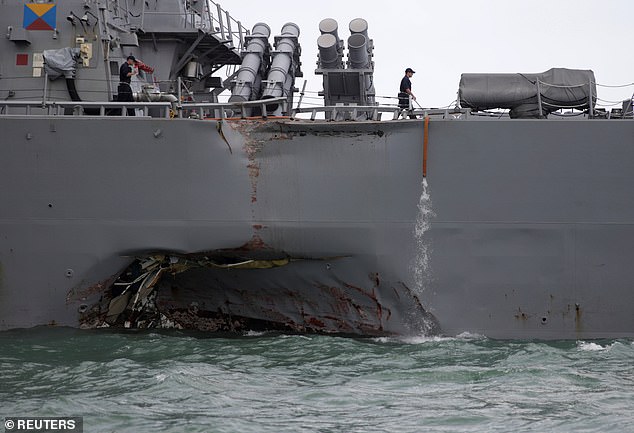
The USS McCain was struck by an Alnic MC oil tanker on August 21, 2017, after crew members lost control of the guided missile destroyer and it sailed into the tanker's path. 
The impact collapsed a bulkhead where sailors were sleeping, flooding the compartment and killing 10 and injuring 58 in the Navy's worst accident at sea in decades.  
ProPublica delved into the maritime disaster and published an extensive report on Friday that argues that the USS McCain's Integrated Bridge and Navigation System (IBNS) is largely at fault for the collision. 
In the wake of the disaster, the Navy placed blame on operator error, charging that the sailors manning the bridge at the time did not follow protocol and were improperly trained on the complex IBNS, designed and installed by Northrup Grumman.
ProPublica's report concluded that the blame should not have been cast so heavily on the crew, charging that no amount of training would have been adequate to run the flawed IBNS system.  
The non-profit investigative outlet also highlights the fact that Northrop has been hired to fix IBNS errors its engineers were responsible for in the first place. 
A touch-screen control system installed in the USS John S McCain may have caused the warship's deadly 2017 collision that left 10 sailors dead, a new report suggests
A touch-screen control system installed in the USS John S McCain may have caused the warship's deadly 2017 collision that left 10 sailors dead, a new report suggests 
The USS McCain was struck by an Alnic MC oil tanker on August 21, 2017, after crew members lost control of the guided missile destroyer and it sailed into the tanker's path. The impact collapsed a bulkhead where sailors were sleeping, flooding the compartment and killing 10 and injuring 58 in the Navy's worst accident at sea in decades
The USS McCain was struck by an Alnic MC oil tanker on August 21, 2017, after crew members lost control of the guided missile destroyer and it sailed into the tanker's path. The impact collapsed a bulkhead where sailors were sleeping, flooding the compartment and killing 10 and injuring 58 in the Navy's worst accident at sea in decades 
An NTSB investigation found that 'the design of the John S McCain's touch-screen steering and thrust control system increased the likelihood of the operator errors that led to the collision'. 
ProPublica reconstructed the control console based on the system's technical manual, confidential Navy reports, a safety review by the NTSB and interviews with a former Navy technician who worked on the system.  
It describes the system as 'flawed' and 'unstable' with 'multiple and cascading failures regularly'.  
'A number of current and former Navy officials remain convinced the navigation system should never have been put to use,' ProPublica writes. 'And they worry about the Navy's slow pace in installing a new, improved version.'
One senior Navy officer with direct knowledge of the McCain disaster told the outlet: 'The IBNS has no place on the bridge of a U.S. destroyer. It's not designed to have the control that you need to navigate a warship.' 
In the wake of the tanker crash, the Pentagon launched a probe and forced several admirals into retirement. 
The USS McCain's captain, the ship's petty officer and several sailors on duty that night were also punished. 
The IBNS was first introduced in 2008, when the Navy awarded Northrop a nearly $7million contract to install it on the USS John Paul Jones. 
It was touted at the time as the 'way of the future', promising to improve safety and reduce the number of sailors needed on the bridge.  
However, ProPublica writes that problems with the system did not take long to develop. 
Retrofitting each ship took months as contractors had to strung more than three miles of cables and fiber optics through each one. The Navy was only able to modernize a few ships each year, so the installation process dragged on for several years. 
During that time, Northrup continued making improvements which meant that the controls on one ship were typically different from those on another, making it harder for sailors to familiarize themselves with the system.   
'The IBNS was so complex that it overwhelmed the junior sailors who used it,' the ProPublica report states, citing interviews with a former Navy technician who worked on the system. 
The technician said that the system was prone to frequent malfunctions. In 2014, Navy officials discovered a flaw in the IBNS that caused the system to get overwhelmed by too much data. The Navy's solution was telling sailors to delete data before it reached a certain point.   
'They were patches on top of patches that left the Navy’s destroyers without a full picture of the seas around them,' ProPublica writes. 
'But none of the problems was serious enough to attract high-level attention. A Navy system designed to track problems in major ship systems did not contain any reports that mentioned the IBNS until last year, according to a Navy official.'
USS John S McCain returns to sea for first time since 2017 collision


Loaded: 0%
Progress: 0%
0:00
Previous
Play
Skip
Mute
Current Time0:00
/
Duration Time1:29
Fullscreen
Need Text
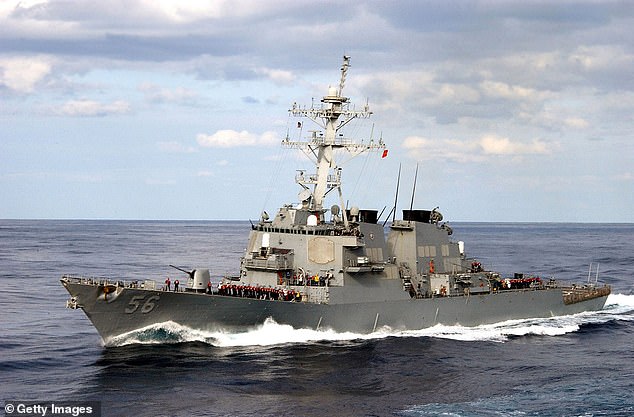
The USS McCain is pictured in 2003. In 2016 it was retrofitted with the Integrated Bridge and Navigation System (IBNS) designed by Northrup Grumman
The USS McCain is pictured in 2003. In 2016 it was retrofitted with the Integrated Bridge and Navigation System (IBNS) designed by Northrup Grumman 
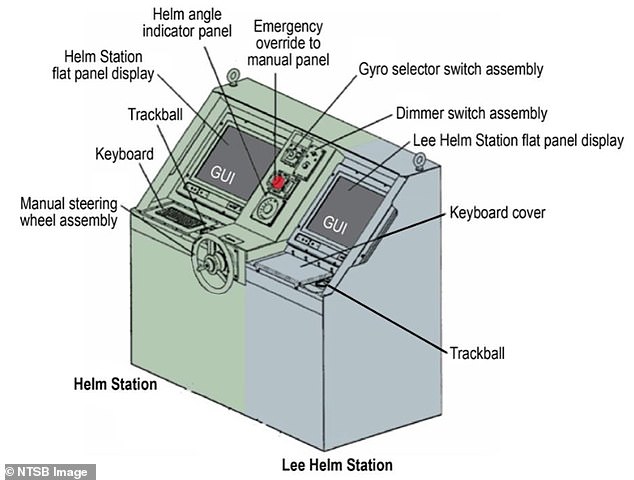
The IBNS features a pair of touch screens that combine a number of controls and display ship data. A diagram of the complicated navigation system is shown above
The complexities of the interfaces led to the McCain's helmsmen struggling to manage the helm and propulsion control. Pictured is a not-to-scale illustration of the accident-pertinent features of the McCain's bridge
A new version of the IBNS was installed in the USS McCain in 2016. It was the first ship in the 7th Fleet to receive the new system.  
ProPublica notes: 'The 7th Fleet was a strange choice to test out the newest version. Unlike U.S.-based ships, 7th Fleet ships — the largest armada in the world — were constantly responding to real-world crises.'
Problems with the new system emerged in a matter of months as the IBNS began to crash when it tried to integrate radar images in the ship's navigation computer. 
Navy technicians who boarded the McCain in January 2017 could not reproduce the error, but told its captain, Sanchez, that the 'potential for these types of failures is inherent'. 
'By March, senior officers aboard the McCain had designated the IBNS as a major problem,' ProPublica writes. 
'In August alone, the navigation system issued alerts on 63 different occasions — most of them related to the steering system, and most of them quickly fixed.
'The McCain's crew could do little to find a permanent solution to the constant alarms, however. 
'Because of staffing shortfalls, higher-ups had waived a requirement to have a technician on board with specialized training to maintain the IBNS.' 
Without outside help, sailors resorted to rebooting the system when it malfunctioned, according to the McCain's second in command, Cmdr Jesse Sanchez, who had told investigators that few of the technicians on the ship understood the IBNS.

Officials on the USS McCain had warned the Navy that few sailors aboard the ship understood the IBNS in the months before the crash 
Commander of US Pacific Fleet confirms remains have been found


Loaded: 0%
Progress: 0%
0:00
Previous
Play
Skip
Mute
Current Time0:00
/
Duration Time1:51
Fullscreen
Need Text
After an onslaught of malfunctions in August 2017, the McCain headed toward Singapore to have the navigation system examined. 
Captain Sanchez warned his crew that getting to the port would be difficult given the high traffic area it would have to pass through.  
The McCain's navigator and second in command had advised Sanchez to add extra crew for the perilous approach, but he ignored that advice. 
His decision was apparently influenced by the USS Fitzgerald crash two months earlier, as there were rumors that that warship's crew had been working 100-hour shifts before the collision. Sanchez didn't want a repeat of that debacle, so he chose to let his men get as much sleep as they could before assisting with the more complicated stretch of the approach. 
Sanchez was on the bridge on the night of the crash in case anything went wrong.  
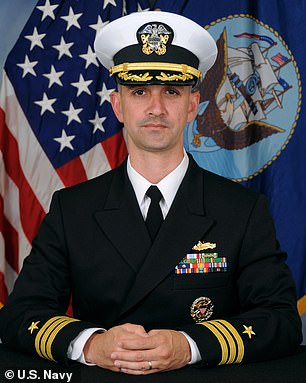
Cmdr Alfredo Sanchez (pictured) was the captain of the USS McCain at the time of the 2017 collision. He was later fired and and charged with homicide
ProPublica writes: 'In those early dark morning hours, he made two decisions about the IBNS that had fateful consequences.'
The IBNS suffered a problem at around 4.35am, prompting Sanchez to put it in backup mode so that he would have more control over the navigation, rather than relying on automated functions.   
'I'm a dinosaur, maybe, but that's why I do it,' Sanchez told investigators. 'When the system got installed and we went out for sea trial, we were comfortable in that configuration.'
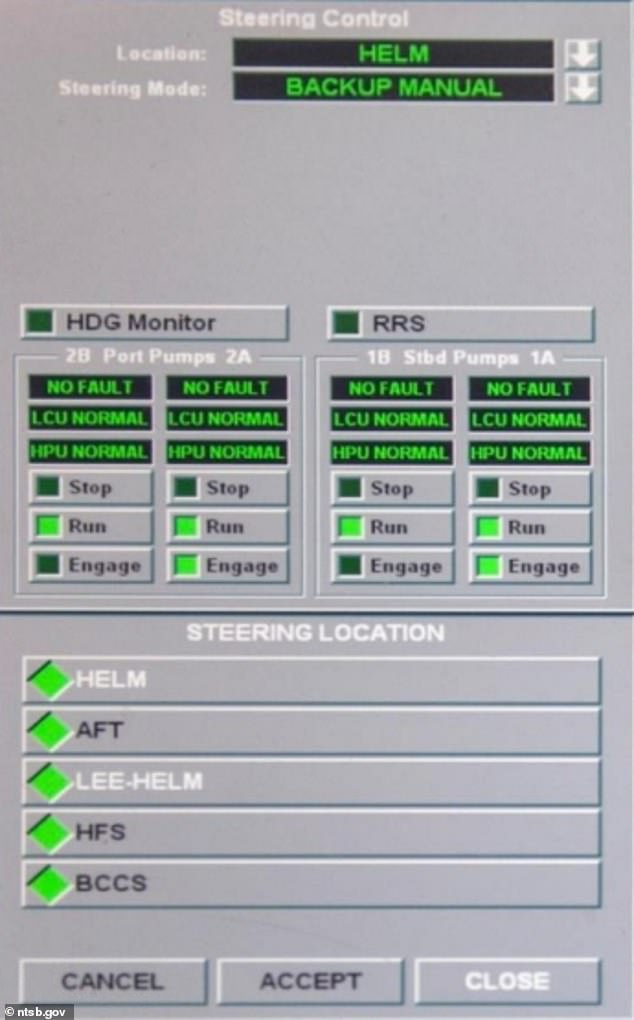
Unbeknownst to Sanchez, placing the system in backup mode put the steering into an emergency setting that removed some of its built-in safeguards.   
About 45 minutes later, Sanchez made his major flawed decision when he changed up the crew manning the bridge, putting two sailors in charge of steering and speed-control who had not practiced the complicated maneuvers necessary when entering the straits. 
The steering control was accidentally transferred to Dontrius Mitchell, when it was supposed to be manned by Dakota Bordeaux.  
The Navy never conclusively determined how the error occurred despite three separate reports examining the collision. 
Bordeaux, Mitchell and a third sailor present all denied having touched any controls that would have transferred steering. 
However, separate reports from the Navy and NTSB ruled out an IBNS malfunction as the cause of the steering transfer. The confidential Navy report concluded that a 'watchstander had to have performed this action'.  
Minutes before the McCain crash, there was an error in the transfer of steering controls on the bridge which led to confusion over which officer was steering. The image above shows the IBNS' steering interface
Minutes before the McCain crash, there was an error in the transfer of steering controls on the bridge which led to confusion over which officer was steering. The image above shows the IBNS' steering interface 
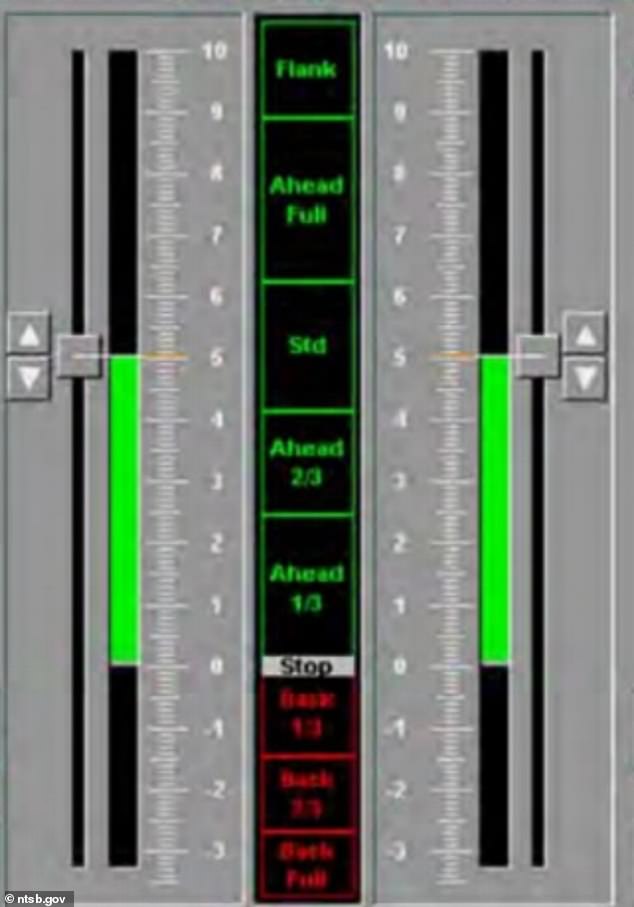
At the same time that steering control was transferred, an error in the propellers caused them to start operating separately. One propeller was working harder than the other, causing the ship to turn into the path of the oil tanker. The image above shows the IBNS propeller interface
The steering switch spawned confusion among the crew, in which, ProPublica asserts, the IBNS 'indisputably played a role'.  
Because the system was in backup mode, the IBNS software did not alert Mitchell and Bordeaux that steering control had been switched to the former. 
There was an indicator on both of their displays that showed who had control, but it was so small that they didn't notice it. 
Bordeaux went to turn the ship, and when it didn't work he assumed there'd been a malfunction and called out for help.  
Within minutes, Mitchell realized the transfer error and completed it himself. In the process of switching over control, an error occurred with the propeller shafts which caused them to run separately.  
One of the propellers began running faster than the other, causing the ship to turn 45 degrees and sail straight into the path of the Alnic MC tanker.
In a last ditch effort to regain control of the ship, the sailors pressed a big red button that reverted control to a backup IBNS station at the rear of the ship.
For a few moments the aft steering station had control of the ship, until a sailor pressed the red button again, unknowingly sending the control back to the front station.  
The ProPublica report concluded that crew members mistakenly believed that the big red button reverted control to the back of the ship. It's actual function was to send control to its original location.  
It is unclear how the misunderstanding developed and why it was so widespread among the crew. 
The report points to the fact that the instruction manual on the bridge was three years out of date. 
In a period of about 16 seconds, steering control was reverted from the front and back stations three times before crew members finally got it settled in the back station. 
By that point it was too late to correct the ship's trajectory, at at 5.24am it collided with the oil tanker, which gouged a 28-foot hold in two of the McCain's sleeping quarters, Berthing 3 and Berthing 5. 
Berthing 5, which sat below the waterline, quickly flooded. Only two of the 12 sailors inside managed to escape. 
Abraham Lopez, 39; Nathan Findley, 31; Corey George Ingram, 28; Dustin Louis Doyon, 26; Kevin Sayer Bushell, 26; Logan Stephen Palmer, 23; Timothy Thomas Eckels Jr, 23; Kenneth Aaron Smith, 22; Jacob Daniel Drake, 21; and John Henry Hoagland III, 20, were killed.  
Berthing 3 also flooded, and all 71 men managed to escape. 
For the next nine hours, sailors fought back flooding while they waited for ships based in Singapore and Malaysia to help bring the McCain back to port. 
Forty-eight soldiers onboard were injured, and 50 were recognized for their bravery during the incident. 
Meghan Mccain fires back at Trump over ship controversy


Loaded: 0%
Progress: 0%
0:00
Previous
Play
Skip
Mute
Current Time0:00
/
Duration Time0:37
Fullscreen
Need Text
The 10 sailors killed in the McCain collision were (clockwise from top left): Kenneth Smith, 22; Logan Palmer, 23; John Hoagland III, 20; Dustin Doyon, 26; Jacob Drake, 21; Timothy Eckels Jr, 23; Kevin Bushell, 26; Abraham Lopez, 39; Nathan Findley, 31; Corey Ingram, 28
In the months after the collision, Alfredo Sanchez and his second in command, Jesse Sanchez, who are not related, were both fired from their commands. 
Bordeaux was demoted, given a pay cut and put on promotion. 
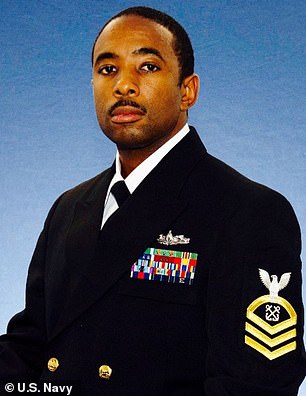
The Navy also sanctioned other crew members and Chief Petty Officer Jeffery D. Butler, a senior enlisted officer who was responsible for training Bordeaux and other sailors on how to use the IBNS.    
A few weeks later the Navy released a comprehensive review of collisions in the 7th Fleet, which included several mentions of the IBNS that 'pieced together, offer a damning portrait of the system', ProPublica found.  
The Navy then issued a new set of IBNS instructions meant to address operator response to system malfunctions. 
The new instructions required that captains split control of steering and propulsion between two officers, which is exactly what Sanchez had done. 
Still, in 2018, the Navy recommended Sanchez and Butler for court martial. 
Sanchez was charged with homicide and eventually pleaded guilty to a lesser charge of dereliction of duty. 
Butler was charged with dereliction of duty and accused of failing to 'gain a proper understanding' of the IBNS in order to train his soldiers. 
In court, Butler told Judge William Weiland, a Navy commander, that he had only received about 30 minutes to an hour of training on the system. He admitted that he cleared sailors without putting them through proper training because of their qualifications and the heavy workload aboard the McCain.  
'I should have paid more attention to the training,' Butler said. 'I could have told my junior sailors how to better operate their systems.'
Chief Petty Officer Jeffrey Butler (pictured) was charged with dereliction of duty and accused of failing to 'gain a proper understanding' of the IBNS in order to train his soldiers
He pleaded not guilty to the charge in May 2018. Before receiving his sentence, Butler turned to face the courtroom full of the fallen sailors' loved ones.  
'I am truly sorry for your loss,' Butler said through tears. 'They were more than just my shipmates. They were family.'
The officer asked the judge to allow him to keep his rank, which would entitle him to an additional $200,000 in retirement pay, money he hoped to use for his daughters' college educations.  
'I may not have been a perfect chief, but I have put my heart and soul into that title,' he told Weiland. 
The judge denied his request. 
The ProPublica report calls out the Navy for '[laying] blame on sailors and officers while downplaying the role of decisions made at the highest levels of service'.  
'The Navy disciplined several admirals in charge of the 7th Fleet, but it stopped short of senior leadership, including the former chief of naval operations, John Richardson, who allowed ships to sail without having enough time to conduct training or repairs,' the reports state. 
Speaking to ProPublica earlier this year, Richardson, who is now retired, called the USS McCain crash and the preceding Fitzgerald crash 'avoidable tragedies'.   
'The Navy has committed almost half a billion dollars to build the navigation system and install it on more than 60 destroyers by the end of the next decade — the entire fleet of the tough, stalwart warships that form the backbone of the modern Navy,' ProPublica writes.
'Yet no one responsible for the development or deployment of the technology has faced any known consequences for the McCain disaster.'