Saturday, February 27, 2021

Defense News: Germany procuring Rafael's Trophy defense system for its Leopard 2 tanks


Germany procuring Rafael's Trophy defense system for its Leopard 2 tanks


Following the Israeli company's delivery of the system to the US Army, Germany decides to acquire the Trophy to protect its troops and assets from anti-armor attacks

By Israel Defense , 02/23/21

Model of Trophy system mounted on German Leopard 2 tank. Rafael photo


Israel's Rafael Advanced Defense Systems announced Tuesday that Germany's Ministry of Defense has decided to equip the German military's Leopard 2 tank forces with Rafael's Trophy active protection system (APS).

Following the decision, which was made by Germany's defense procurement agency BAAINBw and approved by the federal parliament, Rafael was awarded a contract for an initial batch of Trophy systems, which includes a contract with Krauss-Maffei Wegmann (KMW), the Leopard tank's original equipment manufacturer, entailing the provision of systems for a company of tanks, interceptors, and spare parts, as well as operational and technical training. The systems will be delivered over the next several years, Rafael said. 

It is expected that Germany will procure additional Trophy systems to equip most of its modern fleet of Leopard 2 tanks with APS capabilities.

Developed by Rafael in response to successful anti-armor attacks, the Trophy APS provides combat-proven protection against rocket and missile threats and simultaneously locates the origin of the hostile fire for immediate response. The Trophy system, the only fully-integrated, combat-proven APS in the world, has been installed on IDF Merkava tanks since 2010, as well as on Namer APCs. Trophy has made numerous combat interceptions with no injuries to crews or dismounted troops or damage to platforms since its first operational interception in 2011. Trophy has accrued over 1,000,000 operating hours, including 5,400 successful field tests, and is now under contract for serial production of over 1,800 systems, according to Rafael. 

Trophy system mounted on IDF Merkava Mk.4 2 tank. Rafael photo


In January, Rafael and partner DRS announced that they had completed the delivery of Trophy APS ordered by the U.S. Army for installation on Abrams main battle tanks, under contracts awarded on an urgent need basis by the Army’s Program Executive Office for Ground Combat Systems. 

Trophy system mounted on US Army Abrams 2 tank. Rafael photo


Ran Gozali, Rafael's EVP and Head of the Land and Naval Division, said "Germany is joining an exclusive group of advanced tier-1 nations who have chosen Trophy APS to protect their troops and assets from the ever-increasing threat of anti-armor warfare. We are thankful to the German government for joining other user nations and for their confidence in our system and our experience, and we look forward to working with KMW on the integration and installation of Trophy on the Leopard 2 and on future platforms."  


Please recommend this page & follow the Sputniks Orbit 

SPACE - S0 - 20210227 - Ice Break, Lightning Surge, Galactic Record Breaker

SPACE - S0 - 20210227 - Ice Break, Lightning Surge, Galactic Record Breaker

Good Morning, 0bservers!


Remember yesterday when I mentioned how the Phi Angle had finally stabilized after days of wild readings? Well, the Phi Angle heard that and said "hold my beer", because after just 12 hours of seeming calm, it decided to pretend to be the interference you get from a blender with a dodgy electric motor. And the rest of the DSCOVR chart joined in on the fun, with the shift forcing a jump in Particle Density, which was PRECEDED by a jump (albeit mild) in solar wind speeds from 400 KPS to 460 KPS. It had a jagged pattern for about six hours before it decided to "stabilize" (and I'm being generous here) into a downward arch starting about 2000 UTC and then intensifying the curve after midnight UTC, all the way back down to where it hit its low - 400 KPS. Talk about goin' nowhere fast! Oddly enough, the Temperature dropped about the same time the Particle Density rose, then dropping significantly about three hours later. This activity really didn't do diddly (yes, that is a scientific term) to the KP-Index, which stayed in the green all day and night. KP-3s were predominant yesterday, but we're seeing a bit of a calming there as it transitions to KP-2 readings. The GOES Magnetometer had a wild high yesterday, topping out the chart at nearly 150 nanoTeslas, but its drop afterward still stayed above the threshold. Electron Flux readings breached the threshold again during the day (odd, that normally does that on our night-side, go figure) but it has returned to its normal position. The Proton Flux, sadly, remains the Tommy Newsom of our chart collection (Google it, kids!). X-Ray Flux readings are calming a bit as the background radiation has gone back below the Class B flare line. Only two small flares of note, neither reaching the middle of that Class B range. The large coronal hole in the South is now passing central heliographic longitude (fancy science speak for "the middle") but a new Southern coronal hole system is developing about two to three days behind. The flares mentioned earlier seem to be coming from the first of the departing sunspots in the North, with some minor sparking and surging activity noted there. One more thing. I normally don't report the ENLIL Spiral charts which show CME discharges, but this one is a bit unusual. The one on the SpaceWeatherNews.com site does show a CME coming out from the Sun, well ahead of our orbit (so no risk to Earth). However, the one on the NOAA site shows no such ejection. It's just weird how they don't seem to match...

Please Recommend this page and be sure to follow the Sputnik's Orbit 


AND WHILST YOU ARE HERE BE SURE TO FOLLOW AND RECOMMEND THE COCONUT WHISPERER https://disqus.com/home/forum/the-coconut-whisperer/

Researchers produce beams of entangled atoms

FEBRUARY 24, 2021, by Vienna University of Technology
https://phys.org/news/2021-02-entangled-atoms.html

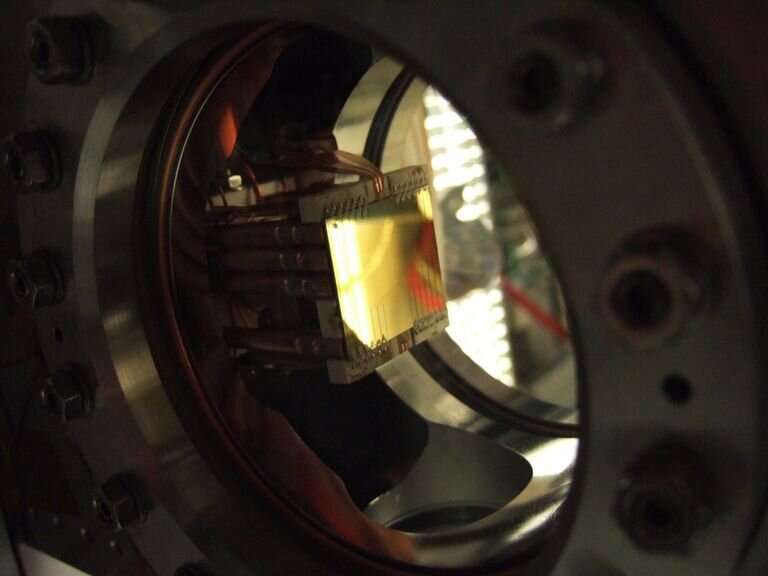
The atom chip at TU Wien. 
Credit: Vienna University of Technology

Heads or tails? If we toss two coins into the air, the result of one coin toss has nothing to do with the result of the other. Coins are independent objects. In the world of quantum physics, things are different: Quantum particles can be entangled, in which case they can no longer be regarded as independent individual objects, they can only be described as one joint system.

For years, it has been possible to produce entangled photons—pairs of light particles that move in completely different directions but still belong together. Spectacular results have been achieved, for example in the field of quantum teleportation or quantum cryptography. Now, a new method has been developed at TU Wien (Vienna) to produce entangled atom pairs—and not just atoms which are emitted in all directions, but well-defined beams. This was achieved with the help of ultracold atom clouds in electromagnetic traps.

Entangled particles

"Quantum entanglement is one of the essential elements of quantum physics," says Prof. Jörg Schmiedmayer from the Institute of Atomic and Subatomic Physics at TU Wien. "If particles are entangled with each other, then even if you know everything there is to know about the total system, you still cannot say anything at all about one specific particle. Asking about the state of one particular particle makes no sense, only the overall state of the total system is defined."

There are different methods of creating quantum entanglement. For example, special crystals can be used to create pairs of entangled photons: a photon with high energy is converted by the crystal into two photons of lower energy—this is called "down conversion." This allows large numbers of entangled photon pairs to be produced quickly and easily.

Entangling atoms, however, is much more difficult. Individual atoms can be entangled using complicated laser operations—but then you only get a single pair of atoms. Random processes can also be used to create quantum entanglement: if two particles interact with each other in a suitable way, they can turn out to be entangled afterwards. Molecules can be broken up, creating entangled fragments. But these methods cannot be controlled. "In this case, the particles move in random directions. But when you do experiments, you want to be able to determine exactly where the atoms are moving," says Jörg Schmiedmayer.


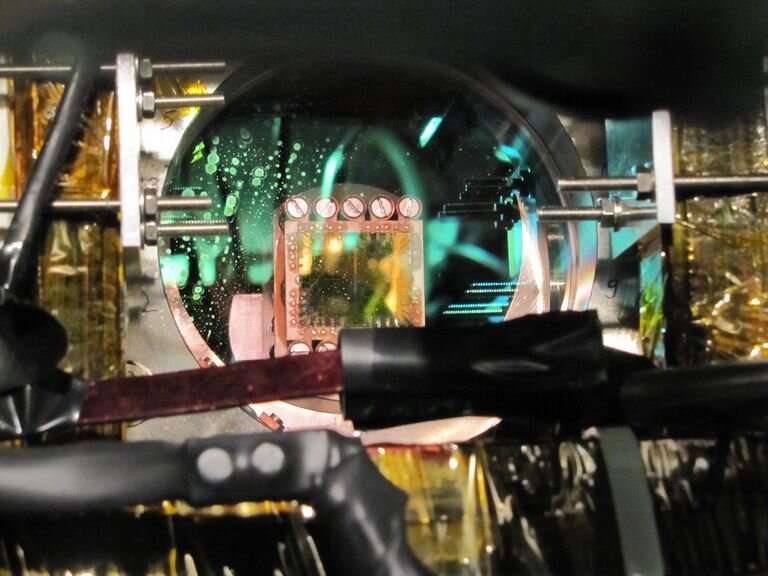
The atom chip, precisely controlling the atoms. 
Credit: Vienna University of Technology


The twin pair

Controlled twin pairs could now be produced at TU Wien with a novel trick: a cloud of ultracold atoms is created and held in place by electromagnetic forces on a tiny chip. "We manipulate these atoms so that they do not end up in the state with the lowest possible energy, but in a state of higher energy," says Schmiedmayer. From this excited state, the atoms then spontaneously return to the ground state with the lowest energy.


HThe atom chip, precisely controlling the atoms. Credit: Vienna University of Technology
owever, the electromagnetic trap is constructed in such a way that this return to the ground state is physically impossible for a single atom—this would violate the conservation of momentum. The atoms can therefore only get trasferred to the ground state as pairs and fly away in opposite directions, so that their total momentum remains zero. This creates twin atoms that move exactly in the direction specified by the geometry of the electromagnetic trap on the chip.

The double-slit experiment

The trap consists of two elongated, parallel waveguides. The pair of twin atoms may have been created in the left or in the right waveguide—or, as quantum physics allows, in both simultaneously. "It's like the well-known double-slit experiment, where you shoot a particle at a wall with two slits," says Jörg Schmiedmayer. "The particle can pass through both the left and the right slit at the same time, behind which it interferes with itself, and this creates wave patterns that can be measured."


A look at the atom chip in the experimental setup. Credit: Vienna University of Technology

The same principle can be used to prove that the twin atoms are indeed entangled particles: only if you measure the entire system—i.e., both atoms at the same time—can you detect the wave-like superpositions typical of quantum phenomena. If, on the other hand, you restrict yourself to a single particle, the wave superposition disappears completely.

"This shows us that in this case it makes no sense to look at the particles individually," explains Jörg Schmiedmayer. "In the double-slit experiment, the superpositions disappear as soon as you measure whether the particle goes through the left or the right slit. As soon as this information is available, the quantum superposition is destroyed. It is very similar here: if the atoms are entangled and you only measure one of them, you could theoretically still use the other atom to measure whether they both originated in the left or the right part of the trap. Therefore, the quantum superpositions are destroyed."

Now that it has been proven that ultracold atom clouds can indeed be used to reliably produce entangled twin atoms in this way, further quantum experiments are to be carried out with these atom pairs—similar to those that have already been possible with photon pairs.

Recommend this post and follow Sputnik's Orbit
https://disqus.com/home/forum/thesputniksorbit-blogspot-com/


Friday, February 26, 2021

Defense News: Israel Defense Ministry selects Lockheed Martin's CH53K as IDF's new heavy lift helicopter


Defense Ministry selects Lockheed Martin's CH53K as IDF's new heavy lift helicopter


The aircraft is essential to the IDF's ability to carry out a wide range of operational activities, Defense Minister Gantz said   


by IsraelDefense, 02/25/2021

USMC  CH53K with cargo load under slung. Lockheed Martin  photo

Defense Minister Benny Gantz: "The decision to purchase new heavy lift helicopters for the IAF, after decades, is a significant step in progressing the IDF's force build-up. It is also essential to the IDF's ability to carry out a wide range of operational activities. The new helicopter is adapted to the (IAF's) operational requirements and to the challenges of the changing battlefield."

USMC  CH53K mid-air refuelling from a C130 tanker. Lockheed Martin  photo

Today, Defense Minister Benny Gantz accepted the recommendations presented by IDF Chief of the General Staff, Lt. Gen. Aviv Kochavi, and Defense Ministry Director General, Maj. Gen. (Res.) Amir Eshel, to select Lockheed Martin's CH53K helicopters as the IDF's new heavy lift aircraft, as part of the IDF's "Tnufa" (Momentum) multi-year plan. These will replace the "Yassur" helicopters employed by the IAF since the 1960s.

USMC  CH53K mid-air refuelling from a C130 tanker. Lockheed Martin  photo

The decision was made following a professional assessment that included test flights in all the proposed aircraft as well as a thorough examination of the various alternatives in terms of engineering, technological, maintenance and other considerations. All details, including the number of helicopters requested, will be brought to the approval of the Ministerial Committee for Procurement as soon as possible. 

USMC  CH53K with cargo load under slung, coming in to land. Lockheed Martin  photo

The concluding discussion, chaired by the Minister of Defense, was attended by IDF Chief of the General Staff, Director General of the Ministry of Defense, IAF Commander, Maj. Gen. Amikam Norkin, and Head of the IDF's Planning Directorate, Maj. Gen. Tomer Bar.   


Please recommend this page & follow the Sputniks Orbit 

SPACE - S0 - 20210226 - Beaufort Gyre, Oceans in Trouble, New Comet

SPACE - S0 - 20210226 - Beaufort Gyre, Oceans in Trouble, New Comet

Good Morning, 0bservers!


Solar winds spent most of the day yesterday going down from their peak of 500 KPS, although they did pause for a brief rally from 430 KPS back to 500 KPS around 2000 for a couple of hours. They petered out (yes, that is a scientific term) and continued downward to their current 400 KPS reading. Particle Density also lowered a bit through the day, however Temperature readings remained mostly steady (with a brief bump upward around the same time of the speed increase). The Phi Angle was a mess most of yesterday, but it finally seemed to stabilize around midnight UTC. Despite that earlier instability, the KP-Index stayed in the green for 24 hours straight, the first time that's happened in a few days. KP-3s still dominate the chart, though, so we'll see how it goes before the next coronal hole stream impacts us, probably late Saturday through Sunday. We're mostly back to nominal readings for the Magnetometer and Proton Flux charts. The Electron Flux chart did almost breach the threshold again yesterday, but not quite enough to trigger an alert. Hopefully we'll see it back to its usual calm self tomorrow. Background X-Ray Flux readings did dip into the upper Class A flare range yesterday, but clawed its way back to Class B while chucking out a pretty strong Class C flare about 0600 UTC. From the video loop at 193Å, it appears the trailing sunspot in the North (the one that has been destabilizing) had a small intra-atmospheric release which triggered the actual flare from the sunspot group in the South. That surprised me a bit, I really thought the second Northern sunspot group (that closest to the departing lim) would have been the one to blow. The Southern coronal hole has extended upward to the equator and is now crossing the midpoint. The Northern tendril from the polar coronal hole crossed that point about midnight UTC, but it really didn't develop into much, so I don't see any real effect from that one bothering us, it would be overwhelmed by the Southern activity.

Please Recommend this page and be sure to follow the Sputnik's Orbit 


AND WHILST YOU ARE HERE BE SURE TO FOLLOW AND RECOMMEND THE COCONUT WHISPERER https://disqus.com/home/forum/the-coconut-whisperer/

Breathtaking Pic From Hawaii Shows Not One, But Two Rare Sky Phenomena

AYLIN WOODWARD, BUSINESS INSIDER, 26 FEBRUARY 2021
https://www.sciencealert.com/a-thunderstorm-in-hawaii-created-a-truly-amazing-mix-of-phenomenon


(International Gemini Observatory/NOIRLab/NSF/AURA/A. Smith)

In a stormy Hawaiian sky in July 2017, streaks of red and blue lightning seemed to meet above a bed of white light.

Cameras on the Gemini North telescope at the Gemini Observatory in Mauna Kea snapped a stunning picture of the multi-colored light show. The National Optical-Infrared Astronomy Research Laboratory (NOIRLab) released the photo on Wednesday as its "image of the week".

The lightning in the image "appears so otherworldly that it looks like it must be a special effect," NOIR Lab said. It also published a zoomable version.

These colorful lightning phenomena are aptly known as red sprites and blue jets. They're extremely tricky to capture on camera: The flashes last just tenths of a second and can be hard to see from the ground, since they're generally obscured by thunderstorm clouds.

According to Peter Michaud, the education and engagement manager for the NOIR Lab, astronomers in nearby Hilo use the telescope's cameras to remotely keep track of bad weather brewing near the observatory. The camera system takes a photo of the sky every 30 seconds.

"We've seen a few other instances of similar phenomena, but that was by the best example of a lightning sprite in the upper atmosphere," he told Insider. 

Red, white, and blue

Regular white lightning is different from sprites and jets in several key ways. Whereas regular lightning shoots between electrically charged air, clouds, and the ground during storms, sprites and jets start in different places in the sky, and move toward space. Their distinctive hues also set them apart.

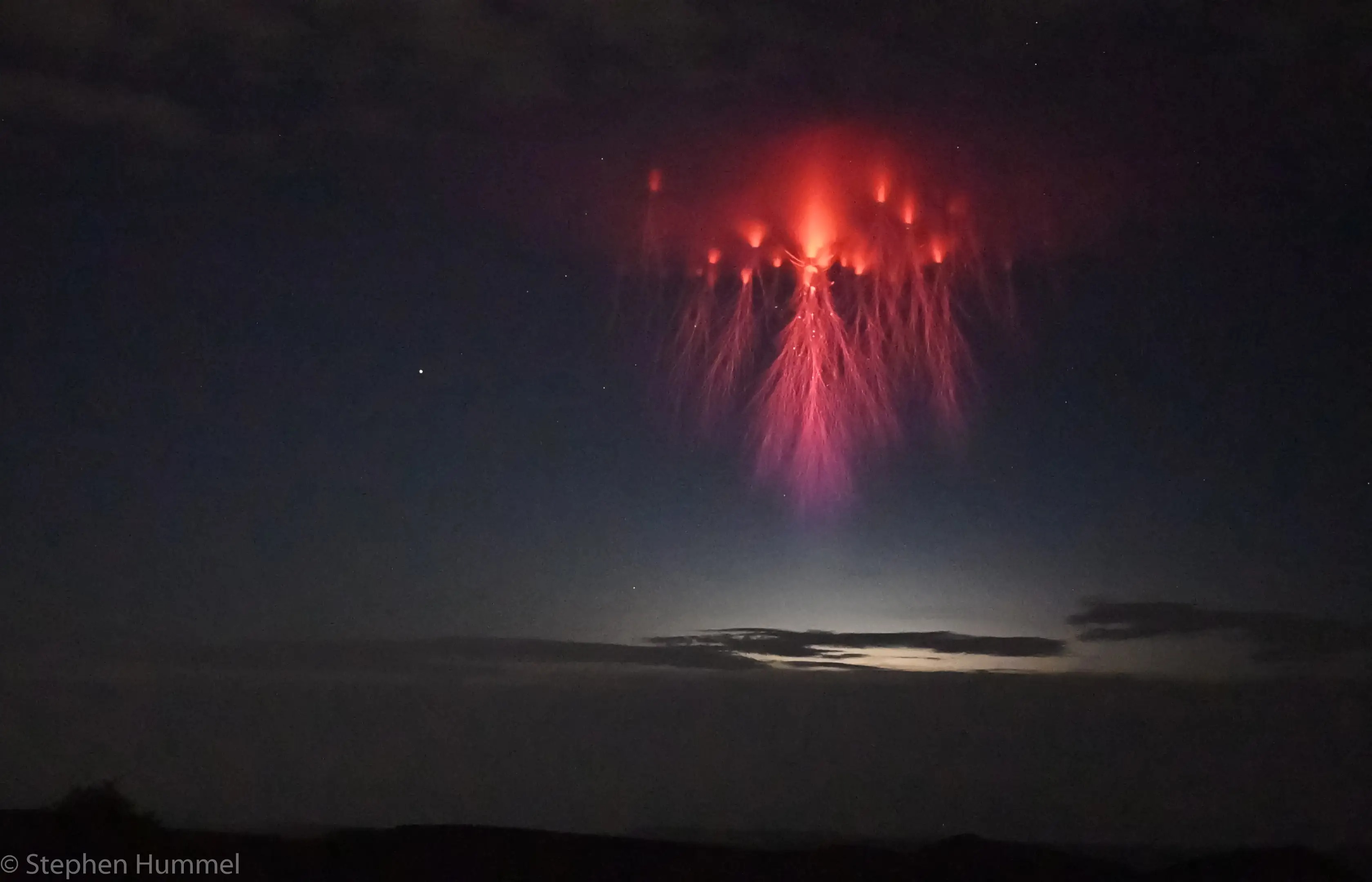
Red sprites are ultrafast bursts of electricity that crackle through the upper regions of the atmosphere – between 37 and 80 km (23 and 49 miles) up in the sky – and move spaceward. Some sprites are jellyfish-shaped, while others, like the one in the Gemini Observatory image, are vertical columns of red light with tendrils snaking down. These are called carrot sprites.

Stephen Hummel, a dark-skies specialist at the McDonald Observatory, captured a spectacular image of a jellyfish sprites from a ridge on Mount Locke in Texas last July (below).

(Stephen Hummel)

"Sprites usually appear to the eye as very brief, dim, grey structures. You need to be looking for them to spot them, and oftentimes I am not certain I actually saw one until I check the camera footage to confirm," Hummel told Insider at the time.

Davis Sentman, who worked as a professor of physics at the University of Alaska Fairbanks, proposed the name "sprite" for the red lightning phenomenon. He said the term was "well suited to describe their appearance," since the word evokes the lightning's fairy-like, fleeting nature. Sentman died in 2011.

Blue jets, meanwhile, are born closer to Earth than red sprites. These cone-shaped electrical discharges are also brighter than sprites, and they blast upward from the tops of clouds.

Thundercloud peaks can sit anywhere from one to 14 miles (22 km) above Earth's surface; blue jets keep moving skyward until they reach a height of roughly 48 km, at which point they vanish. These jets move at speeds of more than 22,300 mph (9.9 km/s).

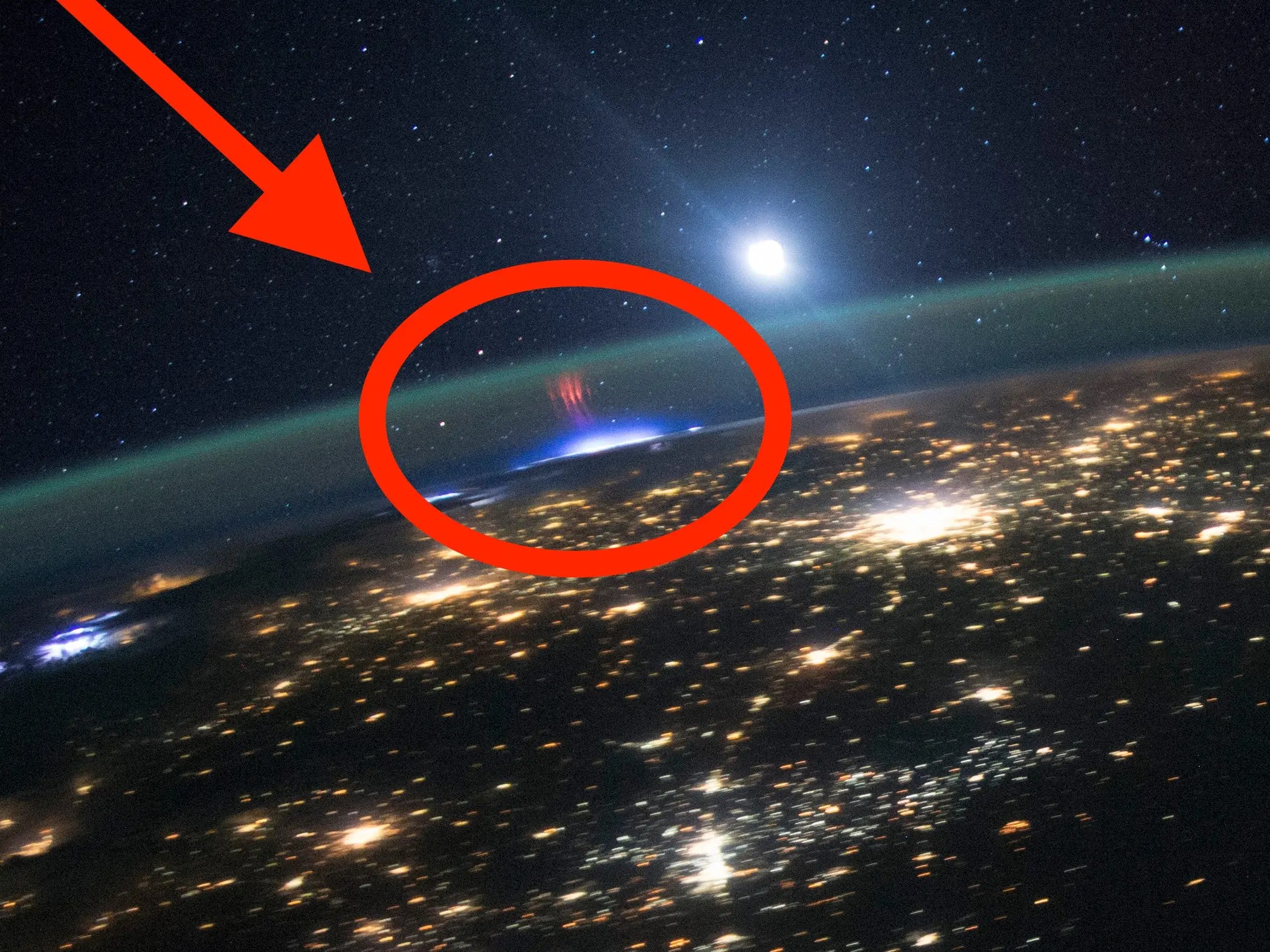
(NASA)

Sprites and jets can be seen from space

When regular lightning strikes the ground, it tends to release positive electrical energy that needs to be balanced out by equal and oppositely charged energy elsewhere in the sky. So sprites and jets are the electrical discharges that balance the equation – that's why these colorful lightning phenomena occur.

"The more powerful the storm and the more lightning it produces, the more likely it is to produce a sprite," Hummel said.

Astronauts can sometimes spot sprites and jets from the International Space Station, 402 km (249 miles) above Earth.

European Space Agency astronaut Andreas Morgensen captured elusive blue jets on video for the first time in color in 2015. He spotted the jets while filming a storm over India's Bay of Bengal. Scientists later used the footage as part of a 2017 study.

Morgensen's observations "are the most spectacular of their kind," the study authors wrote.


Recommend this post and follow Sputnik's Orbit
https://disqus.com/home/forum/thesputniksorbit-blogspot-com/

Thursday, February 25, 2021

World's first video of a space-time crystal

FEBRUARY 24, 2021, by Max Planck Society
https://phys.org/news/2021-02-world-video-space-time-crystal.html

Credit: CC0 Public Domain

A German-Polish research team has succeeded in creating a micrometer-sized space-time crystal consisting of magnons at room temperature. With the help of the scanning transmission X-ray microscope Maxymus at Bessy II at Helmholtz Zentrum Berlin, they were able to film the recurring periodic magnetization structure in a crystal. Published in the Physical Review Letters, the research project was a collaboration between scientists from the Max Planck Institute for Intelligent Systems in Stuttgart, Germany, the Adam Mickiewicz University and the Polish Academy of Sciences in Poznań in Poland.

Order in space and a periodicity in time

A crystal is a solid whose atoms or molecules are regularly arranged in a particular structure. If one looks at the arrangement with a microscope, one discovers an atom or a molecule always at the same intervals. It is similar with space-time crystals: however, the recurring structure exists not only in space, but also in time. The smallest components are constantly in motion until, after a certain period, they arrange again into the original pattern.

In 2012, the Nobel Prize winner in physics Frank Wilczek discovered the symmetry of matter in time. He is considered the discoverer of these so-called time crystals, although as a theorist he predicted them only hypothetically. Since then, several scientists have searched for materials in which the phenomenon is observed. The fact that space-time crystals actually exist was first confirmed in 2017. However, the structures were only a few nanometers in size and formed only at very cold temperatures below minus 250 degrees Celsius. The fact that the German-Polish scientists have now succeeded in imaging relatively large space-time crystals of a few micrometers in a video at room temperature is therefore considered groundbreaking. But also because they were able to show that their space-time crystal, which consists of magnons, can interact with other magnons that encounter it.
A space time crystal formed by magnons filmed with the scanning transmission X-ray microscope Maxymus.

An exceptional experiment succeeded
https://youtu.be/kUY3TglEUCU

"We took the regularly recurring pattern of magnons in space and time, sent more magnons in, and they eventually scattered. Thus, we were able to show that the time crystal can interact with other quasiparticles. No one has yet been able to show this directly in an experiment, let alone in a video," says Nick Träger, a doctoral student at Max Planck Institute for Intelligent Systems who, together with Pawel Gruszecki, is first author of the publication.

In their experiment, Gruszecki and Träger placed a strip of magnetic material on a microscopic antenna through which they sent a radio-frequency current. This microwave field triggered an oscillating magnetic field, a source of energy that stimulated the magnons in the strip—the quasiparticle of a spin wave. Magnetic waves migrated into the strip from left and right, spontaneously condensing into a recurring pattern in space and time. Unlike trivial standing waves, this pattern was formed before the two converging waves could even meet and interfere. The pattern, which regularly disappears and reappears on its own, must therefore be a quantum effect.

Gisela Schütz, Director at Max Planck Institute for Intelligent Systems who heads the Modern Magnetic Systems Department, points out the uniqueness of the X-ray camera: "Not only can it make the wavefronts visible with very high resolution, which is 20 times better than the best light microscope. It can even do so at up to 40 billion frames per second and with extremely high sensitivity to magnetic phenomena as well."

"We were able to show that such space-time crystals are much more robust and widespread than first thought," says Pawel Gruszecki, a scientist at the Faculty of Physics of the Adam Mickiewicz University in Poznań. "Our crystal condenses at room temperature and particles can interact with it—unlike in an isolated system. Moreover, it has reached a size that could be used to do something with this magnonic space-time crystal. This may result in many potential applications."

Joachim Gräfe, former research group leader in the Department of Modern Magnetic Systems and last author of the publication, concludes: "Classical crystals have a very broad field of applications. Now, if crystals can interact not only in space but also in time, we add another dimension of possible applications. The potential for communication, radar or imaging technology is huge."


Recommend this post and follow 
Sputnik's Orbit

https://disqus.com/home/forum/thesputniksorbit-blogspot-com/

SPACE - S0 - 20210225 - Ice Age Tipping Point, Space Weather, Venus

SPACE - S0 - 20210225 - Ice Age Tipping Point, Space Weather, Venus

Good Morning, 0bservers!


Yesterday's CME-boosted solar winds really didn't calm down all that much, taking instead a very slow up and down process between 450-520 KPS through most of yesterday (after the initial spike, anyway). Currently in the 440-460 KPS range. Particle Density and Temperature took a slow drop in the last 24 hours as well, but the Phi Angle has been all over the chart. This might explain the 12-hour minor geomagnetic storm showing up on the KP-Index overnight, which finally calmed back down to KP-3 levels around 0300 UTC. The Magnetometer touched the 40 nT threshold this morning after topping out at 120 nT for the second day in a row. Proton Flux readings are, as always, nominal, and the Electron Flux seems to be returning to that state as well after a few days above its own alert threshold. The X-Ray Flux seems to be holding the background level at lower Class B levels as yesterday, but with more spikes and flares hitting the middle of Class B. There's a new coronal tendril trying to develop in the North and connect to the polar region, while the much larger Southern hole approaches the midpoint. The sunspot in the North closest to the departing lim seems to be the most active, with its trailing companion seeming to destabilize and fade. Still seeing some activity in the Southern sunspot group as well, but not as pronounced.

Please Recommend this page and be sure to follow the Sputnik's Orbit 


AND WHILST YOU ARE HERE BE SURE TO FOLLOW AND RECOMMEND THE COCONUT WHISPERER https://disqus.com/home/forum/the-coconut-whisperer/

Wednesday, February 24, 2021

Health & Science News: Biological antibiotic alternative works against tuberculosis - TAU study


Biological antibiotic alternative works against tuberculosis - TAU study


Antibiotics have for the past century been doctors' main weapon in the battle against bacterial diseases, but many diseases are becoming resistant.


By Aaron Reich,  Jerusalem Post, February 23, 2021

Tuberculosis. (photo credit: ALAIN GRILLET/FLICKR)

Scientists from Tel Aviv University have managed to develop a biological substitute for tuberculosis treatment, which could eventually act as an alternative to traditional antibiotics, according to a study published in the academic journal Nature Communications.

This biological antibacterial solution, which is the first of its kind in human history, succeeded to hinder the growth of tuberculosis in mice. This was done through the isolation of monoclonal antibodies, which were taken from a patient who had suffered but recovered from tuberculosis. 

Antibiotics have for the past century been doctors' main weapon in the battle against bacterial diseases. These chemical agents, efficient and cheap, work by destroying targeted cells, like microbial pathogen cells.

But there have always been limits to antibiotics. Part of this is due to the common biological mechanisms shared by human cells and pathogens alike, which can make it difficult to target the bacteria without also causing harm to the body. 

But a possibly even greater limit to antibiotics is resistance. In recent years, more microbial strains have developed resistance to antibiotics, and their number could keep rising. 

Scientists have been aware of the issue for years, and have been hard at work trying to find a new antibacterial shield. This has seen them investigate many different methods, with one notable example being researchers at the University of Warwick in the UK investigating a 1,000-year-old remedy from the ancient medical text Bald's Leechbook.

But antibodies could be that long sought-after shield. 

ANTIBODIES ARE, essentially, one of the body's greatest shields against disease. They are proteins produced naturally by the human immune system after exposure to infection or to a vaccine. Their reliability and stability are reasons why they see widespread use in the treatment of cancer, autoimmune conditions and viruses like COVID-19.

To test this theory, the research team, led by TAU's Dr. Natalia Freund and doctoral candidate Avia Watson, in collaboration with laboratories in the US and China, chose tuberculosis as the infection of choice for their test model. It was chosen because the vaccine for the disease, which was developed over 100 years ago, does not work on adults, as well as the fact that it evolves and develops more varieties resistant to treatment.

 
Tuberculosis is extremely contagious, is transferred through the air and many of its strains are resistant to antibiotics – these are reminders of how urgent it is to find an alternative to antibiotics.

The disease is widespread and has plagued mankind throughout history. Currently, about 25% of the global population is infected with tuberculosis, and 1.5 million die from it annually. Israel has around 200 active cases per year.

In addition, tuberculosis is known to be very complex, with this complexity and size making isolating monoclonal antibodies extremely challenging. And yet, despite this and other obstacles, the researchers succeeded.

 
They did this by pinpointing a phosphate pump protein on the cell wall, which they found supplies energy to the bacterium and is specific to all strains of tuberculosis. The antibodies the researchers isolated manage to block the pump action, as well as inhibiting bacteria growth and reducing levels. 

This was also shown to be effective in three different strains, and because they target the pump common to all tuberculosis strains, it is likely that it will work against many others.

"Advances in biological medicine have enabled us to rout the germs in new ways that are not based solely on antibiotics, and therefore allow a solution to the challenge posed by resistant germs," Freund said in a statement. 

"Our study is an initial proof of concept of employing monoclonal antibodies (derived from single cells) as an effective therapy in combating bacterial pathogens."

With their success, Freund's laboratory is looking into trying this new biological alternative to antibiotics on other diseases as well.

"The model that has proven successful in this study will enable us to extend our future work to include other diseases such as pneumonia and staphylococcus infections," Freund explained.


Please recommend this page & follow the Sputniks Orbit 

SPACE - S0 - 20210224 - Colder Ice Age, Fake Clouds, Fantasy Animations

SPACE - S0 - 20210224 - Colder Ice Age, Fake Clouds, Fantasy Animations

Good Morning, 0bservers!


We saw a pretty significant drop in solar wind speeds starting around 1500 UTC yesterday, when it dropped from the 550-600 KPS range down to about 470 KPS by 0400. At that point, I think we got that glancing blow that Ben mentioned yesterday from the minor CME that was aiming (mostly) away from Earth the other day, which jumped us up to around 530 KPS. It's now in the 470-500 KPS range. This point was also marked by a pretty odd shift in the Phi Angle, which also had an effect on Particle Density (which was low but had a minor jump), and Temperature. The KP-Index remained mostly on the high side of the green range (KP-3) but we did get one KP-4 sneaking in at 0600 UTC following the jump in speed. The Magnetometer is back to its nominal readings, and the Proton Flux never left its steady state, but Electron Flux readings are remaining above the threshold, although it did finally dip below it for a few hours (first time in at least 60 hours) before going back up. Still seeing a lot of increase in the X-Ray Flux baseline, which appears to now be in the lower B Class flare range, but other than a couple of spikes yesterday afternoon indicating low-level flares (again, mid B Class) it wasn't as bad as the previous day. The new coronal hole in the South has connected with the polar hole and has gained strength and reach. It's still a day or two from crossing the midpoint, but it will be in range to hit us a few days after that. The two new sunspots are still sparking and flaring, but not nearly as much as the previous report. The older one is only now crossing the centerline, but the Magnetogram shows a pretty definite separation between positive and negative, probably alpha complexity at best, so our risk there is lower (but not gone, we all know how sneaky those bloody things can be sometimes). Eyes 0pen, folks...

Please Recommend this page and be sure to follow the Sputnik's Orbit 


AND WHILST YOU ARE HERE BE SURE TO FOLLOW AND RECOMMEND THE COCONUT WHISPERER https://disqus.com/home/forum/the-coconut-whisperer/

Tuesday, February 23, 2021

SPACE - S0 - 20210223 - 149 Magnetic Reversals, Solar-Cycle PaleoChaos

SPACE - S0 - 20210223 - 149 Magnetic Reversals, Solar-Cycle PaleoChaos

Good Morning, 0bservers!


Solar winds have been "jumpy" to say the least, but the same is true for the other readings from the DSCOVR satellite. Speeds generally stayed in the 540-600 KPS range yesterday, slowing down to 580 KPS at the top end around midnight UTC, but then there was a massive spike to 640 KPS about two hours later before returning to yesterday's range. Density stayed mostly steady, but the Temperature ranges were a lot wider and faster than normal, only "cooling down" starting around 0600 UTC. The KP-Index was slightly calmer yesterday than the previous days, with only two KP-4 readings in the early hours. It went back into the green for most of the day and night, but we did get another minor geomagnetic storm reading right after midnight UTC. The Magnetometer readings are normalizing from yesterday, and the Proton Flux remains stable/nominal, but the Electron Flux is still pretty elevated. Looks like flare activity bounced back from a quiet day or two, with a few major jumps into upper Class B range before midnight UTC. This upped the baseline readings near the top of Class A, but then the flares were reduced to the lower part of Class B as well. Some of that flare activity seems to come from the new sunspot group in the North I mentioned yesterday (the one that developed after it passed the midpoint), but we've got a NEW grouping in the South as well. It became visible around midmorning (and wasn't showing up on the Magnetogram yesterday either, so it really "sprung up" as it were) and was already popping and outgassing. On top of that, we've got a new coronal hole group that started developing in the Southern mid-latitudes, and it's growing pretty quickly. While that looks pretty impressive on 193Å, you should really check out the 304Å loop and watch the sunspot in the South first develop and then start sparking and surging (along with the Northern one). Both of the new sunspots on the Magnetogram are showing tight spacing between positive and negative, while the older one (that hasn't yet reached central heliographic longitude) has a lot more separation between them.

Please Recommend this page and be sure to follow the Sputnik's Orbit 


AND WHILST YOU ARE HERE BE SURE TO FOLLOW AND RECOMMEND THE COCONUT WHISPERER https://disqus.com/home/forum/the-coconut-whisperer/

Really Small Black Holes Could Be Out There, Devouring Neutron Stars From Within

MICHELLE STARR, 23 FEBRUARY 2021
https://www.sciencealert.com/tiny-black-holes-could-form-inside-neutron-stars-and-devour-them-from-within

(Victor de Schwanberg/Science Photo Library/Getty Images)

Tiny, all-but-undetectable primordial black holes could be one of the mysterious sources of mass that contributes to dark matter. There are significant limits to their lifespan in open space, but in recent years, astrophysicists have asked: what if these black holes are in the core of neutron stars?

Gradually, such black holes would accrete the neutron star, devouring it from within. These hypothetical systems are yet to be verified, but a new preprint paper, published on arXiv and yet to be peer-reviewed, has calculated how long this devouring would take.

This, in turn, could be used to analyse the current neutron star population to constrain the nature of the black holes considered as a dark matter candidate - whether they are primordial, dating back to the Big Bang, or black holes that formed inside neutron stars.

Although we don't know what dark matter is, it's pretty fundamental to our understanding of the Universe: there simply isn't enough matter we can directly detect - normal matter - to account for all the gravity. In fact, there's so much gravity that scientists have calculated roughly 75 to 80 percent of all matter is dark.

There are a number of candidate particles that could be dark matter. Primordial black holes that formed just after the Big Bang are not one of the leading candidates, because if they were above a certain mass we would have noticed them by now; but, below that mass, they would have evaporated via the emission of Hawking radiation long before now.

Black holes, however, are an attractive candidate for dark matter: they, too, are extremely difficult to detect if they're just hanging out in space just doing nothing. So astronomers continue to look for them.

One idea that has been explored recently is the endoparasitic black hole. There are two scenarios for this. One is that primordial black holes were captured by neutron stars, and sink down to the core. The other is that dark matter particles are captured inside a neutron star; if the conditions are favourable, these could then come together and collapse down into a black hole.

These black holes are small, but they wouldn't remain so. From their cosy position, ensconced inside the neutron star, these little black holes would then parasitise their host.

The team of physicists from Bowdoin College and the University of Illinois at Urbana-Champaign calculated the accretion rate - that is, the rate at which the black hole would devour the neutron star - for a range of black hole mass ratios, from three to nine orders of magnitude less massive than the neutron star host.

Neutron stars have a theoretical upper mass limit of 2.3 times the mass of the Sun, so the black hole masses would extend down into the range of dwarf planets.

For a non-rotating neutron star hosting a non-spinning black hole, the accretion would be spherical. At the team's calculated accretion rates, black holes as small as 10-21 times the mass of the Sun would completely accrete a neutron star well within the lifetime of the Universe.

This suggests that primordial black holes, from the beginning of the Universe, would have completely accreted their host neutron stars before now. These timescales are in direct conflict with the ages of old neutron star populations, the researchers said.

"As an important application, our results corroborate arguments that use the current existence of neutron star populations to constrain either the contribution of primordial black holes to the dark matter content of the Universe, or that of dark matter particles that may form black holes at the center of neutron stars after they have been captured," they wrote in their paper.

So the result is another blow for primordial black holes; but it doesn't rule endoparasitic black holes out entirely. If there are globs of dark matter particles out there floating through space and being slurped into neutron stars, they could be collapsing into black holes and converting neutron stars into black hole stuff even as you read this sentence.

And that is freaking awesome.

The team's paper has been published on arXiv.

Recommend this post and follow Sputnik's Orbit
https://disqus.com/home/forum/thesputniksorbit-blogspot-com/


Monday, February 22, 2021

SPACE - S0 - 20210222 - Galactic Magnetic Reversal, Plasma Universe, Solar Wind

SPACE - S0 - 20210222 - Galactic Magnetic Reversal, Plasma Universe, Solar Wind

Good Morning, 0bservers!


Not much improvement to be seen from yesterday's report, I'm afraid. Solar wind speeds remained elevated, in the 550-630 KPS range all of yesterday, although it has calmed slightly since midnight UTC to the 550-580 KPS range. Particle density had gone down a bit yesterday, but rose again after midnight UTC, showing a sort of square wave motion instead of spikes or sine wave. The same is true for Temperature readings.  The Phi Angle is still shifting between 250° and 360°/0°. The KP-Index had us remaining in the minor geomagnetic storm range for 24 hours straight from Saturday to Sunday, with the later readings on Sunday dropping to KP-3 readings before popping back up to KP-4 after midnight UTC. The Magnetometer readings calmed a bit from yesterday, but not by as much as I would've liked. The Electron Flux actually climbed past the 10³ threshold yesterday, almost hitting 10⁴, while the Proton Flux remains delightfully dull. While the X-Ray Flux background did drop yesterday afternoon for a time, it hopped right back to its original level of mid-Class A, with a few small spikes that never caught up to the Class B line. The video loops show a small, thin coronal hole trying to develop near the centerpoint in the Southern hemisphere, but I'm not sure it's going to expand. The Northern Sunspot group is still heading toward central heliographic longitude, but what surprised me was a new Northern sunspot developing right AT the middle. It's far smaller than the one we can see on the video loop, I only found it when I checked the Magnetogram readings. Looks like Alpha complexity at this point, whereas the larger grouping still seems to be at Beta to Beta-Delta.
* * *
Another new video from Suspicious0bservers, "MAGNETIC EXTINCTION | The World on Notice". 


Enjoy!

Please Recommend this page and be sure to follow the Sputnik's Orbit 


AND WHILST YOU ARE HERE BE SURE TO FOLLOW AND RECOMMEND THE COCONUT WHISPERER https://disqus.com/home/forum/the-coconut-whisperer/

Sunday, February 21, 2021

SPACE - S0 - 20210221 - Tsunami of Fire, Solar Eruption, Climate Hits

SPACE - S0 - 20210221 - Tsunami of Fire, Solar Eruption, Climate Hits

Good Morning, 0bservers!


We've got a messy solar report this morning. Look at the charts yourself and you too will say "yeah, that's a mess". Let's start with the Particle Density, which stayed pretty steady over the day and night. Temperatures went up a bit but stayed steady through the period. So, how is this messy? Well, when those two indicators are steady, you expect the solar wind speed to also be steady. Uh, NOPE! It had an early jump in the morning yesterday above 500 KPS, but around 1100 UTC it decided to go up to over 600 KPS, staying between 550-600 KPS up until now. The Phi Angle seems to have been the catalyst for the speed jump, but then it too stayed mostly steady after that. The KP-Index, however, was a mickle-muckle, as the day, night and morning were predominated by a prolonged KP-4 (minor geomagnetic storm) readings. The Magnetometer was also a bit wonky (yes, that's a scientific term) with another high above 120 nanoTeslas and then a very jagged downward slope just touching the 40 nT line. The Electron Flux also breached its warning threshold for the first time in weeks. About the only nominal thing on the weather page was the Proton Flux, which remained thankfully dull. The X-Ray Flux wasn't too flare-y, but it remained with the X-Ray baseline remained in the middle of the Class A flare range. There were a couple of spikes showing on the chart, but they didn't breach the Class B line. The video loop at 193Å was far too busy, starting the previous 24-hour period (about half the loop) with a plasma filament coming up from the Southern polar coronal hole and causing a cascade collapse for a good quarter of the visible Southern hemisphere. FYI, Ben Davidson predicted this yesterday, and he was right on the money. It did produce a CME, and we may indeed catch a part of that by midweek. We also saw an intra-atmospheric release just below the Northern sunspot group. No actual flaring, but it was still a hot mess.

Please Recommend this page and be sure to follow the Sputnik's Orbit 


AND WHILST YOU ARE HERE BE SURE TO FOLLOW AND RECOMMEND THE COCONUT WHISPERER https://disqus.com/home/forum/the-coconut-whisperer/

Saturday, February 20, 2021

SPACE - S0 - 20210220 - Solar Eruption Watch, Ice Age, Electric Weather

SPACE - S0 - 20210220 - Solar Eruption Watch, Ice Age, Electric Weather

Good Morning, 0bservers!


Looks like the Phi Angle has been messing around with the solar weather today. It was a bit scrambled in the morning, but then it calmed down after it created a rise (then drop) in Particle Density. However, solar wind speeds didn't ramp up until 8 hours AFTER that particle bump. It went from under 400 KPS to almost 540 KPS in three hours, and then dropped back down to 400 KPS by midnight UTC. It then jumped, again, two hours later to above 500 KPS, at the same time as the Phi Angle scrambled itself again. Yeah, it's a bit of a dog's dinner this morning. Temperature readings also followed wind speeds in their pattern, if not their intensity. As to the KP-Index, well, it's been mostly in the minor geomagnetic storm (KP-4) arena since midday yesterday, dropping down to KP-3 after midnight UTC for two readings before ramping back up again. The Magnetometer chart is doing its enhanced hi/lo roller-coaster readings, dropping under the base of 40 nanoTeslas again. The Proton Flux and Electron Flux stayed nominal. Hell, who am I kidding - they were dull as dishwater, and that's a good thing here. Also a good thing is the X-Ray Flux chart, which is showing fewer and smaller spikes when compared to the previous day, but it's still busy. The source of that activity appears to be at both the lim and the new sunspot group, with the former tossing some pretty energetic plasma around the solar skies and the latter bubbling and sparking slightly.

Please Recommend this page and be sure to follow the Sputnik's Orbit 


AND WHILST YOU ARE HERE BE SURE TO FOLLOW AND RECOMMEND THE COCONUT WHISPERER https://disqus.com/home/forum/the-coconut-whisperer/