Wednesday, March 24, 2021

SPACE - S0 - 20210324 - Nearby Star Cluster Torn Apart, Physics Breaks, Galactic Sheet

SPACE - S0 - 20210324 - Nearby Star Cluster Torn Apart, Physics Breaks, Galactic Sheet

Good Morning, 0bservers!


There was a very small rise in the Particle Density around 0400 which seemed to put a pause in the slowdown in solar wind speed. However, it doesn't appear to be the next "major" event, as the current speed is down from yesterday's high of 550 KPS to around the 400-420 KPS range. It's just the first of two of those CMEs the other day, which will (or may) provide a glancing blow and minor speed/density increase. The density "bump" seemed to raise the speed by only about 30 KPS before going back down. Temperatures seemed to follow the Particle Density bump, and both of them seem to have been triggered by a minor Phi Angle shift. The KP-Index remains on the high side of green this morning (KP-3s since midnight UTC) after a day's worth of KP-2s. That lone KP-4 yesterday morning seems to have been all on its own. Magnetometer's nominal, Proton Flux's nominal, Electron Flux is still having issues with its warning threshold. No big flares on the X-Ray Flux charts, just a series of tiny surges into the lower third of Class B. The second portion of that Southern coronal hole is just starting to cross the midpoint. The new active regions are bright enough at 193Å, but the Magnetograph is still showing tight positive/negative grouping on the surface.

Please Recommend this page and be sure to follow the Sputnik's Orbit 


AND WHILST YOU ARE HERE BE SURE TO FOLLOW AND RECOMMEND THE COCONUT WHISPERER https://disqus.com/home/forum/the-coconut-whisperer/

Tuesday, March 23, 2021

Keeping track of spacecraft as Earth's water alters its spin

MARCH 23, 2021, by European Space Agency
https://phys.org/news/2021-03-track-spacecraft-earth.html

Simulated high-resolution ocean-surface currents as expected from ESA’s Earth Explorer 9 candidate SKIM mission. The satellite would carry a novel wide-swath scanning multibeam radar altimeter to measure ocean-surface currents. 
Uniquely, it uses a Doppler technique, which offers more direct measurements than conventional satellite altimeters. These new measurements would improve our understanding of vertical and horizontal ocean–surface dynamics over the global ocean every few days. This would lead to better knowledge of how the ocean and atmosphere interact – for example, how atmospheric carbon dioxide is drawn down into the ocean. 
Credit: ESA

Mass is constantly being redistributed around our planet, as Earth's atmosphere, oceans and other bodies of water on and under the surface melt, shift and stir. This mass redistribution alters Earth's center of gravity, which in turn speeds up and slows down the planet's spin—and so the length of the day—as well as changing the orientation of its spin axis. These changes to Earth's spin and orientation occur over relatively short timescales of days and weeks, and threaten communication between ground stations and missions in orbit and across the solar system.

ESA is working on its own algorithm to predict Earth's orientation with extreme accuracy. Early tests show the new ESA algorithm outperforms those being used today from external providers, marking an important step in ensuring Europe's independent access to space.

The forces at play, changing the day

External gravitational forces, predominantly from the sun and moon, are constantly and predictably acting on our planet. While the sun's enormous gravity keeps Earth in orbit, the gentle tug of the moon has, over billions of years, quite dramatically slowed its spin, increasing the length of a day on Earth.

When the Earth first formed, a day was somewhere between six and eight hours long and a year would have consisted of more than 1000 sunrises and sunsets.

Closer to home, there are forces at play that have much more rapid and unpredictable effects. Earthquakes, atmospheric winds, ocean currents, and remarkably even human activity itself, all act often and unpredictably to redistribute mass around the planet, altering the speed of Earth's spin and the orientation of its spin axis.

Conservation of momentum

The 'conservation of angular momentum' is a law of physics that explains why a figure skater spinning with her arms out, can suddenly speed herself up by pulling in her arms towards her body.


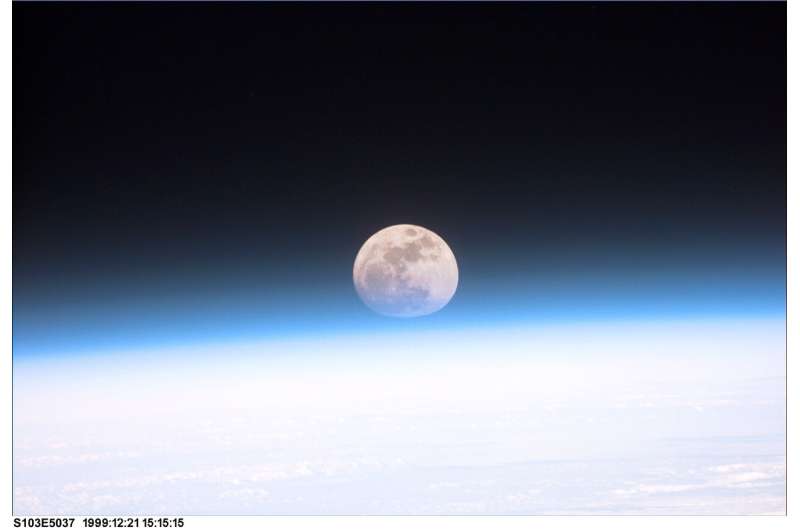
A rarely seen phenomenon: the Earth's atmosphere bending the light from the full Moon thereby compressing it. 
Credit: NASA


Earth's spin too is affected by the distribution of weight around the planet. Earthquakes, remarkably, speed up the spin of our planet in an instant, by rearranging matter through the crust and upper mantle, increasing in a small but not insignificant way the length of the day.

In 2011, a magnitude 9.0 earthquake struck Japan which tragically took thousands of lives and created untold damage. Lasting six minutes, it also shortened the length of the day by 1.8 microseconds (one microsecond = one millionth of a second) and shifted the position of Earth's 'figure axis' – an imaginary line around which the world's mass is balanced—by about 17 cm. (The figure axis is Earth's axis of mass balance, while the spin axis wobbles around it.)

Much larger effects are also underway caused by atmospheric winds and ocean currents, as well as the melting of glaciers and the icecaps. As ice melts or breaks off into the ocean, sea levels rise and Earth's mass is redistributed so it is closer to this central axis, shortening the length of the day.

Such changes are nothing to worry about, unnoticeable to our day-to-day lives. But when it comes to flying spacecraft across deep space, or keeping in sync with satellites in orbit, these tiny changes can mean the difference between finding and losing your mission.

Holding on to ESA missions

To fly ESA missions, the Agency is dependent on what are called Earth orientation parameters (EOPs), which describe the irregularities in the rotation of the planet. If you dont know them, you have a real problem.

"Our ground stations are in communication with interplanetary spacecraft millions of kilometers away. They need to be pointed with extreme accuracy to target these relatively tiny objects," explains Werner Enderle, Head of ESA's Navigation Support Office based at the Agency's ESOC Operations Center in Darmstadt, Germany.

"One degree on Earth equates to thousands of kilometers in space, so if you don't have accurate values for Earth's orientation, you can be off by a long way."

Getting these parameters requires a huge amount of work analyzing the cumulative effects of the weather, climate change and geological activity. Because these systems are so complex, we can currently calculate the changes in Earth's orientation on relatively short timescales, weeks and months ahead.


A map of the terrain displacement based on Envisat Advanced Synthetic Aperture Radar of the earthquakes that struck Japan beginning on 11 March 2011. The map is derived from an interferogram generated by INGV using data acquired on 19 February and 21 March 2011 on track 347. The map shows a large portion of the surface displacement field. The maximum displacement along the Line Of Sight (of the satellite) reaches about 2.5 m relative to a reference point within the entire frame strip located nearby the southern boundary. Credit: Based on ESA data -The Istituto Nazionale di Geofisica e Vulcanologia (S. Stamondo, M. Chini and C. Bignami)

ESA determines Earth's orientation

Currently, these vital parameters are provided by the United States Naval Observatory (UNSO), based on contributions from Institutions around the world including ESA. However, ESA is working on determining its own EOP values, ensuring Europe's independent access to space and removing dependency on an external provider. These orientation values, computed by a team at the Navigation Support Office, will be made freely available around Autumn this year.

The tool estimates and predicts Earth's orientation and rotation up to 90 days in advance using space-based measurements from global navigation satellite systems (GNSS) and satellite laser ranging among others, an area in which the office has a great deal of expertise.

"Our algorithm uses atmospheric and weather conditions, seismic activity, the rate at which sea levels are rising and Earth's ice is melting and a host of other variables, all of which interact in complex and hard-to-predict ways," explains Erik Schoenemann, Navigation Engineer at ESOC who leads the project.

"It's easy to take these values for granted, but all spaceflight activity relies on them and a huge amount of work goes into getting them.
We are really happy to now have our own source of this data, securing our ability to conduct complex missions in different orbits and to receive the incredible data they send home."

So far, early tests show the new ESA algorithm significantly outperforms those currently in use, marking an important step in ensuring Europe's independent access to space.

Recommend this post and follow Sputnik's Orbit
https://disqus.com/home/forum/thesputniksorbit-blogspot-com/


Posted by Chuck in Space

https://disqus.com/home/forum/lifeofearth/

SPACE - S0 - 20210323 - Earth Rotation Glitches, Nano Nova, NLCs

SPACE - S0 - 20210323 - Earth Rotation Glitches, Nano Nova, NLCs

Good Morning, 0bservers!


After hitting a peak of 660 KPS yesterday morning, solar winds began a steady slowdown around noon UTC, with the current speed in the 500-520 KPS range. Particle Density remains elevated, but Temperatures reduced slightly. The Phi Angle had stabilized for about 12 hours starting in the early afternoon yesterday, but it's a bit verschimmelt (if not verklempt) after midnight UTC. While we were in the green zone on the KP-Index all of yesterday, we did get a KP-4 (minor geomagnetic storm) reading around 0600 UTC. Magnetometer is nominal, Proton Flux is nominal, Electron Flux is allergic to nominal. X-Ray Flux background is just below the Class B flare line, and there were several small spikes above that line from mid-afternoon to midnight UTC. We've got some new coronal hole development, including a small-to-medium one just along the equator which should cross the midpoint later today. There's another one behind it, further South, and cutting a diagonal SE-to-NW line, which should arrive about 36 hours afterward. Seeing that second new sunspot up on the Northeast lim just crossed. The Magnetogram from SDO shows both of them with some tight positive/negative grouping, whereas the sunspot group that passed the midpoint appears to be disintegrating.

Please Recommend this page and be sure to follow the Sputnik's Orbit 


AND WHILST YOU ARE HERE BE SURE TO FOLLOW AND RECOMMEND THE COCONUT WHISPERER https://disqus.com/home/forum/the-coconut-whisperer/

Monday, March 22, 2021

SPACE - S0 - 20210322 - 2nd CME Erupts at Earth, Ozone Destruction, Deep Mantle

SPACE - S0 - 20210322 - 2nd CME Erupts at Earth, Ozone Destruction, Deep Mantle

Good Morning, 0bservers!


Solar winds tried to calm a little bit yesterday, but despite dropping to a low of 550 KPS they did pop up near 700 KPS around 2200 UTC. It dropped back to 600 KPS around midnight UTC (where it currently stands) but there were some odd drops and rises in the readings as well. These were more pronounced in the Particle Density readings, which had some very sharp drops (as did the Temperature chart, which almost mirrors that). The Phi Angle was a mixmaster mess, with solar magnetism all over the place. The elevated wind speed and density have had the KP-Index showing minor geomagnetic storms (KP-4/yellow) but we did have two KP-5 (red, level one geomagnetic storm activity) for about six hours before returning to green levels. Remember, the health effects of such storms remain for 24 hours or so after the last high reading. The Magnetometer appears to be nominal as well as the Proton Flux. The Electron Flux, however, is dancing along the alert threshold line. Background readings from the X-Ray flux rose on Saturday along with a few low-Class B spikes, but we did have a pretty strong Class B spike (upper third of the chart) around 0100 UTC. Seeing a new sunspot group on the Magnetogram, densely packed positive/negative complexity there, and I can barely see what looks like another sunspot just crossing the Eastern lim. Unfortunately, all the video loops are down so I can't see the detail of that spot, or the source of this morning's spike.
* * *
Another new video from Suspicious0bservers, "Rare Cosmological Event | Advanced Catastrophism".
   
   
Enjoy!

Please Recommend this page and be sure to follow the Sputnik's Orbit 


AND WHILST YOU ARE HERE BE SURE TO FOLLOW AND RECOMMEND THE COCONUT WHISPERER https://disqus.com/home/forum/the-coconut-whisperer/

Saturday, March 20, 2021

GDLS-Canada, Mercedes Benz & Marshall Canada Team Up for Logistics Vehicle Modernization

Canadian Defence Review: CANADA’S LEADING DEFENCE MAGAZINE
26.02.2021, LVM UPDATE - The Power Team,BY GABRIEL OAKLEY
http://www.canadiandefencereview.com/featured_content?blog/225


One of Canada’s largest defence companies, General Dynamics Land Systems-Canada, has partnered with Mercedes-Benz and Marshall Canada to compete for the Department of National Defence’s (DND) Logistics Vehicle Modernization (LVM) project.

The LVM project is a commitment made by the government to “acquire new fleets of light and heavy logistics vehicles, trailers, vehicle modules, armour protection kits, initial in-service and logistics support,” as outlined in Canada’s defence policy: Strong, Secure, Engaged.

With its partners Mercedes-Benz, a long time supplier of military trucks to the Canadian Army, and Marshall Canada, a leading aerospace and defence solution provider, General Dynamics Land Systems-Canada has formed a power team to deliver a robust Canadian-based solution for LVM.

GDLS-CANADA LEADING THE TEAM

General Dynamics Land Systems-Canada has a 40-plus-year history of manufacturing and sustaining the Canadian Army’s Light Armoured Vehicle fleet. With a focus on people, technology and innovation, it is committed to continue that tradition.

The company recently successfully completed the upgrade of the Canadian Army’s LAV III fleet, providing it with a flexible, multipurpose capability to effectively respond to a full range of operations, ensuring that the LAV remains the backbone of the Canadian Army.

General Dynamics continues to deliver on complex programs that deliver world-class vehicle capabilities to the Canadian Army and support it once fielded.

The company has put together the ideal team with the qualifications needed to fulfil the requirements of the LVM project. Each team member brings years of experience, a commitment to innovation, and proven track record. Together, they will provide a world-class fleet to the Canadian Army and make a significant contribution to Canada’s defence-automotive sector.

“General Dynamics Land Systems-Canada is very excited about the opportunity to submit a winning proposal to modernize Canada’s logistics vehicles,” said Dave Haggerty, director of Canadian programs. “For soldiers, having best-in-class capabilities makes the difference for the mission.”

At the heart of the offering is the Zetros range of extreme-duty trucks, whose base platform will power the team’s proposal for the future of Logistics Vehicles.

THE MERCEDES-BENZ ZETROS

Mercedes-Benz will provide the chassis for both the light and heavy vehicle, offering the Zetros, one of the stars in the Mercedes-Benz Special Trucks line. Specifically designed as an off-road vehicle, the Zetros is at its best in demanding transport tasks for heavy payload in austere conditions. The Zetros provides superior highway and cross-country performance because of its precision chassis design and robust components, which ensure fast and safe driving over varying types of ground.

Zetros incorporates technologies proved in more than a million fielded vehicles. It has been extensively tested to Mercedes-Benz’ demanding quality standards for unconditional off-road performance, including more than 50 million kilometers of engine testing.

“After careful consideration, Daimler Truck AG, a division of Mercedes Benz, believes aligning our strong product portfolio with General Dynamics’ systems integrator capability and customer focus will enable the best possible solution to be offered to Canada.” Dennis Hunn, Mercedes-Benz LVM project manager told CDR.

He added “We have had the privilege of supplying the Canadian Armed Forces for many years and know that, through this partnership, we are positioned to be a reliable partner for delivering the logistics vehicle capabilities to meet or exceed soldiers’ needs through this lineup.”

With more than 120 years of experience in designing and manufacturing high-quality automotive products, Mercedes-Benz is a leading global supplier of trucks used by militaries around the world. Mercedes-Benz specialty trucks are highly valued by military customers from more than 17 NATO and allied nations worldwide, including trucks in service with Canada.

MISSION MODULES FROM
MARSHALL CANADA

Marshall Canada, a key LVM partner, will design and produce all of the mission modules for both the light and heavy capabilities. Marshall is a leading aerospace and defence solution provider with over 100 years of demonstrated quality in defence vehicle engineering and shelter design, as well as conversion and modification of military, civil and business aircraft.

“Marshall Canada is delighted to have been selected to partner with General Dynamics Land Systems-Canada on such a strategically important program and will be incredibly proud to play a role in delivering the Department of National Defence with a logistic fleet replacement that will help to revolutionize Canadian Army logistics” said Marshall Canada Managing Director, Sam Michaud.

Michaud added “Our participation in the program aligns directly with our plans to grow our footprint in the Canadian home market to build on our existing position within both the Land and Air domains. We are delighted to be part of such a strong team with a very compelling vision of what we are able to achieve both in terms of meeting program requirements and, importantly, delivering significant benefits to the Canadian economy as we grow our own team and build critical capability in the home market supply chain.”

“Marshall is recognised globally as a market-leader in the design, manufacture and support of deployable infrastructure and we believe that our vast experience and expertise, when combined with that of the other partners on the team, will ensure the best solution, in terms of both quality and value, for the end user.”

BENEFITS TO CANADIAN ECONOMY

General Dynamics is an economic driver for the nation’s defence industrial base, with a supply chain of more than 700 Canadian suppliers and extensive engagement from regional, small- and medium-sized enterprises from coast to coast.

The company plans to use the LVM project and key partners to leverage know-how from the best of industry to stimulate Canada’s global competitiveness in the post-pandemic economy while providing the highest-quality logistics solution to the Canadian Army.

Recommend this post and follow Sputnik's Orbit
https://disqus.com/home/forum/thesputniksorbit-blogspot-com/


SPACE - S0 - 20210320 - Solar Storm, Big Quake, Volcano, Disaster Cycle

SPACE - S0 - 20210320 - Solar Storm, Big Quake, Volcano, Disaster Cycle

Happy Spring, 0bservers!


We finally got a strong rise in Particle Density starting around 2000 UTC, peaking around 0400 UTC before taking a sharp drop. Which, as regular readers understand, was the "trigger" for the next jump in solar winds, which slowly rose from yesterday's 300 KPS low to 350 KPS at midnight UTC, 400 KPS at 0200, and then the major surge starting around 0400 with the speed topping out at nearly 550 KPS. It's currently in the 480-510 KPS range. The Phi Angle didn't shift as much as I had expected, but the positive/negative magnetic gap at the very top of the DSCOVR charts showed a major widening when the solar winds really kicked into high gear. The KP-Index was pretty calm all through yesterday, with green bars all the way.... until 0900 UTC, when we went from a KP-3 reading to a KP-6 (Level-2 Geomagnetic Storm). I believe the scientific technical term for that is YOWZA!  The Magnetometer reacted by driving the low readings below the 40 nT threshold. Proton Flux was, as always, nominal. The Electron Flux breached its own warning threshold again, but not as much as in previous days. X-Ray Flux background radiation levels actually went down a bit since yesterday, to about the middle of Class A, with very few upward spikes (again, none reaching Class B as reported the previous day). The Southern polar coronal hole is still crossing the midpoint, but there is a Northern node to it that is within striking range of Earth we should keep an eye on. Looked to be a plasma release just trailing that, but it was just at the end of the video loop. The leading sunspot group in the North is about a day from crossing the Western lim, and the trailing one is about 36 hours from the centerpoint. There's some brightness coming in from the Eastern lim, but it's not yet showing up on the Magnetogram so we'll have to wait and see.

Please Recommend this page and be sure to follow the Sputnik's Orbit 


AND WHILST YOU ARE HERE BE SURE TO FOLLOW AND RECOMMEND THE COCONUT WHISPERER https://disqus.com/home/forum/the-coconut-whisperer/

Friday, March 19, 2021

Hubble shows torrential outflows from infant stars may not stop them from growing

MARCH 18, 2021, by ESA/Hubble Information Centre
https://phys.org/news/2021-03-hubble-torrential-outflows-infant-stars.html

These four images taken by NASA's Hubble Space Telescope reveal the chaotic birth of stars in the Orion complex, the nearest major star-forming region to Earth. The snapshots show fledgling stars buried in dusty gaseous cocoons announcing their births by unleashing powerful winds and pairs of spinning, lawn-sprinkler-style jets shooting off in opposite directions. Near-infrared light pierces the dusty region to unveil details of the birthing process. The stellar outflows are carving out cavities within the hydrogen gas cloud. This relatively brief birthing stage lasts about 500,000 years. Although the stars themselves are shrouded in dust, they emit powerful radiation, which strikes the cavity walls and scatters off dust grains, illuminating in infrared light the gaps in the gaseous envelopes. Astronomers found that the cavities in the surrounding gas cloud sculpted by a forming star's outflow did not grow regularly as they matured, as theories propose. The young stars in these images are just a subset of an ambitious study of 304 developing stars, the largest-ever to date. Researchers used data previously collected from NASA's Hubble and Spitzer space telescopes and the European Space Agency's Herschel Space Telescope. The protostars were photographed in near-infrared light by Hubble's Wide Field Camera 3. The images were taken Nov. 14, 2009, and Jan. 25, Feb. 11, and Aug. 11, 2010. 
Credit: NASA, ESA, and N. Habel and S. T. Megeath (University of Toledo)

Stars aren't shy about announcing their births. As they are born from the collapse of giant clouds of hydrogen gas and begin to grow, they launch hurricane-like winds and spinning, lawn-sprinkler-style jets shooting off in opposite directions.

This action carves out huge cavities in the giant gas clouds. Astronomers thought these stellar temper tantrums would eventually clear out the surrounding gas cloud, halting the star's growth. But in a comprehensive analysis of 304 fledgling stars in the Orion Complex, the nearest major star-forming region to Earth, researchers discovered that gas-clearing by a star's outflow may not be as important in determining its final mass as conventional theories suggest. Their study was based on previously collected data from NASA's Hubble and Spitzer space telescopes and the European Space Agency's Herschel Space Telescope.

The study leaves astronomers still wondering why star formation is so inefficient. Only 30% of a hydrogen gas cloud's initial mass winds up as a newborn star.

Though our galaxy is an immense city of at least 200 billion stars, the details of how they formed remain largely cloaked in mystery.

Scientists know that stars form from the collapse of huge hydrogen clouds that are squeezed under gravity to the point where nuclear fusion ignites. But only about 30 percent of the cloud's initial mass winds up as a newborn star. Where does the rest of the hydrogen go during such a terribly inefficient process?

It has been assumed that a newly forming star blows off a lot of hot gas through light-saber-shaped outflowing jets and hurricane-like winds launched from the encircling disk by powerful magnetic fields. These fireworks should squelch further growth of the central star. But a new, comprehensive Hubble survey shows that this most common explanation doesn't seem to work, leaving astronomers puzzled.

Researchers used data previously collected from NASA's Hubble and Spitzer space telescopes and the European Space Agency's Herschel Space Telescope to analyze 304 developing stars, called protostars, in the Orion Complex, the nearest major star-forming region to Earth. (Spitzer and Herschel are no longer operational.)

In this largest-ever survey of nascent stars to date, researchers are finding that gas—clearing by a star's outflow may not be as important in determining its final mass as conventional theories suggest. The researchers' goal was to determine whether stellar outflows halt the infall of gas onto a star and stop it from growing.

Instead, they found that the cavities in the surrounding gas cloud sculpted by a forming star's outflow did not grow regularly as they matured, as theories propose.

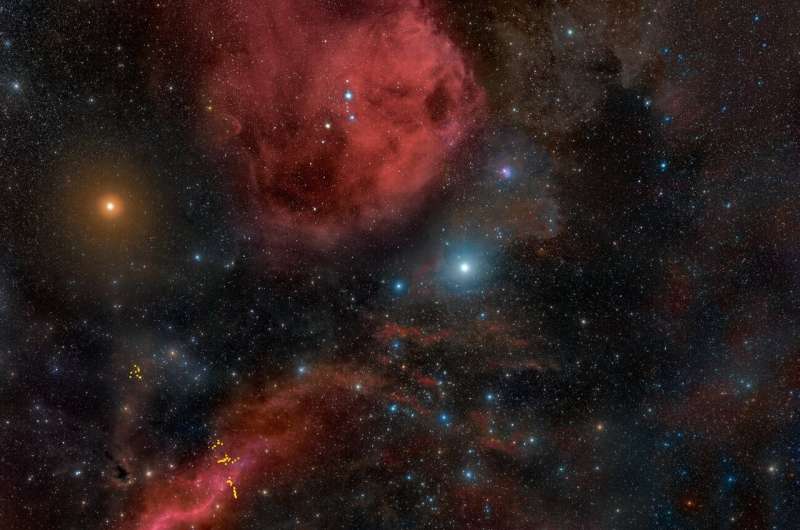
This ground-based image offers a wide view of the entire Orion cloud complex, the closest major star-forming region to Earth. The red material is hydrogen gas ionized and heated by ultraviolet radiation from massive stars in Orion. The stars are forming in clouds of cold hydrogen gas that are either invisible or appear as dark regions in this image. The crescent shape is called Barnard's Loop and partly wraps around the winter constellation figure of Orion the Hunter. The hunter's belt is the diagonal chain of three stars at image center. His feet are the bright stars Saiph (bottom left) and Rigel (bottom right). This landscape encompasses tens of thousands of newly forming stars bursting to life. Many are still encased in their natal cocoons of gas and dust and only seen in infrared light. Researchers used NASA's Hubble and Spitzer space telescopes and the European Space Agency's Herschel Space Telescope to analyze how young stars' powerful outflows carve out cavities in the vast gas clouds. The study is the largest-ever survey of developing stars. 
Credit: R. B. Andreo, DeepSkyColors.com; Data Overlay: NASA, ESA, STScI, N. Habel and S. T. Megeath (University of Toledo)

"In one stellar formation model, if you start out with a small cavity, as the protostar rapidly becomes more evolved, its outflow creates an ever-larger cavity until the surrounding gas is eventually blown away, leaving an isolated star," explained lead researcher Nolan Habel of the University of Toledo in Ohio.

"Our observations indicate there is no progressive growth that we can find, so the cavities are not growing until they push out all of the mass in the cloud. So, there must be some other process going on that gets rid of the gas that doesn't end up in the star."

The team's results will appear in an upcoming issue of The Astrophysical Journal.

A Star is Born

During a star's relatively brief birthing stage, lasting only about 500,000 years, the star quickly bulks up on mass. What gets messy is that, as the star grows, it launches a wind, as well as a pair of spinning, lawn-sprinkler-style jets shooting off in opposite directions. These outflows begin to eat away at the surrounding cloud, creating cavities in the gas.

Popular theories predict that as the young star evolves and the outflows continue, the cavities grow wider until the entire gas cloud around the star is completely pushed away. With its gas tank empty, the star stops accreting mass—in other words, it stops growing.

To look for cavity growth, the researchers first sorted the protostars by age by analyzing Herschel and Spitzer data of each star's light output. The protostars in the Hubble observations were also observed as part of the Herschel telescope's Herschel Orion Protostar Survey.

Then the astronomers observed the cavities in near-infrared light with Hubble's Near-infrared Camera and Multi-object Spectrometer and Wide Field Camera 3. The observations were taken between 2008 and 2017. Although the stars themselves are shrouded in dust, they emit powerful radiation which strikes the cavity walls and scatters off dust grains, illuminating the gaps in the gaseous envelopes in infrared light.

The Hubble images reveal the details of the cavities produced by protostars at various stages of evolution. Habel's team used the images to measure the structures' shapes and estimate the volumes of gas cleared out to form the cavities. From this analysis, they could estimate the amount of mass that had been cleared out by the stars' outbursts.

"We find that at the end of the protostellar phase, where most of the gas has fallen from the surrounding cloud onto the star, a number of young stars still have fairly narrow cavities," said team member Tom Megeath of the University of Toledo. "So, this picture that is still commonly held of what determines the mass of a star and what halts the infall of gas is that this growing outflow cavity scoops up all of the gas. This has been pretty fundamental to our idea of how star formation proceeds, but it just doesn't seem to fit the data here."

Future telescopes such as NASA's upcoming James Webb Space Telescope will probe deeper into a protostar's formation process. Webb spectroscopic observations will observe the inner regions of disks surrounding protostars in infrared light, looking for jets in the youngest sources. Webb also will help astronomers measure the accretion rate of material from the disk onto the star, and study how the inner disk is interacting with the outflow.

Recommend this post and follow Sputnik's Orbit
https://disqus.com/home/forum/thesputniksorbit-blogspot-com/

Posted by Chuck in Space
https://disqus.com/home/forum/lifeofearth/

SPACE - S0 - 20210319 - 3 Space Mysteries, Magnetic Reversal Hyperactivity

SPACE - S0 - 20210319 - 3 Space Mysteries, Magnetic Reversal Hyperactivity

Good Morning, 0bservers!


Nothing yet from the coronal hole streams, although we should be seeing an increase in solar wind speeds today/tomorrow. Not much change from yesterday, except the speed went down a bit more, touching 300 KPS right now. Temperatures are lower again, but there was a drop then steady increase in Particle Density, which does not foreshadow a wind speed increase quite yet. The Phi Angle has been a bit shifty, and it has driven some of the Particle Density movement, but nothing of real note or concern. Yesterday's KP-Index readings were calm, although we did see a brief KP-3 hit the detectors around 0600 UTC. Magnetometer's nominal, Proton Flux's nominal, but the Electron Flux did pop back above the threshold yesterday and it's looking a bit jumpy this morning as well. X-Ray Flux is good overall, with only one small spike earlier this morning that didn't quite make it up to Class B. The Northernmost part of the Southern coronal hole has turned past the midpoint, but there's still the polar region that will be crossing throughout today. No new sunspots, and the ones we've got seem to be calm. The newest one is about 2 days away from the center, but we're already "in range" should it decide to pop off significantly.

Please Recommend this page and be sure to follow the Sputnik's Orbit 


AND WHILST YOU ARE HERE BE SURE TO FOLLOW AND RECOMMEND THE COCONUT WHISPERER https://disqus.com/home/forum/the-coconut-whisperer/

Thursday, March 18, 2021

Astronomers map silk of cosmic web

MARCH 17, 2021, by Netherlands Research School for Astronomy
https://phys.org/news/2021-03-astronomers-silk-cosmic-web.html

An image of some two billion years after the Big Bang in the constellation Fornax (Oven). Each point of light is an entire galaxy. The blue silk of the cosmic web was discovered with MUSE. The gas extends over a distance of 15 million light years. That's roughly equivalent to 150 times our Milky Way placed back to back. Credit: ESO/NASA/Roland Bacon et al.


An international team of astronomers, including several from the Netherlands, has mapped a piece of the cosmic web without using bright quasars for the first time. Their findings will be published shortly in the journal Astronomy & Astrophysics.

Astronomers have long assumed that the billions of galaxies in our universe are connected by a huge cosmic web of gas flows. The web itself is difficult to see because it generates almost no light. Until now, only nodes in the cosmic web had been mapped using quasars. These are supermassive black holes in the centers of galaxies whose surroundings emit enormous amounts of light. The light is then scattered by the cosmic web, making the web around the quasars visible. Unfortunately, quasars are rare. Moreover, they are only located at nodes of the cosmic web. As a result, they provide a limited view.

For the first time, researchers have managed to see a small piece of the cosmic web without using quasars. A team led by Roland Bacon (CNRS, Centre de Recherche Astrophysique de Lyon, France) focused the Very Large Telescope on a part of the iconic Hubble Ultra Deep Field for 140 hours ( over six nights between August 2018 and January 2019).

Using the Multi Unit Spectroscopic Explorer (MUSE), the researchers were able to capture the light from groups of stars and galaxies that was scattered by gas filaments from the cosmic web. This is light from about 2 billion years after the Big Bang.

The observations showed that potentially more than half of the scattered light comes not from large bright radiating sources, but from a sea of previously undiscovered galaxies of very low luminosity that are far too dim to be observed individually.

The results strengthen the hypothesis that the young universe consisted of vast numbers of, small groups of freshly formed stars. Co-author Joop Schaye (Leiden Observatory, Leiden University, the Netherlands): "We think that the light we are seeing comes mainly from young galaxies, each containing millions of times fewer stars than our own Milky Way. Such tiny galaxies were likely responsible for the end of the cosmic 'dark ages," when less than a billion years after the Big Bang, the universe was illuminated and heated by the first generations of stars."

Co-author Michael Maseda (Leiden Observatory, Leiden University) adds, "The MUSE observations thus not only give us a picture of the cosmic web, but also provide new evidence for the existence of the extremely small galaxies that play such a crucial role in models of the early universe."

In the future, the astronomers would like to map larger pieces of the cosmic web. That's why they are working to improve the MUSE instrument so that it provides a two to four times larger field of view.


Recommend this post and follow Sputnik's Orbit
https://disqus.com/home/forum/thesputniksorbit-blogspot-com/


Posted by Chuck in Space
https://disqus.com/home/forum/lifeofearth/


SPACE - S0 - 20210318 - Recurrent Nova, StarWater, Hiding in Plain Sight

SPACE - S0 - 20210318 - Recurrent Nova, StarWater, Hiding in Plain Sight

Good Morning, 0bservers!


Continuing calm from the solar wind front, as speeds extended their downward trend. The speed at midnight UTC yesterday was about 390 KPS, and that spent the day and night on a gentle slide to about 340 KPS. Still a ways to go downward, but I don't think that'll be happening once those coronal hole streams arrive. Particle Density, on the other hand, was doing a slow and steady rise throughout all of yesterday, while Temperature remained mostly steady on the low side. There was a shift in solar magnetism as the Phi Angle chart showed a strong jump around midnight UTC today. The KP-Index remained green, with KP-1s and KP-2s predominating. And we have a triple-nominal this morning for a change from the Magnetometer, Proton Flux and Electron Flux charts. X-Ray Flux looks good as well, as the background radiation levels have dropped slightly in the past 24, with only the slightest upward bumps (never leaving Class A flare range). The major section of the Southern coronal hole is now passing the centerline, so expect output from this system arriving in the next 36-60 hours. The departing sunspot group in the North retains its magnetic complexity (looks like Beta, but it's hard to tell on a B/W image). However, the incoming Northern spot is no slouch either, with more positive/negative mixing in one area which may indicate Beta-Delta complexity.

Please Recommend this page and be sure to follow the Sputnik's Orbit 


AND WHILST YOU ARE HERE BE SURE TO FOLLOW AND RECOMMEND THE COCONUT WHISPERER https://disqus.com/home/forum/the-coconut-whisperer/

Wednesday, March 17, 2021

SPACE - S0 - 20210317 - Ocean Collapse, Dating Fiasco, Storm Alert

SPACE - S0 - 20210317 - Ocean Collapse, Dating Fiasco, Storm Alert

Good Morning, Fellow "Irish" 0bservers!


Solar winds are still slowing, dropping over 100 KPS from yesterday's high to a current 350 KPS. Temperatures also declined, but Particle Density actually had a slight increase compared to where it started yesterday morning. There was a strong shift in the Phi Angle around 1800 UTC. KP-Index readings were all in the green, mostly low-level KP-1s. The Magnetometer and Proton Flux look good, and the Electron Flux has not yet dropped below the threshold. The X-Ray Flux showed a flare around the same time as the Phi Angle shift, but it was only up to the middle of Class B flare range. The Southern coronal hole system continues to pass across the midpoint, and we've got elevated earthquake risks due to the coronal hole streams incoming. The new sunspot group from the Eastern lim is more visible now on the Magnetogram, and there's a lot more complexity and intermix of positive/negative magnetism, so we may see a higher flare risk from this depending on how it continues to develop.

Please Recommend this page and be sure to follow the Sputnik's Orbit 


AND WHILST YOU ARE HERE BE SURE TO FOLLOW AND RECOMMEND THE COCONUT WHISPERER https://disqus.com/home/forum/the-coconut-whisperer/

Tuesday, March 16, 2021

Defense News: Israel unveils the 'Iron Sting' laser, GPS-guided mortar munition


Israel unveils the 'Iron Sting' laser, GPS-guided mortar munition

A ‘networked precision fire system’ that engages targets accurately and prevents collateral damage • 10-year development concludes with successful trials

By Udi Shaham,  Jerusalem Post, March 14, 2021

Iron Sting laser, GPS-guided mortar munition [Credit: Israel Defense Ministry Spokesperson's Office]

As the IDF completes preparations for possible combat in both the southern and the northern fronts — where it is expected to encounter a smarter, well-organized enemy —the Defense Ministry, the IDF’s Ground Forces and Elbit Systems have revealed a precise, laser and GPS guided mortar munition: the “Iron Sting.”

The 120 mm mortar has recently undergone final trials in a testing site in southern Israel. The completion of testing enables the start of serial production ahead of the system’s supply to the IDF, the Defense Ministry said in a statement on Sunday.

The body in charge of development of the system in the Defense Ministry is the Directorate of Defense R&D (DDR&D).

The series of tests was carried out using two networked "Cardom" mortar systems developed by Elbit: a “Cardom” system, mounted on an M113 APC and a “Cardom Spear” system, mounted on a Hummer 4X4 SUV.

The ministry said in a statement that Iron Sting is designed to engage targets precisely, in both open terrains and urban environments, while reducing the possibility of collateral damage and preventing injury to non-combatants. Its operational use will revolutionize ground warfare and equip battalions with organic, accurate and effective firepower.

Following the announcement, Defense Minister Benny Gantz said that "the technology made available to the IDF by Israeli industries changes the battlefield and provides our forces with more accurate and effective means.

"The integration of ‘Iron Sting' into the IDF corresponds to the vision presented in the military’s ‘Tnufa’ multi-year plan,” he said. “It also fulfills the IDF’s needs, adapting combat capabilities to contend with enemies hidden within civilian, urban environments, while meeting the legal and moral standards set by the State of Israel.”

DDR&D’s Head of Research and Development, Brig. Gen. Yaniv Rotem, said that “ten years of research and development have led us to this moment when we can provide the IDF’s ground forces with advanced capabilities made for the modern battlefield.

“This laser and GPS-guided mortar munition provides troops with a precise firing capability that has only been implemented in missiles and air munition thus far,” he said. “This is a very complex program and a groundbreaking system on the international level.”

Col. Arik Aviv, head of the IDF’s Ground Forces’ Weapons Department, said that “the Ground Forces command is leading the process of integrating the ‘Iron Sting’ into the IDF. This precise guided mortar munition is groundbreaking for IDF battalions, equipping them with accurate and organic firepower.

This capability has so far been reserved for large and complex missiles,” he said. “Thanks to this impressive technological development, it will now be implemented in mortar munitions on a wide scale.”

Yehuda (Udi) Vered, general manager of Elbit Systems Land Division, said: "The introduction of this laser and GPS guided munition transforms the mortar system from statistical firepower into a precision fire system, thus delivering a significant change in fire capabilities at the tactical level.

“We believe that we have been able to develop an efficient solution that enables us to increase precision and reduce collateral damage.”


Please recommend this page & follow the Sputniks Orbit 

Three bacterial strains discovered on space station may help grow plants on Mars

MARCH 15, 2021, by Frontiers
https://phys.org/news/2021-03-bacterial-strains-space-station-mars.html

Credit: Pixabay/CC0 Public Domain

In order to withstand the rigors of space on deep-space missions, food grown outside of Earth needs a little extra help from bacteria. Now, a recent discovery aboard the International Space Station (ISS) has researchers may help create the 'fuel' to help plants withstand such stressful situations.

Publishing their findings to Frontiers in Microbiology, researchers working with NASA described the discovery and isolation of 4 strains of bacteria belonging to the family Methylobacteriaceae from different locations aboard the ISS across two consecutive flights.

While 1 strain was identified as Methylorubrum rhodesianum, the other 3 were previously undiscovered and belong to a novel species novel. The rod-shaped, motile bacteria were given the designations IF7SW-B2T, IIF1SW-B5, and IIF4SW-B5 with genetic analysis showing them to be closely related to Methylobacterium indicum.

Methylobacterium species are involved in nitrogen fixation, phosphate solubilization, abiotic stress tolerance, plant growth promotion and biocontrol activity against plant pathogens.

Potential for Mars missions

Now, in honor of the renowned Indian biodiversity scientists Dr. Ajmal Khan, the team has proposed to call the novel species Methylobacterium ajmalii.

Commenting on the discovery, Dr. Kasthuri Venkateswaran (Venkat) and Dr. Nitin Kumar Singh of NASA's Jet Propulsion Laboratory, (JPL), says that the strains might possess " biotechnologically useful genetic determinants" for the growing of crops in space.

However, further experimental biology is needed to prove that it is, indeed, a potential game-changer for space farming.

"To grow plants in extreme places where resources are minimal, isolation of novel microbes that help to promote plant growth under stressful conditions is essential," they said.

Along with JPL, other researchers collaborating on this discovery are based at the University of Southern California, Los Angeles; Cornell University and the University of Hyderabad in India.

With NASA one day looking to take humans to the surface of Mars—and potentially beyond—the US National Research Council Decadal Survey recommends that the space agency use the ISS as a "test-bed for surveying microorganisms", according to Venkat and Singh.

"Since our group possess expertise in cultivating microorganisms from extreme niches, we have been tasked by the NASA Space Biology Program to survey the ISS for the presence and persistence of the microorganisms," they add.

"Needless to say, the ISS is a cleanly-maintained extreme environment. Crew safety is the number 1 priority and hence understanding human/plant pathogens are important, but beneficial microbes like this novel Methylobacterium ajmalii are also needed."

Expanding the ISS lab

As part of an ongoing surveillance mission, 8 locations on the ISS are being monitored for bacterial growths and have been for the last 6 years. These sample areas include where the crew assembles or where experiments are conducted, such as the plant growth chamber.

While hundreds of bacterial samples from the ISS have been analyzed to date, approximately 1,000 samples have been collected from various other locations on the space station but are awaiting a trip back to Earth where they can be examined.

According to Venkat and Singh, the eventual goal is to bypass this lengthy process and potentially find new novel strains using molecular biology equipment developed and demonstrated for the ISS.

"Instead of bringing samples back to Earth for analyses, we need an integrated microbial monitoring system that collect, process, and analyze samples in space using molecular technologies," Venkat and Singh said.

"This miniaturized 'omics in space' technology—a biosensor development—will help NASA and other space-faring nations achieve safe and sustainable space exploration for long periods of time."


Recommend this post and follow Sputnik's Orbit
https://disqus.com/home/forum/thesputniksorbit-blogspot-com/


Posted by Chuck in space

https://disqus.com/home/forum/lifeofearth/

SPACE - S0 - 20210316 - The Lost Ice Core, Bombshell Greenland Discovery

SPACE - S0 - 20210316 - The Lost Ice Core, Bombshell Greenland Discovery

Good Morning, 0bservers!


Sorry for the absence, folks, when I'm On-Call at work I barely have time to go boo, let alone do solar reports. Pulled 80+ hours, with over 20 of those on the weekend. And I'm scheduled for this every six weeks...

Solar wind speeds continue to slow down from the Saturday Night Surge, with a steady trend to our current 400-420 KPS range. Particle Density and Temperature are also looking good with steady to slightly lower levels, and the Phi Angle is stable. We're well out of Sunday's minor geomagnetic storm activity with green all across the KP-Index. The Magnetometer and Proton Flux readings are nominal, but we did see the Electron Flux breach the alert threshold again. The X-Ray Flux chart shows steady, with no spikes or flares since that mid-Class B reading from late morning yesterday. Seeing some strong development and extension of the Southern polar coronal hole, with the leading edge passing the midpoint today, and the trailing Northward tendril about 36 hours behind that. The major Northern sunspot group is just now crossing central heliographic longitude, and I'm seeing some potential spots crossing the Eastern lim with some pretty good activity and prominences showing up at 304Å. The angle is bad, but the Magnetogram does show magnetic complexity for the incoming group.

Please Recommend this page and be sure to follow the Sputnik's Orbit 


AND WHILST YOU ARE HERE BE SURE TO FOLLOW AND RECOMMEND THE COCONUT WHISPERER https://disqus.com/home/forum/the-coconut-whisperer/

Monday, March 15, 2021

Magnetic Shift, Earth Skeleton, Earthquake/Volcano Watch | S0 News Mar.15.2021

15 Mar 2021
Daily Sun, Earth and Science News! By Suspicious 0bservers


https://youtu.be/BmQh87FASF4


Today's Featured Links: 
Disaster Playlist: https://youtube.com/playlist?list=PLH...​ 
Lithosphere-Asthenosphere Conductivity: https://www.sciencedirect.com/science...​ Upper Mantle Geomagnetic: https://assets.researchsquare.com/fil...​ 
Deep Conductive Hydrogen: https://www.nature.com/articles/s4156...​ 
Earth EM Vortices Under Magnetic Shift: https://www.researchgate.net/profile/...​ Radiation Belt Events Underestimated: https://agupubs.onlinelibrary.wiley.c...​ Volcanos and Indian Drought: https://www.nature.com/articles/s4159...

Recommend this post and follow Sputnik's Orbit​
https://disqus.com/home/forum/thesputniksorbit-blogspot-com/

Posted by Chuck in the absence of Doc. Farmer

Sunday, March 14, 2021

Russia deploys giant space telescope in Lake Baikal

MARCH 13, 2021
https://phys.org/news/2021-03-russia-deploys-giant-space-telescope.html

The underwater neutrino telescope was lowered to a depth of 750-1,300 meters in Lake Baikal

Russian scientists on Saturday launched one of the world's biggest underwater space telescopes to peer deep into the universe from the pristine waters of Lake Baikal.

The deep underwater telescope, which has been under construction since 2015, is designed to observe neutrinos, the smallest particles currently known.

Dubbed Baikal-GVD, the telescope was submerged to a depth of 750-1,300 meters (2,500-4,300 feet), around four kilometres from the lake's shore.

Neutrinos are very hard to detect and water is an effective medium for doing so.

The floating observatory consists of strings with spherical glass and stainless steel modules attached to them.

On Saturday, scientists observed the modules being carefully lowered into the freezing waters through a rectangular hole in the ice.

"A neutrino telescope measuring half a cubic kilometre is situated right under our feet," Dmitry Naumov of the Joint Institute for Nuclear Research told AFP while standing on the lake's frozen surface.

In several years the telescope will be expanded to measure one cubic kilometre, Naumov said.

The Baikal telescope will rival Ice Cube, a giant neutrino observatory buried under the Antarctic ice at a US research station at the South Pole, he added.

Russian scientists say the telescope is the largest neutrino detector in the Northern Hemisphere and Lake Baikal—the largest freshwater lake in the world—is ideal for housing the floating observatory.

"Of course, Lake Baikal is the only lake where you can deploy a neutrino telescope because of its depth," Bair Shoibonov of the Joint Institute for Nuclear Research told AFP.

"Fresh water is also important, water clarity too. And the fact that there is ice cover for two-two and a half months is also very important."

The telescope is the result of a collaboration between scientists from the Czech Republic, Germany, Poland, Russia and Slovakia.

Recommend this post and follow Sputnik's Orbit
https://disqus.com/home/forum/thesputniksorbit-blogspot-com/


Posted by Chuck in Space
https://disqus.com/home/forum/lifeofearth/