The Sputniks Orbit

The Sputniks Orbit covers Defense, Science and Technology only, no politics, racism, religion, porn, or social agendas allowed

Wednesday, June 23, 2021

Is dark matter real, or have we misunderstood gravity?

JUNE 22, 2021, by University of Amsterdam
https://phys.org/news/2021-06-dark-real-misunderstood-gravity.html

In the centre of the image the elliptical galaxy NGC5982, and to the right the spiral galaxy NGC5985. These two types of galaxies turn out to behave very differently when it comes to the extra gravity – and therefore possibly the dark matter – in their outer regions.
 Credit: Bart Delsaert (www.delsaert.com)

For many years now, astronomers and physicists have been in a conflict. Is the mysterious dark matter that we observe deep in the Universe real, or is what we see the result of subtle deviations from the laws of gravity as we know them? In 2016, Dutch physicist Erik Verlinde proposed a theory of the second kind: emergent gravity. New research, published in Astronomy & Astrophysics this week, pushes the limits of dark matter observations to the unknown outer regions of galaxies, and in doing so re-evaluates several dark matter models and alternative theories of gravity. Measurements of the gravity of 259,000 isolated galaxies show a very close relation between the contributions of dark matter and those of ordinary matter, as predicted in Verlinde's theory of emergent gravity and an alternative model called Modified Newtonian Dynamics. However, the results also appear to agree with a computer simulation of the Universe that assumes that dark matter is 'real stuff'.

The new research was carried out by an international team of astronomers, led by Margot Brouwer (RUG and UvA). Further important roles were played by Kyle Oman (RUG and Durham University) and Edwin Valentijn (RUG). In 2016, Brouwer also performed a first test of Verlinde's ideas; this time, Verlinde himself also joined the research team.

Matter or gravity?

So far, dark matter has never been observed directly—hence the name. What astronomers observe in the night sky are the consequences of matter that is potentially present: bending of starlight, stars that move faster than expected, and even effects on the motion of entire galaxies. Without a doubt all of these effects are caused by gravity, but the question is: are we truly observing additional gravity, caused by invisible matter, or are the laws of gravity themselves the thing that we haven't fully understood yet?

To answer this question, the new research uses a similar method to the one used in the original test in 2016. Brouwer and her colleagues make use of an ongoing series of photographic measurements that started ten years ago: the KiloDegree Survey (KiDS), performed using ESO's VLT Survey Telescope in Chile. In these observations one measures how starlight from far away galaxies is bent by gravity on its way to our telescopes. Whereas in 2016 the measurements of such 'lens effects' only covered an area of about 180 square degrees on the night sky, in the mean time this has been extended to about 1000 square degrees—allowing the researchers to measure the distribution of gravity in around a million different galaxies.

Comparative testing

Brouwer and her colleagues selected over 259,000 isolated galaxies, for which they were able to measure the so-called 'Radial Acceleration Relation' (RAR). This RAR compares the amount of gravity expected based on the visible matter in the galaxy, to the amount of gravity that is actually present—in other words: the result shows how much 'extra' gravity there is, in addition to that due to normal matter. Until now, the amount of extra gravity had only been determined in the outer regions of galaxies by observing the motions of stars, and in a region about five times larger by measuring the rotational velocity of cold gas. Using the lensing effects of gravity, the researchers were now able to determine the RAR at gravitational strengths which were one hundred times smaller, allowing them to penetrate much deeper into the regions far outside the individual galaxies.

This made it possible to measure the extra gravity extremely precisely—but is this gravity the result of invisible dark matter, or do we need to improve our understanding of gravity itself? Author Kyle Oman indicates that the assumption of 'real stuff' at least partially appears to work: "In our research, we compare the measurements to four different theoretical models: two that assume the existence of dark matter and form the base of computer simulations of our universe, and two that modify the laws of gravity—Erik Verlinde's model of emergent gravity and the so-called 'Modified Newtonian Dynamics' or MOND. One of the two dark matter simulations, MICE, makes predictions that match our measurements very nicely. It came as a surprise to us that the other simulation, BAHAMAS, led to very different predictions. That the predictions of the two models differed at all was already surprising, since the models are so similar. But moreover, we would have expected that if a difference would show up, BAHAMAS was going to perform best. BAHAMAS is a much more detailed model than MICE, approaching our current understanding of how galaxies form in a universe with dark matter much closer. Still, MICE performs better if we compare its predictions to our measurements. In the future, based on our findings, we want to further investigate what causes the differences between the simulations."


Recommend this post and follow
Sputnik's Orbit


Posted by Chuck


https://chuckincardinal.blogspot.com/
Posted by chuckincardinal on June 23, 2021 No comments:
Email ThisBlogThis!Share to XShare to FacebookShare to Pinterest

SPACE - S0 - 20210623 - Solar Flare and CME Eruption, Mystery Lights, Polar Shift News

SPACE - S0 - 20210623 - Solar Flare and CME Eruption, Mystery Lights, Polar Shift News

Good Morning, 0bservers!


Most of the period has shown calming of the solar wind speeds, hitting a low of 320 KPS around 0730 UTC this morning, with the highest level at 395 KPS at 0230 UTC yesterday. We did see a jump up to 375 KPS at 0800 UTC for just under two hours before it fell back below 340 KPS. Particle Density was mildly variable, with the current level below the point of yesterday's report. Temperatures were mildly variable as well but retained long periods of stability once they'd shift. The Phi Angle went pretty wild starting around noon UTC, stabilized ad midnight UTC for about three hours then shifted to a new stable polarity for another five hours, before getting wonky starting at 0800 UTC. The sudden shift at 0300 UTC looks like a polarity collision on the Bt/Bz chart. The KP-Index remained in the KP-1 to KP-2 range throughout the reporting period. Getting nominal readings from the Magnetometer, Proton Flux and Electron Flux charts. The X-Ray Flux showed a flare just below the Class C line around 1300 UTC, but then we saw a stronger one into mid-Class C at 0600 UTC. The video loops show the eruption and expulsion along the Northeast lim best at 193Å, but 304Å shows the brightness of the flare in spectacular fashion. It's still a bit hard to see that new sunspot group on the Magnetogram, but it's at least Beta-Delta complexity.
* * *
Another new video from Suspicious0bservers, "You Don't Know Nova". Fascinating information on what does and doesn't constitute a "nova".
  
  
Enjoy!
 
Please Recommend this page and be sure to follow the Sputnik's Orbit 
https://disqus.com/home/forum/thesputniksorbit-blogspot-com/ 


AND WHILST YOU ARE HERE BE SURE TO FOLLOW AND RECOMMEND THE COCONUT WHISPERER https://disqus.com/home/forum/the-coconut-whisperer/
Posted by Doc Farmer on June 23, 2021 No comments:
Email ThisBlogThis!Share to XShare to FacebookShare to Pinterest

Tuesday, June 22, 2021

Space News: Technion, IAI to partner on building, launching nano-satellite to moon


Technion, IAI to partner on building, launching nano-satellite to moon


"We are working to promote close research cooperation and to turn the Technion into a hub for many diverse industries, a platform where industry and academia meet."

By AARON REICH  , Jerusalem Post, JUNE 21, 2021
https://www.jpost.com/health-science/technion-iai-to-partner-on-building-launching-nano-satellite-to-moon-671626

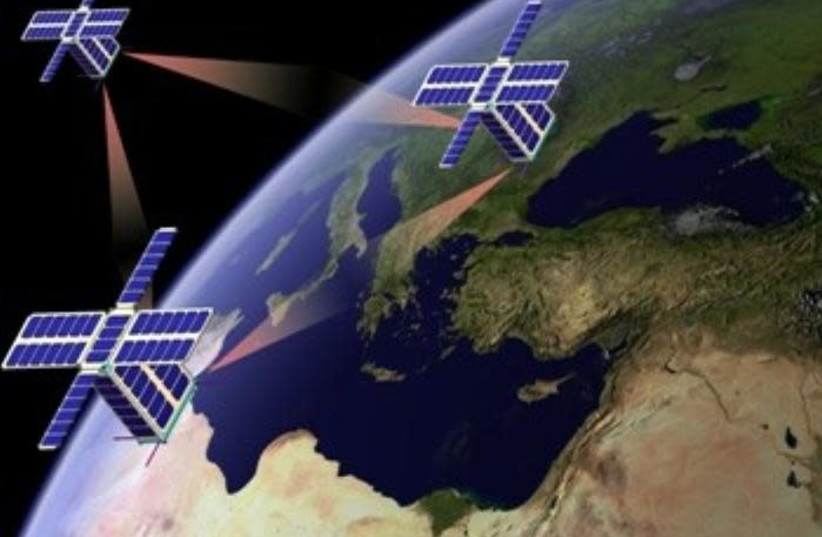
A computer-generated redition of the nano-satellites in orbit (photo credit: Courtesy)


Technion-Israel Institute of Technology and Israel Aerospace Industries' (IAI) Space Division are partnering to literally reach for the stars by developing and launching a nano-satellite to orbit the moon.
The project, which is to be carried out by Technion students with the help of IAI space engineers and facilities, will begin at the start of the 2021/22 academic year in October and will progress until it finishes in a few years' time.

The project is also being assisted through a major effort by the Technion Faculty of Aerospace Engineering to balance aeronautics and outer space.

"While in the past only about 10% of the faculty syllabus was dedicated to space, in the past few years there has been an effort to change this and reach a more equal balance between the two fields," Faculty dean Prof. Tal Shima said in a statement. 

"To achieve this. we updated the faculty curriculum and we are currently in the process of hiring new staff members with expertise in outer space. Cooperation with IAI's space facility will allow us to expose students to additional joint projects with IAI focused on space. This is a fascinating field where activity in Israel and the world is stepping up and I hope to see as many students as possible focusing on it."

The project will be headed by Prof. Gil Yudilevitch for the Technion, and by Technion alumnus and current IAI space engineer Niko Adamsky for IAI.

"The project will allow students to become partners in a project with the industry and help them reach the end of their studies prepared to be integrated into Israel's developing space industry," Yudilevitch explained

"The interface between academia and industry is changing fast and the Technion is investing great efforts in being established in Israel and internationally," Technion president Prof. Uri Sivan said at a signing ceremony.

 
"We are working to promote close research cooperation and to turn the Technion into a hub for many diverse industries, a platform where industry and academia meet. We are quickly working to commercialize technologies that originated on campus."

"As an alumnus of the Technion, accompanying projects and different mentoring programs over the years, I am excited by the existing and future cooperation between IAI and the Technion," IAI president and CEO Boaz Levy explained. 

"We must strengthen cooperation with the Technion, especially the Faculty of Aerospace Engineering, which is unique to its kind in Israel, and which holds a leadership position among similar faculties worldwide. Increasing our cooperation with the Technion produces added value to both sides and will help us strengthen and integrate in creating groundbreaking, challenging, and leading technology in Israel and abroad. To this end, it is important we formulate together the image of the engineer we envision – an involved engineer with system-wide perspective and deep business understanding and research capabilities."

This is not the first time IAI and Technion have collaborated together for nano-satellite technology. In August 2020, Technion and IAI collaborated to develop an advanced and unique innovative receiver and a satellite computer as part of the Adelis-SAMSON project. Said project saw Technion launch three autonomous nano-satellites called CubeSats on March 20, 2021. The satellites were launched from Kazakhstan onboard a Glavkosmos Soyuz rocket, and each 8 kg. satellite came equipped with sensors, control systems and navigation tools.

This was not the Israeli university's first foray into space. In 1998, Technion launched the Gurwin-TechSat II. Eleven years later, that satellite is still in orbit.

However, this is not the first time an Israeli university has launched nano-satellites. In February, a nanosatellite designed, developed, assembled and tested by Tel Aviv University was launched from a NASA launch facility in Virginia. 

The development and launching of nanosatellites is seen by some experts as being a part of the the "Civil Space Revolution." Also called New Space, this term refers to how the field of satellites is no longer limited to just massive, well-funded companies. This is especially notable, as many experts believe the nanosatellite field will be critical in maintaining high-speed Internet and communications in the future.

Technion had already joined New Space with the Adelis-SAMSON satellites, and now this new project could see them go a little farther.

Maayan Hoffman and Sarah Chemla contributed to this report.


Please recommend this page & follow the Sputniks Orbit 
https://disqus.com/home/forum/thesputniksorbit-blogspot-com/
Posted by Sputnik One on June 22, 2021 No comments:
Email ThisBlogThis!Share to XShare to FacebookShare to Pinterest

SPACE - S0 - 20210622 - A Titan Has Fallen, Solar Chemistry, End-Permian Extinction

SPACE - S0 - 20210622 - A Titan Has Fallen, Solar Chemistry, End-Permian Extinction 

Good Morning, 0bservers!


Solar winds stayed steady through most of yesterday morning, in the 350-375 KPS range, but became more variable in the afternoon and evening moving into the 320-390 KPS range. It's since calmed down as of 0600 UTC to the 370-340 KPS range and seems to be dropping further. Particle Density started tapering off around 0600 UTC yesterday but took a sharper rise after midnight UTC with a dropoff around 0700 UTC. Not sure if that's the portent of the coronal hole stream, but we'll have to wait and see if the winds pick up in the next six hours. Temperatures jumped around 0500 from 4400°K to 5200°K, but then started dropping back about two hours later, with the current readings near 4000°K. The Phi Angle was pretty variable (but not wildly so) for most of yesterday, but seems to have steadied itself around 0300 UTC. And we're seeing a BIG gap in the Bt/Bz polarities since 0200 UTC. KP-Index readings were calm all of yesterday (KP-1) but we did see a KP-3 pop up at 0300 UTC, lowering to KP-2 by 0600 UTC. Magnetometer sine wave is nominal, as is the Proton Flux, and the Electron Flux finally dipped below the alert threshold around 2300 UTC. Background radiation levels on the X-Ray Flux increased to above the Class B line throughout the period, and we did have one spike to mid-Class B around 0200-0300 UTC. It must've been a pretty lame one (or on the far side of the Sun), because it didn't show up on the video loops. There is a new equatorial coronal hole developing now and crossing central heliographic longitude, and I'm seeing some new potential sunspot glows along the Eastern lim, one in the North and a weaker one in the South. Neither are showing up on the Magnetogram image from SOHO, but the departing sunspot in the North is gaining in complexity at the moment, so we might see some action from that as it moves toward the Western lim.
 
Please Recommend this page and be sure to follow the Sputnik's Orbit 
https://disqus.com/home/forum/thesputniksorbit-blogspot-com/ 


AND WHILST YOU ARE HERE BE SURE TO FOLLOW AND RECOMMEND THE COCONUT WHISPERER https://disqus.com/home/forum/the-coconut-whisperer/
Posted by Doc Farmer on June 22, 2021 No comments:
Email ThisBlogThis!Share to XShare to FacebookShare to Pinterest

Monday, June 21, 2021

New research adds a wrinkle to our understanding of the origins of matter in the Milky Way

JUNE 19, 2021, by University of Maryland Baltimore County
https://phys.org/news/2021-06-wrinkle-milky.html

Credit: CC0 Public Domain

New findings published this week in Physical Review Letters suggest that carbon, oxygen, and hydrogen cosmic rays travel through the galaxy toward Earth in a similar way, but, surprisingly, that iron arrives at Earth differently. Learning more about how cosmic rays move through the galaxy helps address a fundamental, lingering question in astrophysics: How is matter generated and distributed across the universe?

"So what does this finding mean?" asks John Krizmanic, a senior scientist with UMBC's Center for Space Science and Technology (CSST). "These are indicators of something interesting happening. And what that something interesting is we're going to have to see."

Cosmic rays are atomic nuclei—atoms stripped of their electrons—that are constantly whizzing through space at nearly the speed of light. They enter Earth's atmosphere at extremely high energies. Information about these cosmic rays can give scientists clues about where they came from in the galaxy and what kind of event generated them.

An instrument on the International Space Station (ISS) called the Calorimetric Electron Telescope (CALET) has been collecting data about cosmic rays since 2015. The data include details such as how many and what kinds of atoms are arriving, and how much energy they're arriving with. The American, Italian, and Japanese teams that manage CALET, including UMBC's Krizmanic and postdoc Nick Cannady, collaborated on the new research.

Iron on the move

Cosmic rays arrive at Earth from elsewhere in the galaxy at a huge range of energies—anywhere from 1 billion volts to 100 billion billion volts. The CALET instrument is one of extremely few in space that is able to deliver fine detail about the cosmic rays it detects. A graph called a cosmic ray spectrum shows how many cosmic rays are arriving at the detector at each energy level. The spectra for carbon, oxygen, and hydrogen cosmic rays are very similar, but the key finding from the new paper is that the spectrum for iron is significantly different.

There are several possibilities to explain the differences between iron and the three lighter elements. The cosmic rays could accelerate and travel through the galaxy differently, although scientists generally believe they understand the latter, Krizmanic says.

"Something that needs to be emphasized is that the way the elements get from the sources to us is different, but it may be that the sources are different as well," adds Michael Cherry, physics professor emeritus at Louisiana State University (LSU) and a co-author on the new paper. Scientists generally believe that cosmic rays originate from exploding stars (supernovae), but neutron stars or very massive stars could be other potential sources.

Next-level precision

An instrument like CALET is important for answering questions about how cosmic rays accelerate and travel, and where they come from. Instruments on the ground or balloons flown high in Earth's atmosphere were the main source of cosmic ray data in the past. But by the time cosmic rays reach those instruments, they have already interacted with Earth's atmosphere and broken down into secondary particles. With Earth-based instruments, it is nearly impossible to identify precisely how many primary cosmic rays and which elements are arriving, plus their energies. But CALET, being on the ISS above the atmosphere, can measure the particles directly and distinguish individual elements precisely.

Iron is a particularly useful element to analyze, explains Cannady, a postdoc with CSST and a former Ph.D. student with Cherry at LSU. On their way to Earth, cosmic rays can break down into secondary particles, and it can be hard to distinguish between original particles ejected from a source (like a supernova) and secondary particles. That complicates deductions about where the particles originally came from.

"As things interact on their way to us, then you'll get essentially conversions from one element to another," Cannady says. "Iron is unique, in that being one of the heaviest things that can be synthesized in regular stellar evolution, we're pretty certain that it is pretty much all primary cosmic rays. It's the only pure primary cosmic ray, where with others you'll have some secondary components feeding into that as well."

"Made of stardust"

Measuring cosmic rays gives scientists a unique view into high-energy processes happening far, far away. The cosmic rays arriving at CALET represent "the stuff we're made of. We are made of stardust," Cherry says. "And energetic sources, things like supernovas, eject that material from their interiors, out into the galaxy, where it's distributed, forms new planets, solar systems, and... us."

"The study of cosmic rays is the study of how the universe generates and distributes matter, and how that affects the evolution of the galaxy," Krizmanic adds. "So really it's studying the astrophysics of this engine we call the Milky Way that's throwing all these elements around."

A global effort

The Japanese space agency launched CALET and today leads the mission in collaboration with the U.S. and Italian teams. In the U.S., the CALET team includes researchers from LSU; NASA Goddard Space Flight Center; UMBC; University of Maryland, College Park; University of Denver; and Washington University.The new paper is the fifth from this highly successful international collaboration published in PRL, one of the most prestigious physics journals.

CALET was optimized to detect cosmic ray electrons, because their spectrum can contain information about their sources. That's especially true for sources that are relatively close to Earth in galactic terms: within less than one-thirtieth the distance across the Milky Way. But CALET also detects the atomic nuclei of cosmic rays very precisely. Now those nuclei are offering important insights about the sources of cosmic rays and how they got to Earth.

"We didn't expect that the nuclei—the carbon, oxygen, protons, iron—would really start showing some of these detailed differences that are clearly pointing at things we don't know," Cherry says.

The latest finding creates more questions than it answers, emphasizing that there is still more to learn about how matter is generated and moves around the galaxy. "That's a fundamental question: How do you make matter?" Krizmanic says. But, he adds, "That's the whole point of why we went in this business, to try to understand more about how the universe works."


Recommend this post and follow
Sputnik's Orbit
https://disqus.com/home/forum/thesputniksorbit-blogspot-com/


Posted by Iron Chuck

https://chuckincardinal.blogspot.com/
Posted by chuckincardinal on June 21, 2021 No comments:
Email ThisBlogThis!Share to XShare to FacebookShare to Pinterest

SPACE - S0 - 20210621 - Solar Eruptions, Deep Electric, Sneaky Nova

SPACE - S0 - 20210621 - Solar Eruptions, Deep Electric, Sneaky Nova 

Good Morning, 0bservers!


Note: This post reflects Disqus Post number 80,000 for me. A few weeks ago I had 500,000 upvotes. At this writing it is below 14,000. Before the day is out, that will be scum-bot'd down to the negative numbers. M'eh - easy come, easy go. It is just irksome that the fuckwits can actually pull this kind of crap. 

Anyway, the space weather's the REAL story here, amirite?

Solar wind speeds spent all of yesterday and this morning slowing down, from a peak of 460 KPS at 0100 UTC yesterday to its current 350-360 KPS range. Particle density had a slow rise until about noon UTC when it dropped, then started rebuilding again until it peaked around midnight UTC after which it started a slow decline. Temperatures were steady for most of the morning before dropping below 5000°K around 1400 UTC, declining further until a surge around 2000 UTC, dropping back at midnight, and then a major dip to nearly 4000°K around 0600, and then returning to 5000°K at last report. Those movements mirror some wide gaps in the Bt/Bz chart, which have also driven some moderate changes in the Phi Angle readings. Most of the KP-Index readings in the last 48 hours were quite low, almost exclusively KP-1, but we did have a short KP-3 burst at midnight UTC before returning back to previous levels. Magnetometer is nominal, as is the Proton Flux, but the Electron Flux has stayed above the Alert Threshold for almost 48 hours before finally going back below it around 0200 UTC (it's crept back above it at last reading). No apparent flares or spikes on the X-Ray Flux, but we have seen a pretty steady rise in background radiation since Saturday, crossing into low-Class B range for much of yesterday evening before dropping just below the line. A small coronal hole developed just East of the centerpoint last night and has already passed the line. While it's in the lower latitudes I doubt it'll have much effect. However, we should start feeling the effects of the Northern coronal hole system today and tomorrow. While I couldn't see anything on the video loops, the ENLIL spiral showed a small "ptoo" (yes, that is a scientific term) heading inbound toward Earth, but slightly behind our orbit so it's doubtful we'll see any major effects here.
 
Please Recommend this page and be sure to follow the Sputnik's Orbit 
https://disqus.com/home/forum/thesputniksorbit-blogspot-com/ 


AND WHILST YOU ARE HERE BE SURE TO FOLLOW AND RECOMMEND THE COCONUT WHISPERER https://disqus.com/home/forum/the-coconut-whisperer/
Posted by Doc Farmer on June 21, 2021 No comments:
Email ThisBlogThis!Share to XShare to FacebookShare to Pinterest

Saturday, June 19, 2021

The give and take of mega-flares from stars

JUNE 16, 2021, by Harvard-Smithsonian Center for Astrophysics
https://phys.org/news/2021-06-mega-flares-stars.html

Credit: CC0 Public Domain

The long relationships between stars and the planets around them—including the Sun and the Earth—may be even more complex than previously thought. This is one conclusion of a new study involving thousands of stars using NASA's Chandra X-ray Observatory.

By conducting the largest survey ever of star-forming regions in X-rays, a team of researchers has helped outline the link between very powerful flares, or outbursts, from youthful stars, and the impact they could have on planets in orbit.

"Our work tells us how the Sun may have behaved and affected the young Earth billions of years ago," said Kostantin Getman of Pennsylvania State University in University Park, Pennsylvania, who led the study. "In some ways, this is our ultimate origin story: How the Earth and Solar System came to be."

The scientists examined Chandra's X-ray data of more than 24,000 stars in 40 different regions where stars are forming. They captured over a thousand stars that gave off flares that are vastly more energetic than the most powerful flare ever observed by modern astronomers on the Sun, the "Solar Carrington Event" in 1859. "Super" flares are at least one hundred thousand times more energetic than the Carrington Event and "mega" flares up to 10 million times more energetic.

These powerful flares observed by Chandra in this work occur in all of the star-forming regions and among young stars of all different masses, including those similar to the Sun. They are also seen at all different stages in the evolution of young stars, ranging from early stages when the star is heavily embedded in dust and gas and surrounded by a large planet-forming disk, to later stages when planets would have formed and the disks are gone. The stars in the study have ages estimated to be less than 5 million years, compared to the Sun's age of 4.5 billion years.

The Lagoon Nebula, one of the star-forming regions in the latest study, is about 4,400 light years from Earth in the Milky Way galaxy where stars. This field-of-view shows the southern portion of a large bubble of hydrogen gas, plus a cluster of young stars. X-rays from Chandra (purple) have been combined with infrared data (blue, gold, and white) have been combined with infrared data from the Spitzer Space Telescope in this composite image. 
Credit: X-ray: NASA/CXC/Penn State/K. Getman, et al; Infrared: NASA/JPL/Spitze

The team found several super-flares occur per week for each young star, averaged over the whole sample, and about two mega-flares every year.

"We want to know what kinds of impact—good and bad—these flares have on the early lives of planets," said co-author Eric Feigelson, also of Penn State. "Flares this powerful can have major implications."

Over the past two decades, scientists have argued that these giant flares can help "give" planets to still-forming stars by driving gas away from disks of material that surround them. This can trigger the formation of pebbles and other small rocky material that is a crucial step for planets to form.

On the other hand, these flares may "take away" from planets that have already formed by blasting any atmospheres with powerful radiation, possibly resulting in their complete evaporation and destruction in less than 5 million years.

RCW 120 is another star-forming region that was part of the new research. It is slightly farther away than the Lagoon Nebula at a distance of about 5,500 light years. This view of RCW 120, which has the same wavelengths and colors as the Lagoon composite, contains an expanding bubble of hydrogen gas, about 13 light years across. This structure may be sweeping up material into a dense shell and triggering the formation of stars. 
Credit: X-ray: NASA/CXC/Penn State/K. Getman, et al; Infrared: NASA/JPL/Spitzer

The researchers also performed detailed modeling of 55 bright super- and mega-flares and found that most of them resemble long-lasting flares seen on the Sun that produce "coronal mass ejections," powerful ejections of charged particles that can damage planetary atmospheres. The Solar Carrington Event involved such an ejection.

This work is also important for understanding the flares themselves. The team found that the properties of the flares, such as their brightness and frequency, are the same for young stars with and without planet-forming disks. This implies that the flares are likely similar to those seen on the Sun, with loops of magnetic field having both footprints on the surface of the star, rather than one anchored to the disk and one to the star.

"We've found that these giant flares are like ones on the Sun but are just greatly magnified in energy and frequency, and the size of their magnetic loops," said co-author Gordon Garmire from the Huntingdon Institute for X-ray Astronomy in Huntingdon, Pennsylvania." Understanding these stellar outbursts may help us understand the most powerful flares and coronal mass ejections from the Sun."


Recommend this post and follow
Sputnik's Orbit
https://disqus.com/home/forum/thesputniksorbit-blogspot-com/


Posted by Chuck


https://chuckincardinal.blogspot.com/

Posted by chuckincardinal on June 19, 2021 No comments:
Email ThisBlogThis!Share to XShare to FacebookShare to Pinterest

SPACE - S0 - 20210619 - Electroquakes, Magnetic Sense, Long-Cycle Extinction Pulse

SPACE - S0 - 20210619 - Electroquakes, Magnetic Sense, Long-Cycle Extinction Pulse 

Good Morning, 0bservers!

     
Solar wind speeds remained variable most of yesterday, with a high of 540 KPS and a low of 460 KPS, but after 0800 UTC we saw a rather sharp (and almost immediate) drop from 550 KPS to 460 KPS and has stabilized to near 480 KPS for the last two hours. Particle Density was steady until midnight UTC when it started a mild rise, followed by several sharp downward spikes after 130 UTC. Temperatures remained lowered but steady throughout the period, and the Phi Angle and Bt/Bz charts are still a bit jumpy. KP-Index readings remained green, with KP-2s and KP-1s. Magnetometer readings remained nominal, as did the Proton Flux. However, the Electron Flux has remained mostly above the alert threshold. X-Ray Flux readings were still calm, with the background radiation lowering a bit from yesterday, and not spikes or surges. Video loops are showing the Northern coronal hole lower latitude portion crossing the midpoint, with the polar portion about another a day away. The Northern sunspot is also crossing the centerline, and I'm not seeing any new ones on the Eastern lim to replace it. We're still at risk from this one, though, for at least the next few days, so Eyes 0pen on this one.
 
Please Recommend this page and be sure to follow the Sputnik's Orbit 
https://disqus.com/home/forum/thesputniksorbit-blogspot-com/ 


AND WHILST YOU ARE HERE BE SURE TO FOLLOW AND RECOMMEND THE COCONUT WHISPERER https://disqus.com/home/forum/the-coconut-whisperer/
Posted by Doc Farmer on June 19, 2021 No comments:
Email ThisBlogThis!Share to XShare to FacebookShare to Pinterest

Friday, June 18, 2021

Largest structures in the universe show clear light-shifted signal of rotation

JUNE 15, 2021, by Leibniz-Institut für Astrophysik Potsdam (AIP)
https://phys.org/news/2021-06-largest-universe-light-shifted-rotation.html

Artist’s impression of cosmic filaments: huge bridges of galaxies and dark matter connect clusters of galaxies to each other. Galaxies are funnelled on corkscrew like orbits towards and into large clusters that sit at their ends. Their light appears blue-shifted when they move towards us, and red-shifted when they move away.
 Credit: AIP/ A. Khalatyan/ J. Fohlmeister

By mapping the motion of galaxies in huge filaments that connect the cosmic web, astronomers at the Leibniz Institute for Astrophysics Potsdam (AIP), in collaboration with scientists in China and Estonia, have found that these long tendrils of galaxies spin on the scale of hundreds of millions of light years. A rotation on such enormous scales has never been seen before. The results published in Nature Astronomy signify that angular momentum can be generated on unprecedented scales.

Cosmic filaments are huge bridges of galaxies and dark matter (plasma CC) that connect clusters of galaxies to each other. They funnel galaxies toward and into large clusters that sit at their ends. "By mapping the motion of galaxies in these huge cosmic superhighways using the Sloan Digital Sky survey—a survey of hundreds of thousands of galaxies—we found a remarkable property of these filaments: they spin," says Peng Wang, first author of the now published study and astronomer at the AIP.

Noam Libeskind, initiator of the project at the AIP, says, "Despite being thin cylinders—similar in dimension to pencils—hundreds of millions of light years long, but just a few million light years in diameter, these fantastic tendrils of matter rotate. On these scales, the galaxies within them are themselves just specks of dust. They move on helixes, or corkscrew-like orbits, circling around the middle of the filament while traveling along it. Such a spin has never been seen before on such enormous scales, and the implication is that there must be an as-yet unknown physical mechanism responsible for torquing these objects."

How the angular momentum responsible for the rotation is generated in a cosmological context is one of the key unsolved problems of cosmology. In the standard model of structure formation, small overdensities present in the early universe grow via gravitational instability as matter flows from under to overdense regions. Such a potential flow is irrotational or curl-free; there is no primordial rotation in the early universe. As such, any rotation must be generated as structures form. The cosmic web in general, and filaments in particular, are intimately connected with galaxy formation and evolution. They also have a strong effect on galaxy spin, often regulating the direction of how galaxies and their dark matter halos rotate. However, it is not known whether the current understanding of structure formation predicts that filaments themselves, being uncollapsed quasi-linear objects, should spin.

"Motivated by the suggestion from the theorist Dr. Mark Neyrinck that filaments may spin, we examined the observed galaxy distribution, looking for filament rotation," says Noam Libeskind. "It's fantastic to see this confirmation that intergalactic filaments rotate in the real universe, as well as in computer simulation."

By using a sophisticated mapping method, the observed galaxy distribution was segmented into filaments. Each filament was approximated by a cylinder. Galaxies within it were divided into two regions on either side of the filament spine (in projection) and the mean redshift difference between the two regions was carefully measured. The mean redshift difference is a proxy for the velocity difference (the Doppler shift) between galaxies on the receding and approaching side of the filament tube. It can thus measure the filament's rotation. The study implies that depending on the viewing angle and end point mass, filaments in the universe show a clear signal consistent with rotation.


Recommend this post and follow
Sputnik's Orbit

https://disqus.com/home/forum/thesputniksorbit-blogspot-com/


Posted by Plasmon Chuck
https://chuckincardinal.blogspot.com/

Posted by chuckincardinal on June 18, 2021 No comments:
Email ThisBlogThis!Share to XShare to FacebookShare to Pinterest

SPACE - S0 - 20210618 - Micronova Stories Update, Primordial Magnetism

SPACE - S0 - 20210618 - Micronova Stories Update, Primordial Magnetism 

Good Morning, 0bservers!

     
Solar wind speeds are reducing, but more slowly than usual, with some wider variations/instability in the last three hours. They stayed steady at around 550 KPS for most of yesterday, but then started rapid oscillations between 480-550 KPS around 1400 UTC until 2000 UTC when they stayed near the 500 KPS line. However their oscillations started again around 0800 UTC in the 470-540 KPS range. These oscillations were mirrored (at least in time if not intensity on the Particle Density and Temperature charts. However, Particle Density dropped sharply at 2000 UTC and has remained mostly steady at that lower level. Phi Angle readings are still pretty jumpy, but not nearly as bad as Wednesday. The Bt/Bz variations are much closer right now as well. KP-Index readings are in the green and slightly more calm than yesterday. The Magnetometer's sine wave is nominal, the Proton Flux chart looks good, but the Electron Flux really took a leap over the Alert Threshold yesterday, dropped below it after 0200 UTC, and just went above it again around 0900 UTC. X-Ray Flux readings show no spikes or flares of note, and the background radiation level is also a bit lower than yesterday. The video loops did show a couple (1800 UTC and 0230 UTC) intra-atmospheric releases near the sunspot group in the North, but it didn't seem to eject anything outside of that. The latter one seems to have created a temporary coronal hole as it blew past, but it soon filled back in. The more stable coronal hole North of that is turning in toward the centerpoint. The Magnetogram is showing the sunspot group getting close to central heliographic longitude, possibly by early Sunday, with a trail of positive/negative areas scattered below and behind it. LASCO C3 did show a CME around 1530 UTC, but from the angle it appears behind our orbit and possibly behind the facing disc of the Sun, so that should pose no issues here.
 
Please Recommend this page and be sure to follow the Sputnik's Orbit 
https://disqus.com/home/forum/thesputniksorbit-blogspot-com/ 


AND WHILST YOU ARE HERE BE SURE TO FOLLOW AND RECOMMEND THE COCONUT WHISPERER https://disqus.com/home/forum/the-coconut-whisperer/
Posted by Doc Farmer on June 18, 2021 No comments:
Email ThisBlogThis!Share to XShare to FacebookShare to Pinterest

Thursday, June 17, 2021

Boundary of heliosphere mapped for the first time

JUNE 14, 2021, by Los Alamos National Laboratory
https://phys.org/news/2021-06-boundary-heliosphere.html

A diagram of our heliosphere. 
For the first time, scientists have mapped the heliopause, which is the boundary between the heliosphere (brown) and interstellar space (dark blue). 
Credit: NASA/IBEX/Adler Planetarium

For the first time, the boundary of the heliosphere has been mapped, giving scientists a better understanding of how solar and interstellar winds interact.

"Physics models have theorized this boundary for years," said Dan Reisenfeld, a scientist at Los Alamos National Laboratory and lead author on the paper, which was published in the Astrophysical Journal today. "But this is the first time we've actually been able to measure it and make a three-dimensional map of it."

The heliosphere is a bubble created by the solar wind, a stream of mostly protons, electrons, and alpha particles that extends from the Sun into interstellar space and protects the Earth from harmful interstellar radiation.

Reisenfeld and a team of other scientists used data from NASA's Earth-orbiting Interstellar Boundary Explorer (IBEX) satellite, which detects particles that come from the heliosheath, the boundary layer between the solar system and interstellar space. The team was able to map the edge of this zone—a region called the heliopause. Here, the solar wind, which pushes out toward interstellar space, collides with the interstellar wind, which pushes in towards the Sun.

https://youtu.be/w__vzNXSFoI

To do this measurement, they used a technique similar to how bats use sonar. "Just as bats send out sonar pulses in every direction and use the return signal to create a mental map of their surroundings, we used the Sun's solar wind, which goes out in all directions, to create a map of the heliosphere," said Reisenfeld.

They did this by using IBEX satellite's measurement of energetic neutral atoms (ENAs) that result from collisions between solar wind particles and those from the interstellar wind. The intensity of that signal depends on the intensity of the solar wind that strikes the heliosheath. When a wave hits the sheath, the ENA count goes up and IBEX can detect it.

"The solar wind 'signal' sent out by the Sun varies in strength, forming a unique pattern," explained Reisenfeld. "IBEX will see that same pattern in the returning ENA signal, two to six years later, depending on ENA energy and the direction IBEX is looking through the heliosphere. This time difference is how we found the distance to the ENA-source region in a particular direction."

The first three-dimensional map of the boundary between our solar system and interstellar space--a region known as the heliopause. 
Credit: Los Alamos National Laboratory

They then applied this method to build the three-dimensional map, using data collected over a complete solar cycle, from 2009 through 2019.

"In doing this, we are able to see the boundary of the heliosphere in the same way a bat uses sonar to 'see' the walls of a cave," he added.

The reason it takes so long for the signal to return to IBEX is because of the vast distances involved. Distances in the solar system are measured in astronomical units (AU) where 1 AU is the distance from the Earth to the Sun. Reisenfeld's map shows that the minimum distance from the Sun to the heliopause is about 120 AU in the direction facing the interstellar wind, and in the opposite direction, it extends at least 350 AU, which is the distance limit of the sounding technique. For reference, the orbit of Neptune is about 60 AU across.


Recommend this post and follow
Sputnik's Orbit
https://disqus.com/home/forum/thesputniksorbit-blogspot-com/


Posted by Chuck.

https://chuckincardinal.blogspot.com/
Posted by chuckincardinal on June 17, 2021 No comments:
Email ThisBlogThis!Share to XShare to FacebookShare to Pinterest

SPACE - S0 - 20210617 - Betelgeuse Micronova, Mega-Flare Effects, Plasma Tunnel

SPACE - S0 - 20210617 - Betelgeuse Micronova, Mega-Flare Effects, Plasma Tunnel

Good Morning, 0bservers!


Solar winds remain elevated, but only slightly lower than yesterday's highs of 660-670 KPS, currently in the 530-550 KPS range. Both Particle Density and Temperature have reduced as well and are again steady. As to the Phi Angle? It's still pretty much a bloody mess, driven it would seem by the polarity issues shown on the Bt/Bz chart. The KP-Index has calmed from yesterday's minor geomagnetic storm, but we're still in the higher end of the green range with KP-3s and KP-2s going back and forth. The Magnetometer is back in its nominal sine wave pattern, the Proton Flux chart looks good as well, but the Electron Flux chart is flirting with the Alert Threshold line at the moment (since about 1500 UTC yesterday). X-Ray Flux levels are in the mid-Class A range with only background radiation to report (no flares). The ENLIL Spiral animation is showing an Earth-directed CME at the moment, but I can't see any evidence of it on the video loops which all appeared pretty calm. Same goes for the LASCO C3 video, and the ENLIL spiral on the NOAA website.
* * *
Another new video from Suspicious0bservers, "A Disaster is Coming". The timelines Ben lays out are disturbing, to say the least.
  
  Enjoy!
 
Please Recommend this page and be sure to follow the Sputnik's Orbit 
https://disqus.com/home/forum/thesputniksorbit-blogspot-com/ 


AND WHILST YOU ARE HERE BE SURE TO FOLLOW AND RECOMMEND THE COCONUT WHISPERER https://disqus.com/home/forum/the-coconut-whisperer/
Posted by Doc Farmer on June 17, 2021 No comments:
Email ThisBlogThis!Share to XShare to FacebookShare to Pinterest

Wednesday, June 16, 2021

New thin-film tech to revolutionize night vision

JUNE 15, 2021, by Australian National University
https://phys.org/news/2021-06-thin-film-tech-revolutionize-night-vision.html

Dr Rocio Camacho Morales says the researchers have made the "invisible, visible". 
Credit: Jamie Kidston, The Australian National University

Researchers from The Australian National University (ANU) have developed new technology that allows people to see clearly in the dark, revolutionizing night-vision.

The first-of-its-kind thin film, described in a new article published in Advanced Photonics, is ultra-compact and one day could work on standard glasses.

The researchers say the new prototype tech, based on nanoscale crystals, could be used for defense, as well as making it safer to drive at night and walking home after dark.

The team also say the work of police and security guards—who regularly employ night vision—will be easier and safer, reducing chronic neck injuries from currently bulk night-vision devices.

"We have made the invisible visible," lead researcher Dr. Rocio Camacho Morales said.

"Our technology is able to transform infrared light, normally invisible to the human eye, and turn this into images people can clearly see—even at distance.

"We've made a very thin film, consisting of nanometre-scale crystals, hundreds of times thinner than a human hair, that can be directly applied to glasses and acts as a filter, allowing you to see in the darkness of the night."

The technology is extremely lightweight, cheap and easy to mass produce, making them accessible to everyday users.

Currently, high-end infrared imaging tech requires cryogenic freezing to work and are costly to produce. This new tech works at room temperatures.

Dragomir Neshev, Director of the ARC Centre for Excellence in Transformative Meta-Optical Systems (TMOS) and ANU Professor in Physics, said the new tech used meta-surfaces, or thin films, to manipulate light in new ways.

"This is the first time anywhere in the world that infrared light has been successfully transformed into visible images in an ultra-thin screen," Professor Neshev said.

"It's a really exciting development and one that we know will change the landscape for night vision forever."

The new tech has been developed by an international team of researchers from TMOS, ANU, Nottingham Trent University, UNSW and European partners.

Mohsen Rahmani, the Leader of the Advanced Optics and Photonics Lab in Nottingham Trent University's School of Science and Technology, led the development of the nanoscale crystal films.

"We previously demonstrated the potential of individual nanoscale crystals, but to exploit them in our everyday life we had to overcome enormous challenges to arrange the crystals in an array fashion," he said.

"While this is the first proof-of-concept experiment, we are actively working to further advance the technology."


Recommend this post and follow
Sputnik's Orbit

https://disqus.com/home/forum/thesputniksorbit-blogspot-com/


Posted by Chuck in the dark

https://chuckincardinal.blogspot.com/
Posted by chuckincardinal on June 16, 2021 No comments:
Email ThisBlogThis!Share to XShare to FacebookShare to Pinterest

SPACE - S0 - 20210616 - Strongest Nova, Coronal Hole Impact, RNA 2 DNA

SPACE - S0 - 20210616 - Strongest Nova, Coronal Hole Impact, RNA 2 DNA

Good Morning, 0bservers!

     
We had a pretty sharp rise in solar winds around 1200 UTC from 370 KPS to 600 KPS in the span of two hours, peaking out at 630 KPS a few hours after that. It has since stayed in the 530-620 KPS range, currently between 560-580 KPS as of 1000 UTC. This one was preceded by a strong rise in Particle Density followed by an almost immediate drop on the charts at the same point as the speed increase. This had a double-cause - expected increases in solar wind speeds due to coronal hole flows combined with a rather sharp Bt/Bz collision. The latter has stabilized somewhat but the Bz portion of the chart is fluctuating far more than the Bt. And, as expected, the Phi Angle is pretty messed up. Temperatures dropped at the point of the collision down to about 4500°K, then jumped to 5200°K, and it's now riding the 5900°K-6000°K range. NASA had predicted a KP-4 for yesterday, but we jumped to a KP-5 around 2100 UTC (level 1 geomagnetic storm) followed by 2 KP-4s (minor storm) and we're back in the green KP-3 leves for the last two readings. The Magnetometer was anything but nominal when the Bt/Bz collision occurred, dropping down to ZERO nT at least twice, while the sine wave was on the rise. It popped above 140 nT a few hours after that, but has dropped down to just below 60 nT as of 0200 UTC and is back on the rise. No problems on the Proton Flux or Electron Flux charts, though, and the X-Ray Flux is mostly calm. Only saw one minor spike just into Class B flare range around 0800 UTC, and background radiation is down to about mid-Class A. No obvious issues on the video loops at 193Å, the Southern coronal hole is pretty much past the midpoint, but I'm seeing a new one forming at the upper latitudes in the North. The new sunspot group in the North appears bright but relatively quiet. No releases or CMEs noted on the other wavelengths. The Magnetogram continues to show Beta-Delta complexity on the Northern sunspot, but there's a trailing line of negative polarity beneath and behind it that could connect.
 
Please Recommend this page and be sure to follow the Sputnik's Orbit 
https://disqus.com/home/forum/thesputniksorbit-blogspot-com/ 


AND WHILST YOU ARE HERE BE SURE TO FOLLOW AND RECOMMEND THE COCONUT WHISPERER https://disqus.com/home/forum/the-coconut-whisperer/
Posted by Doc Farmer on June 16, 2021 No comments:
Email ThisBlogThis!Share to XShare to FacebookShare to Pinterest
Newer Posts Older Posts Home
Subscribe to: Posts (Atom)

Total Pageviews

Contributors

  • Algorithmic Analyst
  • Laura J
  • Sputnik One
  • chuckincardinal
  • mahatmacoatmabag

Defense News: IAI Unveils ELLYON, a New AI-Powered Electronic Warfare Aircraft

Popular Posts

  • Health and Wellness News: Once and for all: Dr. Maya Rosman reveals how many eggs are allowed per day
      Once and for all: Dr. Maya Rosman reveals how many eggs are allowed per day In the past, eggs were considered a food that raises cholester...
  • Archaeology News: 4,000 years of partnership: the biological shift that turned wild horses into riding companions
    4,000 years of partnership: the biological shift that turned wild horses into riding companions DNA of ancient horses reveals 3 genetic vari...
  • Archaeology News: Marble bust believed to depict Roman goddess of love found during excavations at Alicante beach
    Marble bust believed to depict Roman goddess of love found during excavations at Alicante beach Archaeologists have also uncovered the found...
  • Defense News: The IDF’s New Machine Gun: A Major Boost to Infantry Independence and Lethality
    The IDF’s New Machine Gun: A Major Boost to Infantry Independence and Lethality The introduction of a SIG Sauer .338-caliber machine gun int...
  • Archaeology News: Ancient magnetite fossils may be remnants of a natural GPS used by marine creatures
      Ancient magnetite fossils may be remnants of a natural GPS used by marine creatures Scientists say microscopic magnetite fossils may have ...

Blog Archive

  • ▼  2026 (56)
    • ▼  July 2026 (4)
      • Defense News: IAI Unveils ELLYON, a New AI-Powered...
      • Space News: Scientists identify nearby 'super-Eart...
      • Health & Wellness News: Tel Aviv University study ...
      • Defense News: Israel Shipyards launches AREONOUS t...
    • ►  June 2026 (10)
    • ►  May 2026 (10)
    • ►  April 2026 (5)
    • ►  March 2026 (6)
    • ►  February 2026 (8)
    • ►  January 2026 (13)
  • ►  2025 (113)
    • ►  December 2025 (15)
    • ►  November 2025 (12)
    • ►  October 2025 (19)
    • ►  September 2025 (16)
    • ►  August 2025 (6)
    • ►  July 2025 (8)
    • ►  June 2025 (6)
    • ►  May 2025 (17)
    • ►  April 2025 (9)
    • ►  March 2025 (5)
  • ►  2024 (216)
    • ►  December 2024 (3)
    • ►  November 2024 (2)
    • ►  October 2024 (2)
    • ►  September 2024 (9)
    • ►  August 2024 (9)
    • ►  July 2024 (10)
    • ►  June 2024 (31)
    • ►  May 2024 (34)
    • ►  April 2024 (24)
    • ►  March 2024 (24)
    • ►  February 2024 (38)
    • ►  January 2024 (30)
  • ►  2023 (404)
    • ►  December 2023 (25)
    • ►  November 2023 (34)
    • ►  October 2023 (37)
    • ►  September 2023 (40)
    • ►  August 2023 (51)
    • ►  July 2023 (43)
    • ►  June 2023 (40)
    • ►  May 2023 (28)
    • ►  April 2023 (22)
    • ►  March 2023 (23)
    • ►  February 2023 (28)
    • ►  January 2023 (33)
  • ►  2022 (384)
    • ►  December 2022 (18)
    • ►  November 2022 (12)
    • ►  October 2022 (30)
    • ►  September 2022 (30)
    • ►  August 2022 (26)
    • ►  July 2022 (41)
    • ►  June 2022 (48)
    • ►  May 2022 (36)
    • ►  April 2022 (36)
    • ►  March 2022 (52)
    • ►  February 2022 (24)
    • ►  January 2022 (31)
  • ►  2021 (619)
    • ►  December 2021 (36)
    • ►  November 2021 (41)
    • ►  October 2021 (45)
    • ►  September 2021 (55)
    • ►  August 2021 (41)
    • ►  July 2021 (61)
    • ►  June 2021 (49)
    • ►  May 2021 (54)
    • ►  April 2021 (51)
    • ►  March 2021 (55)
    • ►  February 2021 (60)
    • ►  January 2021 (71)
  • ►  2020 (836)
    • ►  December 2020 (81)
    • ►  November 2020 (86)
    • ►  October 2020 (77)
    • ►  September 2020 (68)
    • ►  August 2020 (51)
    • ►  July 2020 (39)
    • ►  June 2020 (55)
    • ►  May 2020 (64)
    • ►  April 2020 (56)
    • ►  March 2020 (70)
    • ►  February 2020 (82)
    • ►  January 2020 (107)
  • ►  2019 (517)
    • ►  December 2019 (122)
    • ►  November 2019 (140)
    • ►  October 2019 (98)
    • ►  September 2019 (84)
    • ►  August 2019 (73)

Pages

  • Home

Followers

Picture Window theme. Powered by Blogger.